Tuesday, October 19, 2010

Cape May

We spent 4 nights at Cape May.   I was enchanted from the first day.  We started the first morning at sunrise at Cape May Lighthouse. 


The lighthouse is tall and stately, and the beam still shines brightly.  

I always try to look around at my surroundings when I'm photographing. I noted the sky away from the lighthouse was filled with these lovely pink tinted clouds. So I'm playing with a composition taken before the sun was up, with the light shining and the pink clouds.  All true to what was there that morning, but I think this version still needs work.


After taking care of trying for dawn and lighthouse shots, I headed over to where the Hawk Watch was going on.  For several years, I've heard  and read about hawk watches. During the fall migrations, people pick places with high numbers of passing raptors and count them as they go by. Some are volunteers, some are paid.  It was on my list of things to attend sometime because you can learn so much about identifying raptors when you have so many passing over you in one day. But more importantly, you are surrounded by folks who really know how to identify hawks even when they are far away and only specs in the sky. 

While the day started sunny, there was a cloud bank coming in.


You could see getting larger and larger and filling the sky.


Before too long, it was dark and hard to see the hawks.


I did have a couple of people who were helping me identify the hawks and other species flying by. I think the most amazing thing was when the gentleman next to me spotted and identified a flock of blue jays just by the way the flock was grouping as they flew.  And . . . I had NEVER seen a flock of blue jays - only individuals. The tree sparrows also came by in large flocks and looked ever so much like a swarming bunch of gnats as they crossed the sky.  The raptor identification was still hard, but I saw a sharp shinned hawk, a Cooper's hawk, a merlin, and a peregrin that morning.

Monday, October 18, 2010

Cuttalossa Mill

I have had the opportunity to meet some of my online photography friends this trip. We stopped in Doylestown, Pennsylvania to meet Ruth Taylor.  She does beautiful images of her home county, Bucks County, Pennsylvania.  She and her husband also run the BytePhoto.com Photography Contest.

While I was really just planning to meet her and have a short visit, she took me out to Cuttalossa Mill where I got a chance to take some photos of this lovely mill.  What a great way to spend the afternoon!

Saturday, October 16, 2010

Minister Creek

We've been seeing some beautiful fall foliage as we go along, but I haven't been finding those ideal photographic compositions. We chose to go through the Allegheny National Forest as we crossed Pennsylvania.  It beautiful, but a little past the peak of color. I was so glad to find Minister Creek, I could hardly wait for the car to stop to hop out, grab the camera, and rush over to the creek.  At first glance, I was concerned, because I could tell it was going to be challenging to get a good camera angle. My first try was looking down on the creek:


I didn't like this camera angle, so I started looking for a way to get down to the creek level.  After finding a spot where I could sit on one rock and work my way down, I found that I had an old grapevine hanging down into my composition as well as a leaning tree.  Luckily I was wearing my river sandals and the water was shallow. I waded in and removed the offending, unattached, dead grapevine and put it on the bank. Taking my next shot, I still wasn't happy with that leaning tree:


The water was shallow enough that I could wade in  a little more. My feet and the bottom of my jeans were definitely wet, and my toes started getting cold quickly.  But I wasn't about to rush out of the water until I had done my best to capture this lovely place.


Presque Isle State Park, Pennsylvania

When I was walking the Magee Marsh, I ran into several people and we chatted about other birding areas.  One of the recommendations was Presque Isle State Park in Pennsylvania.  I was intrigued because Michigan has a Presque Isle River in the Porcupine Mountains that is a wonderful place. So as we planned our route south and east, we chose to visit Presque Isle State Park.

We arrived late in the afternoon and after looking at the map on our iPad, we chose to drive the perimeter.  Once again, we had found a place with many opportunities. Near the city of Erie, it has many opportunities. We saw joggers and bicyclists. There were opportunities for sailing, canoeing, and kayaking on Lake Erie.  There were both shoreline, pond, and forested areas for birding.  It is the only surf sand beach in Pennsylvania. Because of the many habitats, it contains the greatest number of the state's endangered, threatened and rare species than any other similarly sized area in Pennsylvania.

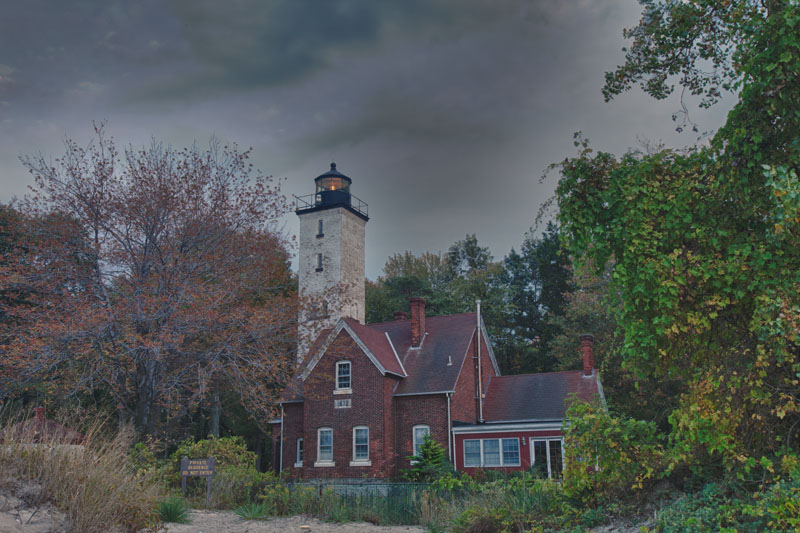
To my delight, we discovered a lighthouse!  It was late in the day and the sun was obscured by clouds. I knew the lighting wasn't the greatest, but I try to be disciplined in my photography.  So I shot both horizontal and vertical, changed positions, and shot for HDR.

Here is one of the original in the sequence I shot for HDR:


Nik has just come out with new HDR software, HDR Efex Pro and since I do a lot of HDR, I bought it the day it came out. This was my first chance to play with it.  

HDR Efex Pro program is a photoshop plugin. You choose which images and it combines them. There are 33 preset choices as well as manual choices so you have a lot of control as to how your final image will look. Here is my first attempt. I liked the stormy day look and I wanted the sky and clouds to be dark enough that the light from the lighthouse would show. This is how the image emerged from HDR Efex Pro:


I usually play with my Topaz plugins: BuzSim and Topaz sharpen. Here was my first attempt and I think I went too far with the BuzSim:


Here is my second attempt using the same HDR conversion - less strong effects, but still enhanced with Topaz BuzSim & Topaz Sharpen. I didn't add the lens flare on this one that made the other light shine more.

 Since I like to play with several choices when I'm doing HDR, I went over to Photomatix and used a different set of images, vertical this time and created this image. Once again I went beyond the Photomatix and used the Topaz BuzSim and Topaz Sharpen for artistic effects.

 Here is a different version on roughly the same original images, using Efex Pro but without adding Topaz.

I don't know yet which of these will be my finished images. I suspect when I get home with my larger calibrated screen and more time, I will revisit these and perhaps start over until I decide which ones I like the best. I suspect that I'll have more than one finished product - a dark brooding look and one with a bluer sky.

Friday, October 15, 2010

Ottawa National Wildlife Refuge & Magee Marsh

I headed to Ottawa National Wildlife Refuge because I was wanting to visit as many National Wildlife Refuges as I could find along our route.  As we left Detroit, I knew I wanted to revisit Bombay Hook in Delaware, and I knew I wanted to visit Chincoteague in Virginia.  Since we didn't have a set itinerary for this trip, we could stop and explore new places. But because we didn't have a planned itinerary, I hadn't done much research about places we would be visiting. 

We got to Ottawa NWR later in the afternoon.  I was excited because the following day was the one day of the month that the auto route was open and I was looking forward to viewing parts of the refuge that are normally closed to the public.  

When we arrived, I learned quickly that Ottawa is a refuge where you hike to get to the best parts. There are also two adjoining state wildlife management areas. I stopped and chatted with other people walking the refuge. I was asked, "How does this compare with other refuges you have visited?"  I must confess I didn't have a good answer, because I had just gotten there and because I hadn't done the research to know what was the best "season" to visit. One of my favorite wildlife refuges is Bosque del Apache. If you go in the winter, it is an incredible places with thousands of geese, ducks, sandhill cranes, and many wintering raptors.  In the summer, the Bosque is quiet.  On my first fall afternoon visit, Ottawa seemed quiet - lovely, but quiet.  I got to see a bald eagle soar by a couple of times, the ducks were apparently on a pond a farther walk than I had time for.  My bird list was short, because my walk was short: white crowned sparrow, blue jay, golden-crowned kinglet, ruby-crowned kinglet, Canada geese, Great blue heron, great egret, American robin, and red wing blackbird.  

We drove over to Magee Marsh Wildlife Area right at twilight and I found the marsh boardwalk. That would be my dawn destination.  Magee Marsh is owned and managed by the state of Ohio.  

We got up early enough that I was on the boardwalk as the sun was coming up.  I was traveling light - my iPhone, my binoculars, and my Sibleys.


As I walked the boardwalk, I could hear skittish waterfowl relocating.  I was pleased to see and identify a swamp sparrow in the brushy area by the waterline near the boardwalk.  A downy woodpecker was working his way up and down a nearby tree.  The redwing blackbirds were on the reeds across the water.  I saw another bird working its way up the tree - after looking in Sibleys - a brown creeper.  I finally caught a glimpse of the waterfowl I was spooking - a winter plumage wood duck.  

The wonderful thing about this boardwalk is that there are plenty of benches - places where you can sit, wait for the birds to come check you out and where you can savor your surroundings. I saw another set of birds that I don't usually see - so had to look them up - thrushes, both Swainson and Hermit (I'm pretty sure I saw both species.) As I scanned the boardwalk in front of me, a house wren appeared to check out who was coming. In the one of the water pools was a great egret and I could hear Canada geese in the distance.  Another bird appeared along the boardwalk, a wren for sure with that upright tail, but oh so small. When checking Sibleys - a winter wren - a life bird for me. And it stayed around long enough for me to get a good look see.  Another bird appeared requiring another search in Sibleys - a juvenile yellow bellied sapsucker.  As I finished my walk, I saw a ruby crowned kinglet and a Carolina wren.

I spent so much time savoring the boardwalk that we were later getting to the auto route at Ottawa.  Even so, my list:  blue jay, great egret, white crowned sparrow, great blue heron, Canada geese, redwing blackbird, northern harrier, pied bill grebe, coot, mallard, greater yellowlegs, white throated sparrow. At one of the ponds was a mix of waterfowl, too far for me to make good id's with just my binoculars. 

We headed back to Magee Marsh and I added dark eyed junco, ring billed gull, trumpeter swan, and brown headed cowbird. What a wonderful day it had been!

In the evening I was researching Ottawa NWR and Magee Marsh and found this incredible article from the American Birding Association: "Magee Anatomy of a Migrant Hotspot."  I knew I had found another "magical" birding spot. It had been wonderful on my fall walks, but it is a place I really MUST come back to during its high season in May.

I went back a second morning to Magee. At the first bench area, I found myself surrounded by golden-crowned kinglets and ruby crowned kinglets. I got another good look at a winter wren (I think my favorite bird here.) And farther down, I was surrounded by thrushes eating the berries.


Thursday, October 14, 2010

iPhone4 Camera

When I went bird watching at Magee Marsh, I knew it was a long boardwalk and I wanted to concentrate on seeing the birds without hauling camera and tripod. I was carrying my iPhone4 to make notes on what birds I was seeing.  But, being a photographer, the morning sunrise and the boardwalk seemed to cry out for me to take their picture to remember the beauty here.

I'm really impressed with iPhone4's 5-megapixel camera.  While technically a point and shoot, it has features that let you go beyond.  With the tap to focus, the camera can changes the exposure as well as the focus, allowing you to capture the beauty in lighting situations that need thought as to exposure.  And, the live view gives you an idea of whether you have tapped correctly to get the finished look you were hoping for.  In addition, they have built in a HDR (High Dynamic Range) function that shoots multiple images and combines them at the time of the capture.  How cool is that?


This image was taken at Burlington of the Mississippi River at flood stage from the restaurant. Note the blown out details in the trees along the river and the sky.

Using tap to focus, the exposure adjusts and I got the view of the river with the tree in silhouette which was my goal.


At Magee Marsh, the sunrise was beautiful. Using the tap to focus I was able to get the details in the sky to capture the delicate colors of sunrise.

I was pleased to even get the "rays,"


The fall colors along the boardwalk were also memorable. Here is an image taken not using the tap to focus. Notice how the sky and foliage and foliage are blown out, because the lighting is so different between the shaded boardwalk and the sunlit foliage.


Here is the same image using the tap to focus and the built in HDR. What a difference!


Then taking the image into photoshop:


While the iPhone4's camera doesn't match the quality of my Canon 5D MKII, it is still a great way to capture moments when I'm walking, doing bird watching or don't have the big camera with me.

Tuesday, October 12, 2010

Detroit Articles

Having just visited Detroit, I was interested when I saw this news article on Yahoo:   Time Magazine:   Real Moms of Grosse Point.

Links in that article led me to an amazing sequence of photographs: The Remains of Detroit.   Photographer Sean Hemmerle did a project photographing buildings in the rust belt. These photos from Detroit show some of the beauty that was once there.  I found it poignant and worth sharing.

To see more of Sean Hemmerle's Rust Belt project click here.

Sunday, October 10, 2010

Detroit


I had to go over to the Canadian side to get this vantage point of Detroit. Silly me, I had never really looked up Detroit on a map. I knew it was in Michigan, but I didn't realize it was right on the border with Canada.  

We spent part of two days driving around Detroit, only seeing a small spectrum of the big metropolitan area.  We drove through one area where there were buildings and houses that had burned, buildings that were boarded up & unused and then just a few blocks later we were in Grosse Point, a very wealthy lakeside community.  What a contrast! 

Downtown Detroit is also full of contrasts - beautiful, new buildings, the Detroit People Mover, and other older buildings empty.  I know that the economy in Detroit is especially bad right now, but many of the buildings we saw throughout the Detroit area that are empty, unused, decaying, show signs that they have not been used in many years.  It is a town of many eras - and it made me wish I had seen it when some of those older buildings were new and occupied. 

Belle Isle Park is also lovely, sitting on the American side of the Detroit River - ponds, fountains, zoos, etc.  We were there when they were doing the Breast Cancer Walk.  But it also has a neglected feel. 

Here are some snapshots from driving around:

Lampstand decorations:


The story behind the plastic bags:


 A building I thought was beautiful as we drove by:


These have seen better days:


 The People Mover just circles downtown. It looks like it would be fun to ride:

Saturday, October 09, 2010

Seney National Wildlife Refuge

We've been fortunate to visit Seney National Wildlife Refuge several times.  Our first visit was in September 2003. We knew it was going to be a great place when we saw sandhill cranes foraging right by the entry sign.  We were thrilled to see bald eagles, trumpeter swans, northern shovelers, loons, green winged teals, glossy ibis, American bitterns, beaver, and muskrats, etc.  We've also learned that by October, most of the birds have already flown south.

But we were "in the neighborhood" and couldn't resist making one loop through the auto trail.  There were still trumpeter swans, a pied bill grebe, assorted sparrows.  The ranger told me that river otters had been spotted - we didn't see those.

But even with most of the birds gone, Seney is still a beautiful place, especially at sunrise or sunset. The clouds were especially lovely this evening.


I never tire of seeing the subtle colors God paints in the sky - unique every day.

Thursday, October 07, 2010

Milwaukee

I wanted to stop in Milwaukee and capture something that would be representative, iconic.  I knew I didn't have much time. I found the lighthouse, but I also wanted a cityscape.  As we drove the lakeshore, I enjoyed the park with the lovely weeping willows. I saw a spot that might work with a reflection, but when I walked over with the camera, the angle didn't work. As sunset approached, I knew I needed to make a decision. The area near the Art Museum looked the most promising.  

While I tried many things, shooting multiple images to merge for a panorama, I ended up happiest with these two wide angle shots. 


I like to pick a spot and start near sunset and photograph for 30 or 45 minutes to get the changing colors from sunset, dusk, twilight and dark.


Wednesday, October 06, 2010

North Point Light, Milwaukee


As we were studying the map as we explored Milwaukee, I saw North Point Lighthouse.  Since I am fascinated with lighthouses, naturally I had to go find it and try to photograph it.  Over time, trees have grown up around it, making it a challenge to photograph, especially since we weren't going to have a lot of time in Milwaukee.

I figured that I would need to combine multiple exposures to get something I would be happy with.  The "front" up able had the deep shadows from the western sun filtering through the trees.  The "back" below was backlit.


The original lighthouse was built in 1855. Shore erosion in the 1870's required a new lighthouse to be constructed.  Finished in 1887, it was first lit in January, 1888.  Beautiful Lake Park was being planned around North Point Lighthouse.  As the trees grew in the park, they obscured the light and the U.S. government discontinued funding in 1907.  In 1909, money was funded to raise the tower and the work building an additional 35 feet was finished in 1913, making the tower 74 feet high. 

I went back after dark to see if the night lights would create still another view, but at least the night I was there, the lighting wasn't dramatic. 

This lighthouse is in such a pretty setting, I felt it well worth my time to stop, photograph, and enjoy seeing it.

Great River Bridge


The Great River Bridge connects Burlington, Iowa with Gulf Port, Illinois.  Bridges over the Mississippi are always impressive because they must be wide enough to span the mighty river and tall enough for the barge traffic to pass under.   The Great River Bridge is a newer bridge, built in 1993 replacing a much older, narrower bridge.  The one tower cable stayed construction makes it very elegant.

This image was taken when the river was at flood stage due to heavy rains in Minnesota, Iowa, and western Illinois.

For more information:  

Tuesday, August 24, 2010

Gros Morne National Park

August 20, 2009

We enterted Gros Morne National Park from the north. So our first views were of these spectacular mountains and beautiful glacier carved fjord at Western Pond.  Sadly, we arrived too late in the day to do the BonTour's Western Pond Boat Tour.  It is a 1.8 mile walk to get to the boats.  The tour lasts 2 hours and costs $52.00 for adults and $25.00 for kids.  It is on my to do list for the next time we make it to Newfoundland.  BonTours also has boat tours of Bonne Bay.


The scenic town of Rocky Harbor is the place to stay to enjoy Gros Marne - good hotels and restaurants as well as beautiful ocean views. Lobster Cove Head Lighthouse drew me because I love lighthouses.


The rocky beaches west of Rocky Harbor made a great sunset vantage point.


The next morning we headed south and drove through the mountains of Gros Morne.


We knew we hadn't given this park the time it deserved, but we got a wonderful taste of the beauty and wonder here.

Tuesday, August 17, 2010

The Arches Provincial Park

August 20, 2009

As we headed south from St. Anthony, we came across this small provincial park.  Lighting wasn't great with the cloud covered, sunless sky. I shot for HDR hoping I could create a good memory photo since I knew we couldn't stay around this location long enough to get a sunrise or sunset setting. 


While the main attraction is this wonderful set of sea arches, the rest of the beach is also lovely.  


These wind sculpted, dead trees tell the story of strong winds and a harsh climate.

Friday, August 06, 2010

Newfoundland's Crown Land


I was fascinated by the small gardens that we saw along the roads in northern Newfoundland. These gardens were not next to someone's house our field, rather they were right next to the road. When I asked local people, it turns out that the best soil for gardens is where soil was brought in to build the roads. This land is "crown land," land owned by federal or provincial governments. According to the Canadian Encyclopedia only 11% of Canada's land is in private hands, 41% is federal crown land and 48% is provincial crown land. Newfoundland has the highest percentage of crown land with 95% being owned by the government. Among the permitted uses in northern Newfoundland are these gardens that provide needed produce during the short growing season.


Picturesque and well kept, the primary crop seems to be potatoes, but some of the larger plots had a mix of garden vegetables. In a place where it is not easy to get fresh produce, these gardens are an important part of the food supply here.

There also seems to be a certain amount of wood gathering permitted.

I suspect that it takes a lot of hard work to live in northern Newfoundland, but I really appreciate a lifestyle that manages to find ways to live off the land using the resources available-fish, wood, native berries, and these lovely gardens.

Wednesday, August 04, 2010

Whale Watching at St. Anthony, Newfoundland

August 20, 2009

Being fascinated by whales and marine mammals, I take every whale watching tour I can find. In St. Anthony, Newfoundland, Northland Discovery Boat Tours offers iceberg, whale, and seabird tours. We were too late in the season for icebergs, but we headed out on a foggy, misty morning. As we headed out to sea, there was Newfie music playing over the loud speaker - lovely, jaunty Irish sounding melodies. As we left the harbor and headed out to sea, these stark, rocky cliffs were amazingly beautiful.


As we reached the choppy open water, we began to watch for spouts.


Whale watching is exciting to me even when it is just watching those sleek bodies gracefully surface and submerge again. Sometimes you are lucky enough to see the tail as they begin their deep dive.


We were seeing humpback whales and they were consistent with their surfacing and deep dive timing. So we got good regular sightings.

We also got to see Atlantic white beaked dolphins. Whales come up and surface with a slow rhythmic pattern, giving you time to capture the experience with your camera. Dolphins zip right past the boat making photographs more a matter of luck than skill.


What with the gray day, low lighting, I didn't expect great shots, but I couldn't resist trying to catch these playful dolphins.


It continued gray and foggy even as we returned past theSt. Anthony Harbor Lighthouse and into the harbor. There's a great restaurant at the lighthouse, the Lightkeeper's Cafe, and a great view. We found the cafe and lighthouse area a great place to end our days at St. Anthony, Newfoundland.


I am grateful I don't get seasick easily, because it was a choppy day on the water. But even with gray skies, swells, and seasick visitors next to me, it was still a great way to spend the morning!