Showing posts with label nature. Show all posts

Saturday, September 05, 2015

International Peace Gardens


The International Peace Gardens straddle the border between the United States and Canada between North Dakota and Manitoba.

 It was dedicated in 1932: TO GOD IN HIS GLORY, we two nations dedicate this garden and pledge ourselves that as long as men shall live, we will not take up arms against one another.

The Civilian Conservation Corps did most of the early construction.

There are 2300 acres to explore. We started our exploration on the Canadian side which is forested with water features and more natural in nature, taking the loop twice during our visit. In some ways I preferred the wild areas with the trees and birds.  However, the formal gardens are beautiful and I enjoyed walking around to see everything.


We saw an immature northern flicker as well as adult northern flickers.  We tried to stop for every bird and I enjoyed seeing birds near our picnic table at lunchtime.


Around the formal garden ponds there were many Northern Leopard Frogs.


The Interpretive Center and Conservatory had a good gift shop, restaurant as well as cactus and succulents from around the world.


The formal gardens were a delight to explore.   I talked to someone who visits every year. He told me the plantings are unique every year. He also told me that the Peace Towers in the background of the first photo have deteriorated and will be removed at some point.


I could not leave without stopping to photograph the floral clock. We spent half our day here and considered it well spent.


Monday, August 17, 2015

Yellowstone's wolves


We have chosen for our last two visits to stay at the northeast corner of the park at Silver Gate, Montana.  The Grizzly Lodge is less than a mile from the entrance to the park and about a 30 minute drive to the wolf viewing area between the Yellowstone Institute and Pebble Creek Campground.  This area usually has an active wolf pack where wolves can be seen.  To see the wolves, one must be at this location near sunrise.  In other years there were wolf watchers there at sunset, we did not see that this year. We got up 3 of our 4 mornings to attempt to see the wolves and were successful twice. The middle morning, the pups were seen by folks near us, but the one dropped out of sight before I saw it.

However, where you look for the wolves changes every time we visit.  The best way to see the wolves is to look for the group of people all standing together with scopes.  This year the group was down in the valley looking up onto the northern grassy sage covered slopes.  While my walking is better, I still have mobility issues and decided not to go down there. I set up my chair and scope on the side of the parking area where they were looking and waited.

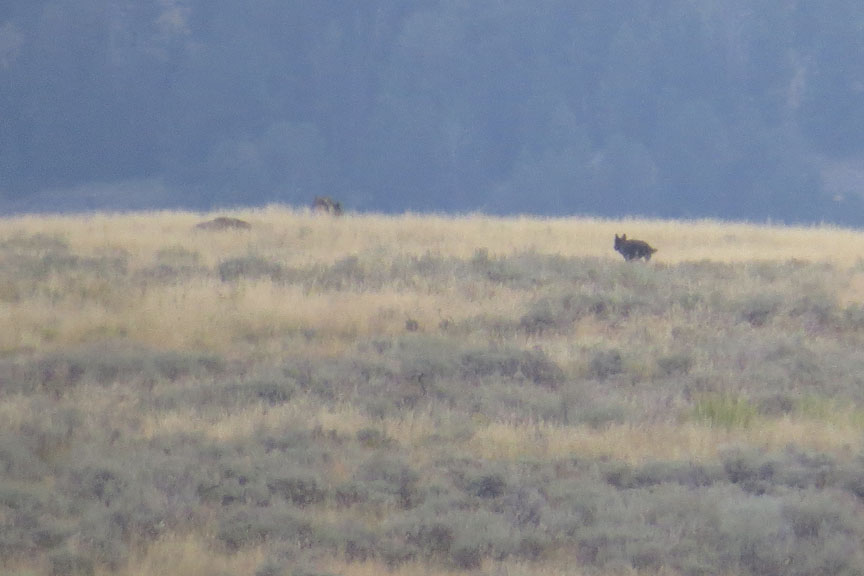
Shortly, they turned their scopes a different direction. I rushed down to the other end of the parking lot and sure enough, there were the wolves, five of them.  Using my Canon Powershot SX50 with its 1200 mm zoom I was able to capture these images.  Most wolf sightings are distant, with the wolves appearing as small moving specks on the hillside.

Here is my first view of the wolf ascending the slope. The black wolves are easier to spot than the gray ones.


This shot captures two more . . .


I like the running shot.


Here it is cropped closer:


It is hard to explain the marvel that catching a glimpse of wolves in the wild invokes. For me part of the joy is that even when you get up to be there at sunrise, you may or may not get to see them. So when you do, it feels like such a blessing.  In other visits I got to witness the morning reunion of the pack - such a joyful, playful event. I could hear the howls and yips.  

Even when the wolves don't show, the upper Lamar Valley is a tranquil and beautiful place to spend the first hours of the day.  It is a great way to start the day!


Monday, August 10, 2015

Sully's Hill National Game Preserve

Monday, August 10

After spending the night at Devil's Lake, we chose a route to visit National Wildlife Refuges as we explored North Dakota.  

We arrived at Sully's Hill National Game Preserve  early in the morning, while it was still cool. Growing up in the Texas Panhandle, prairie dogs always delight me with their activities. 


Sully's Hill's bison are being managed to conserve their genetic diversity.


There was a beautiful wooded nature trail that seemed filled with singing birds. There were a number of yellow warblers. The trail led to a vista over the lake where there were white pelicans in the distance. I saw 12 species of birds within the preserve.


Some birds I photograph to be able to identify later. I was most pleased to identify this one finally as an American Redstart, a life bird for me. The Merlin bird App was very helpful in this identification process.


A thirteen lined ground squirrel was also out and about. He ran right past me at one point.


Sully's Hill was created as a National Park under Theodore Roosevelt in 1904.  During the Great Depression it was transferred to Fish and Wildlife Service.  Interestingly it is one of seven National parks to be be disbanded. Some were turned into National Monuments or merged with other national parks. One, Mackinak National Park, became a state park.

Tuesday, January 29, 2013

Changing Bird Songs - the Savannah Sparrow


Henry sent me an interesting link this morning.  Science Daily has an interesting article in how bird songs have changed over the last 30 years.  I would have thought that bird songs would remain constant over time, but instead a study showed that savannah sparrows songs changed much like human dialects change over time.  

 Interesting.

Monday, November 12, 2012

The Carcass


In other trips to Yellowstone, I had heard people talking about watching wolves on a carcass, but we had never had that opportunity.  On our September trip, many park visitors experienced the wonder of bears and wolves as they fed on the carcass.  The first few days, only the grizzly bears fed.  We heard at one point there were five grizzlies on the carcass.  We passed by every day, usually stopping to spend time.  On the last day we could finally see the skull to identify it as a bison carcass.

The prime viewing spot was at my favorite overlook at Hayden Valley.  Each day there were cars lining the valley - some at better vantage points than others.  There was also an active wolf den at the north end of the valley.

I had both my scope and my Sigma 300-800mm lens focused on the activity.  The carcass was on the other side of the valley from the road - Henry used Google Earth to estimate the distance at 3/4 of a mile.  It felt farther.  The scope can get you visually closer, but I don't have a good digiscoping system set up yet.  But when you crop in on photos with the 300-800mm, you at least have some good "memory" shots of the event.


In our early years of visiting Yellowstone, we didn't have a good scope. I was always grateful when people would generously allow me to peak through their scope.  While I don't have one of the expensive scopes, I now have a decent one.  It is my pleasure to pay back those people from my past by allowing other people to look through my scope so they too can see this marvel of nature in much better detail than their eyes or binoculars allow.

Monday, October 01, 2012

Yellowstone's Pronghorn


I freely admit it - I call them antelope because I grew up with the song "Home on the Range."  But true antelopes are found in Africa.  The American antelope is really the pronghorn, Antilocapra americana. It is so truly unique it is the only member of the family Antelocapridae.  Their horns are unique.  Deer and elk have branched antlers that are shed each year.  Goats and cattle have hollow horns made from hair that are not shed.  Pronghorn have are the only animal with branched, hollow, hairlike horns that are shed annually.  Both males and females have horns, but male horns are larger and have a distinct prong.  Males also have a distinctive black marking on their face below the eye.


Running up to 60 miles per hour, it is the second fastest mammal in the world. It can sustain 30 miles per hour for miles. Only the cheetah is faster and the cheetah cannot sustain its speed as long as the pronghorn.

Pronghorns prosper in dry environments.  Pronghorn are found on the Great Plains from Texas north to North Dakota and in the high desert sage found in New Mexico, Arizona, Nevada, Utah, Colorado, Wyoming and Montana.  They eat forbs (non woody flowering plants) and sagebrush with grass making up only a very small portion of their diet.  In Yellowstone, they are frequently seen in the sagebrush in the Lamar Valley.

On our travels we have seen them regularly in northern New Mexico along highway 84/87 east of Raton, New Mexico and along I-25 in Northern New Mexico and southern Colorado. We've also seen them in other sage brush areas of Colorado.   They are common in the Texas Panhandle. I've seen them regularly near Vega and Borger.  They can also been seen in Texas near Alpine and Marfa.

Unlike deer, pronghorn do not jump fences. With the older style barbed wire fences, pronghorn literally run through them or go under the last wire.  Woven wire fencing is a true obstacle.

Pronghorn can raise the hair on their white rumps as a signal of danger.  This is a signal to the herd that danger is near.


The rut for pronghorn occurs in late summer and early fall.  Fawns are born in the spring, usually in pairs. They can walk within an hour of birth and by the fourth day can outrun a man. Pronghorn fawns are odorless as protection from predators such as coyotes and golden eagles. 

While not all pronghorn migrate, Wyoming pronghorns travel 150 miles between Wyoming's Upper Green River Basin and Grand Teton National Park.  They move away from areas with deep winter snow.  The only land mammal that migrates farther distances in North America is the caribou.  

These photographs came from Lamar Valley in Yellowstone.  We saw a small herd near the road. They were a mix of female and juveniles.   I saw the direction they were heading and chose to get ahead of them and park,  hoping they would stay near the road for some nice close up shots as they walked near the car.  I was most pleased when they did what I anticipated.

Thursday, September 27, 2012

Yellowstone's Coyotes


As you make the rounds on the roads of Yellowstone, coyotes are frequently seen as they work their way through the sage and grass covered meadows.  Our best encounter this year was just west of Canyon Village mid-afternoon.

We first saw him when he was south of the road working his way through the tall grass looking for mice.  He crossed the road and we managed to move ahead of the path I thought he would take.  It is MUCH easier to photograph an animal as it is working its way toward you naturally.  They often will get closer to you than you could ever get if you try to chase it. A parked car makes an excellent blind that coyotes will often ignore in their search for food.

While I did miss a few shots because I was trying for a good head shot when it pounced and caught the mouse, I was still pleased to get some good shots as he was mousing.


It was really special to be able to watch and photograph the actual capture of the mouse so near to the car.  Amazingly enough, the coyote swallowed the mouse pretty much whole, very little chewing!


I know that outside the park, coyotes are a costly nuisance to farmers and even dangerous for pets in the city.  But . . . one of the wonderful things about Yellowstone, it is possible to see wild animals in their home territory doing what they've done for thousands of years.  In Yellowstone I LOVE to see the coyotes go about their business!


Saturday, September 22, 2012

Yellowstone's Night Skies

With clear, dry air  and very few electrical lights, the night sky in Yellowstone is glorious. We tended to explore the park until dark and then make our way back to Silver Gate driving at night. We stopped in Lamar Valley and I decided to try to photograph star trails and the the beautiful Milky Way. There are a lot of ways to approach night astrophotography. One approach is to shoot a long exposure and get beautiful star trails.


I learned quickly that if you are shooting the Milky Way, long exposures just leave the Milky Way blurry - not beautiful. My new Canon 5D MKIII has low noise even at higher ISO's. So I experimented with higher ISO and shorter shutterspeeds. This gave me beautiful Milky Way and much crisper stars.


I tried a different approach with this photo.  I shot away from the Milky Way and gave a much longer exposure trying to get the skyglow to illuminate the scene.  While  it does get the road - hand of man- I like this one.


The following night I went to a different place in Lamar Valley -Soda Butte.  I wanted to illuminate the Butte and get the stars.  My results were mixed because when I used the highest ISO, there is a LOT of noise. One shot was "messed up" by the passage of a car, but it looked better than I expected.

In this one below, the lights from a passing car lighted up Soda Butte.  Because I was trying to position the Milky Way in the third's position, I had to clone out our car and the reflective road poles.  I shot this with an ISO of 25,600 hoping to get the stars crisp. The noise level was much higher than I wanted so I definitely had to use noise reduction software.  There is still noise when you blow this up at pixel level. But it is pleasing anyway.


I did try light painting on Soda Butte, but was not happy with the results.

I meant to try one more time, but as the days went by getting up before dawn to look for wolves and staying out late to enjoy other parts of the park, our stamina gradually diminished. Our last night there was overcast.

Things I would try next time - lower ISO on the star trails over the trees. I used infinity focus for most shots, but I think it might have been better to focus on a brighter star. Henry recommended using a smaller aperture to try to get the stars crisper.

Perhaps I'll have another opportunity as we travel east from Seattle to try more star shots.

Monday, September 17, 2012

Memories of my Trips to Yellowstone


Because we travel so much, people frequently ask me what my favorite place is.  That is a very difficult question for me, because I don't have just one favorite place.  I have  many places that I love - all of them for differrent reasons.  That said, Yellowstone is high on the list of favorite places for me.  We tend to go back over and over again.

I went first as a child when I was 10 or 11.  I went with my grandparents.  It was a very brief visit.  We saw Morning Glory pool and Old Faithful and drove around the park some.  My grandad was very cold natured. The conversation around us made him believe that the available cabins were very cold at night.  We drove south through Jackson, but all the hotels were full.  I saw the Tetons by moonlight.  By the time we found a place to stay it was too far to come back.

My next visit was in 1977.  My husband and I had bought a new extended length van and converted it to a camper complete with bed, closet, and simple porta-a-pottie bathroom.  We spent about three days in Yellowstone as part of a longer trip that took us all the way through Glacier Naitonal Park and Banff and Jasper in Canada. One of the highlights from that trip was going to all of the viewpoints for the Grand Canyon of the Yellowstone and the beautiful waterfalls.  I went all the way down to Uncle Tom's trail.  I'm glad I did it then while I was young - it is a LONG way down!

We brought our kids to Yellowstone in 1985 - Thomas was 5 and Debra was 1 1/2.  We were tent camping and I think we stayed at Grant Village.  Thomas' memory is that you had to wait along time for the geysers to erupt.  That was the trip that we focused on the geysers.  One day we hit it just right to see Grand erupt with 5 glorious bursts and Riverside. We spent most of the day exploring the Lower Geyser Basin.  When we got back to Old Faithful, it was a short single burst - a disappointment after the other longer geysers.

When it was time to go to Yellowstone when the kids were older, Thomas was old enough to stay home.  Sadly his memories of waiting so long for the geysers made him uninterested in returning.  With a nearby family to watch over him, we left for Yellowston in 1993 with just Debra.  I think it was a tent camping trip and I think we stayed at Tower.

At one of these trips, we went to an evening ranger program where they were talking about the desirablity to return wolves to the greater Yellowstone Ecosystem.  The talk made such an impression that both Henry and I remember it today.

At another trip, the bison were in rut. It was so funny to watch the bulls follow the cows with their unique grunts! Usually the bulls are off by themselves, but that time they were always following a female.
While the kids were at Camp Blue Haven,  Henry and I went again in 1998. We made our home base at the hotel in Canyon Village. Canyon Village is very close to Hayden Valley which is one of our favorite places in Yellowstone. So easy to be at the lookout over the valley at sunset and be close to the hotel.  That was the trip where we really learned how to look for elusive wildlife - the bears and the wolves.  The small moving dark dots on the far hillside were worth checking out because some were bears not bison.  That was also right after the wolves had been released.  In Lamar Valley,  there were scientists monitoring the wolves through the radio collars.  It was fascinating to be around the people who knew which wolf you were seeing and where they were in the valley from the radio signals.

When Debra graduated and left for college, Henry and I had the opportunity for extended travel. That first fall, 2002, we discovered the joy of Yelllowstone in the fall.  The elk were in full rut, the air was crisp.  One evening as we headed back to the campground, we could hear the sounds of the elk battling with their antlers for the privilege of mating.  We left at the end of the season as they were closing up the Fishing Bridge RV park as well as other major lodging in the park.

My favorite trip was 2007, once again in the RV.  We came in late May and stayed 3 glorious weeks.  Birds were tending their nests. A coyote den with nine pups was right next to the road.  A grizzly sow with two cubs frequented Dunraven Pass, giving many people a great view.  We started our stay at Fishing Bridge RV Park, but finished up at Pebble Creek Campground in Lamar Valley.  I have so many great photos from that stay.

We've just finished our 2012 trip to Yellowstone.   The wolves were especially easy to see this year, both in Lamar Valley and in Hayden Valley.  Grizzly bears and wolves put on quite a show at a bison carcass in Hayden Valley.  I was surprised that it was still feeding animals even after 3 or 4 days.  We sampled a little bit of everything this trip - wolf and bear watching, geysers, waterfalls, bison, elk, and antelope.  I even did night photography with the beautiful stars and Milky Way.


Some people make it to Yellowstone every year.  We live too far away to come that frequently. But, I never tire of the wonders that I see in Yellowstone. I keep hearing the call to return.  I dream of a winter trip some year.

Sunday, September 09, 2012

Yellowstone's Geyers

One of the things I realized after we were several hours from home was that I had left my geyser book at home. Each trip to Yellowstone has had a different focus and the last few have been more on wildlife than on the geysers. But it is SO nice to have the geyser book so that when you get to a geyser, you can look at the signs and determine by how full the bowl is as well as other tells and get a rough idea how long it might be before it might erupt. Also the thermal features are always changing.

 So, one night away from Yellowstone I googled to find Geyser Information sites.

  Geyser Watch has interesting information about some geysers whose activity level has increased - geysers that hadn't erupted in a long time that were active this year.

  Yellowstone.net also has good current information about what is going on right now at Yellowstone. They also have 3 pages dedicated to the information I was looking for about the signs to look for. I saved the information as .pdf and have moved them to my iPhone so I will have the information at hand.

 We're in Pinedale tonight. Tomorrow is a Grand Teton day.

Wednesday, August 22, 2012

Reddish Egret


When I was at the Brazoria National Wildlife Refuge in June, I had the opportunity to photograph a Reddish Egret.  I'd seen them before, but in a white morph.  Reddish egrets hunt differently than all other egrets and herons - instead of quietly waiting for a fish to swim by, they run quickly through the water chasing their prey, often in circles.  It is very distinctive as well as being the best way to identify a white morph reddish egret.  So I was extremely happy to find this egret in his more outstanding plumage close enough to photograph. The white morphs I had seen were always too far away for good photography.

The dark morph reddish egret are a pale gray with reddish neck and head. The bill is pink with a dark tip.  Legs are blue.  The white morph is solid white with bluish legs, a pink bill with a dark tip.  The white morph looks so much like other egrets that I generally identify it by the distinctive hunting behavior before I see the field marks.  White phase are only 10 to 20 percent of the population in Texas.

Diet consists of small fish - minnows, mullet, pinfish and killfish.  In addition to the aggressive running and splashing through the water, they also open their wings to shade the water below luring small fish into the shaded area.  They frequent shallow brackish waters, flats and lagoons for their foraging.

In Texas, reddish egret nests are found on the ground near a bush, or a prickly pear cactus or on an oyster shell beach.  The nest will have three to four blue green eggs.  Genetically two dark phase birds can have white  phase chicks, but two white phase birds can never have dark phase chick.  When a dark phase and white phase bird mate, their chicks are almost always dark phase.  Both parents construct the nest, incubate and feed the chicks.

According to Texas Parks and Wildlife, reddish egrets are listed as a threatened species in Texas.  It is found year round along the Texas coast.  In 1918, it completely disappeared from Florida. Today in addition to the Texas coast it is found in some parts of Louisiana, Alabama and southern Florida.  While they can be found along the Gulf Coast of Mexico, the West Indies and Baja California, they are rare there.  There are only 1500 to 2000 nesting pairs in the United States and most of these are in Texas.  While no longer hunted for their feathers for women's hats, habitat intrusion by water recreation, pesticides, and land development decrease the available habitat.  Predation by raccoons, coyotes, great-tailed grackles also limits their population growth.

Monday, August 20, 2012

Black-Necked Stilts


Black-necked stilts are one of my favorite birds. For one thing they are EASY to identify - nothing else looks like them with their long pink legs and bold black and white markings.

They breed in shallow wetlands from Washington State and Montana, west to California and south through Texas.  They live and breed year round along the Texas Coast down through Mexico and in Southern California and also in a few places in South America. 


Black-necked stilts nest on the ground. They choose surfaces above the water line, such as clumps of vegetation above the water line.  Both the parents choose the site, looking for places with soft ground that can be scraped away to form a two inch depression for the nest.  They may add lining as they build the nest together  grass, shells, mud chips - whatever is nearby.


The chicks hatch after a 21-26 day incubation time.  They are down-covered and precocial, able to move around, leave the nest, and begin foraging with two hours of hatching.  They are well camouflaged, blending in well with their marshy environment.


 I find that the parents are very vocal when you come near their nest. They fly off, calling plaintively, hoping you will follow them away from the nest.  At Brazoria, there was a very vocal stilt nesting near the port-a-pottie.  I felt sorry for it because it seemed so upset when people came by to use the facility.

Wading through shallow marsh areas, stilts hunt for small aquatic invertebrates and fish.  Sometimes they herd fish into shallow waters to trap them for easy hunting.


In the Austin area, they can be seen in the water treatment ponds at Hornsby Bend. 

Saturday, August 11, 2012

Brazoria National Wildlife Refuge

Back in July, I photographed these black-bellied whistling duck families.  Wednesday afternoon, I saw a family with older ducklings that I suspect is one of the families from July.


Here is the family portrait in August. I didn't have a great angle - fearing that if I got out of the car to get a clearer shot, the ducks would fly.

It was fun to see how much they had grown.

Friday, August 10, 2012

Brazos Bend State Park

I visited Brazos Bend State Park for the first time about a month ago - mid afternoon on a hot summer day.  I went over to the deck at Elm Lake and thoroughly enjoyed watching the purple gallinules, common gallinules, whistling ducks, and all the other birds in the marsh.  I knew I needed to come back and bring my big lens over and sit a spell there.  

I had ordered this  Beach Rolly so that it would be easy to transport my heavy Sigma 300-800 and its sturdy tripod.  This was its first test and it passed handsomely!  It even carried my folding chair!


I got set up just after sunrise.  There were common gallinules in the distance.  But it wasn't long before the bird that I was hoping to photograph came into view - the purple gallinule!  I love this bird with its beautiful irridescent feathers and that beautiful light blue forehead.  I got several chances.  I loved hearing it call. 


There was a juvenile working its way around the lily pads as well.


On one of the snags was a yellow crowned night heron.


There were several little blue herons that posed for me.

I loved seeing this little blue heron with his freshly caught frog.  He worked in around in his mouth and swallowed it whole!


There were several juvenile little blues - notice the green legs and gray beak!


A green heron stopped by for a visit as well.
 

I don't want to forget the black bellied whistling ducks that kept coming in and perching on the trees around me.  


My bird list at Brazos Bend State Park for August 8, 2012:

Black-bellied whistling duck
Anhinga
Little Blue Heron
Cattle Egret
Green heron
Yellow-crowned night heron
White ibis
White-faced ibis
Turkey vulture
Purple gallinule
Common Gallinule
Red-bellied woodpecker
American crow
Red-winged blackbird

I need to come back in cooler weather and hike the trails. I know there are more birds to see!  

P.S.  Although I have yet to see alligators at Brazos Bend State Park - there are supposed to be 300 of them here.