Showing posts with label Yellowstone National Park. Show all posts

Monday, August 17, 2015

Yellowstone's wolves


We have chosen for our last two visits to stay at the northeast corner of the park at Silver Gate, Montana.  The Grizzly Lodge is less than a mile from the entrance to the park and about a 30 minute drive to the wolf viewing area between the Yellowstone Institute and Pebble Creek Campground.  This area usually has an active wolf pack where wolves can be seen.  To see the wolves, one must be at this location near sunrise.  In other years there were wolf watchers there at sunset, we did not see that this year. We got up 3 of our 4 mornings to attempt to see the wolves and were successful twice. The middle morning, the pups were seen by folks near us, but the one dropped out of sight before I saw it.

However, where you look for the wolves changes every time we visit.  The best way to see the wolves is to look for the group of people all standing together with scopes.  This year the group was down in the valley looking up onto the northern grassy sage covered slopes.  While my walking is better, I still have mobility issues and decided not to go down there. I set up my chair and scope on the side of the parking area where they were looking and waited.

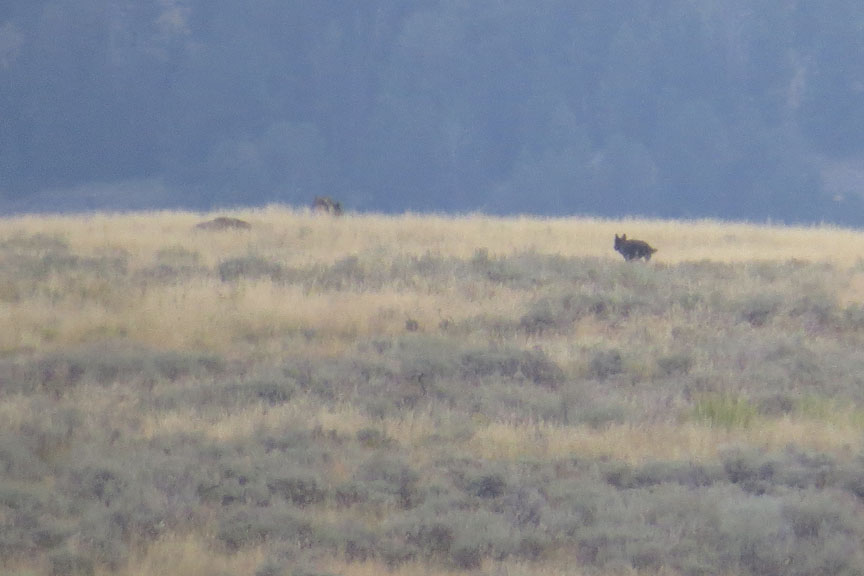
Shortly, they turned their scopes a different direction. I rushed down to the other end of the parking lot and sure enough, there were the wolves, five of them.  Using my Canon Powershot SX50 with its 1200 mm zoom I was able to capture these images.  Most wolf sightings are distant, with the wolves appearing as small moving specks on the hillside.

Here is my first view of the wolf ascending the slope. The black wolves are easier to spot than the gray ones.


This shot captures two more . . .


I like the running shot.


Here it is cropped closer:


It is hard to explain the marvel that catching a glimpse of wolves in the wild invokes. For me part of the joy is that even when you get up to be there at sunrise, you may or may not get to see them. So when you do, it feels like such a blessing.  In other visits I got to witness the morning reunion of the pack - such a joyful, playful event. I could hear the howls and yips.  

Even when the wolves don't show, the upper Lamar Valley is a tranquil and beautiful place to spend the first hours of the day.  It is a great way to start the day!


Monday, November 12, 2012

The Carcass


In other trips to Yellowstone, I had heard people talking about watching wolves on a carcass, but we had never had that opportunity.  On our September trip, many park visitors experienced the wonder of bears and wolves as they fed on the carcass.  The first few days, only the grizzly bears fed.  We heard at one point there were five grizzlies on the carcass.  We passed by every day, usually stopping to spend time.  On the last day we could finally see the skull to identify it as a bison carcass.

The prime viewing spot was at my favorite overlook at Hayden Valley.  Each day there were cars lining the valley - some at better vantage points than others.  There was also an active wolf den at the north end of the valley.

I had both my scope and my Sigma 300-800mm lens focused on the activity.  The carcass was on the other side of the valley from the road - Henry used Google Earth to estimate the distance at 3/4 of a mile.  It felt farther.  The scope can get you visually closer, but I don't have a good digiscoping system set up yet.  But when you crop in on photos with the 300-800mm, you at least have some good "memory" shots of the event.


In our early years of visiting Yellowstone, we didn't have a good scope. I was always grateful when people would generously allow me to peak through their scope.  While I don't have one of the expensive scopes, I now have a decent one.  It is my pleasure to pay back those people from my past by allowing other people to look through my scope so they too can see this marvel of nature in much better detail than their eyes or binoculars allow.

Monday, October 01, 2012

Yellowstone's Pronghorn


I freely admit it - I call them antelope because I grew up with the song "Home on the Range."  But true antelopes are found in Africa.  The American antelope is really the pronghorn, Antilocapra americana. It is so truly unique it is the only member of the family Antelocapridae.  Their horns are unique.  Deer and elk have branched antlers that are shed each year.  Goats and cattle have hollow horns made from hair that are not shed.  Pronghorn have are the only animal with branched, hollow, hairlike horns that are shed annually.  Both males and females have horns, but male horns are larger and have a distinct prong.  Males also have a distinctive black marking on their face below the eye.


Running up to 60 miles per hour, it is the second fastest mammal in the world. It can sustain 30 miles per hour for miles. Only the cheetah is faster and the cheetah cannot sustain its speed as long as the pronghorn.

Pronghorns prosper in dry environments.  Pronghorn are found on the Great Plains from Texas north to North Dakota and in the high desert sage found in New Mexico, Arizona, Nevada, Utah, Colorado, Wyoming and Montana.  They eat forbs (non woody flowering plants) and sagebrush with grass making up only a very small portion of their diet.  In Yellowstone, they are frequently seen in the sagebrush in the Lamar Valley.

On our travels we have seen them regularly in northern New Mexico along highway 84/87 east of Raton, New Mexico and along I-25 in Northern New Mexico and southern Colorado. We've also seen them in other sage brush areas of Colorado.   They are common in the Texas Panhandle. I've seen them regularly near Vega and Borger.  They can also been seen in Texas near Alpine and Marfa.

Unlike deer, pronghorn do not jump fences. With the older style barbed wire fences, pronghorn literally run through them or go under the last wire.  Woven wire fencing is a true obstacle.

Pronghorn can raise the hair on their white rumps as a signal of danger.  This is a signal to the herd that danger is near.


The rut for pronghorn occurs in late summer and early fall.  Fawns are born in the spring, usually in pairs. They can walk within an hour of birth and by the fourth day can outrun a man. Pronghorn fawns are odorless as protection from predators such as coyotes and golden eagles. 

While not all pronghorn migrate, Wyoming pronghorns travel 150 miles between Wyoming's Upper Green River Basin and Grand Teton National Park.  They move away from areas with deep winter snow.  The only land mammal that migrates farther distances in North America is the caribou.  

These photographs came from Lamar Valley in Yellowstone.  We saw a small herd near the road. They were a mix of female and juveniles.   I saw the direction they were heading and chose to get ahead of them and park,  hoping they would stay near the road for some nice close up shots as they walked near the car.  I was most pleased when they did what I anticipated.

Thursday, September 27, 2012

Yellowstone's Coyotes


As you make the rounds on the roads of Yellowstone, coyotes are frequently seen as they work their way through the sage and grass covered meadows.  Our best encounter this year was just west of Canyon Village mid-afternoon.

We first saw him when he was south of the road working his way through the tall grass looking for mice.  He crossed the road and we managed to move ahead of the path I thought he would take.  It is MUCH easier to photograph an animal as it is working its way toward you naturally.  They often will get closer to you than you could ever get if you try to chase it. A parked car makes an excellent blind that coyotes will often ignore in their search for food.

While I did miss a few shots because I was trying for a good head shot when it pounced and caught the mouse, I was still pleased to get some good shots as he was mousing.


It was really special to be able to watch and photograph the actual capture of the mouse so near to the car.  Amazingly enough, the coyote swallowed the mouse pretty much whole, very little chewing!


I know that outside the park, coyotes are a costly nuisance to farmers and even dangerous for pets in the city.  But . . . one of the wonderful things about Yellowstone, it is possible to see wild animals in their home territory doing what they've done for thousands of years.  In Yellowstone I LOVE to see the coyotes go about their business!


Saturday, September 22, 2012

Yellowstone's Night Skies

With clear, dry air  and very few electrical lights, the night sky in Yellowstone is glorious. We tended to explore the park until dark and then make our way back to Silver Gate driving at night. We stopped in Lamar Valley and I decided to try to photograph star trails and the the beautiful Milky Way. There are a lot of ways to approach night astrophotography. One approach is to shoot a long exposure and get beautiful star trails.


I learned quickly that if you are shooting the Milky Way, long exposures just leave the Milky Way blurry - not beautiful. My new Canon 5D MKIII has low noise even at higher ISO's. So I experimented with higher ISO and shorter shutterspeeds. This gave me beautiful Milky Way and much crisper stars.


I tried a different approach with this photo.  I shot away from the Milky Way and gave a much longer exposure trying to get the skyglow to illuminate the scene.  While  it does get the road - hand of man- I like this one.


The following night I went to a different place in Lamar Valley -Soda Butte.  I wanted to illuminate the Butte and get the stars.  My results were mixed because when I used the highest ISO, there is a LOT of noise. One shot was "messed up" by the passage of a car, but it looked better than I expected.

In this one below, the lights from a passing car lighted up Soda Butte.  Because I was trying to position the Milky Way in the third's position, I had to clone out our car and the reflective road poles.  I shot this with an ISO of 25,600 hoping to get the stars crisp. The noise level was much higher than I wanted so I definitely had to use noise reduction software.  There is still noise when you blow this up at pixel level. But it is pleasing anyway.


I did try light painting on Soda Butte, but was not happy with the results.

I meant to try one more time, but as the days went by getting up before dawn to look for wolves and staying out late to enjoy other parts of the park, our stamina gradually diminished. Our last night there was overcast.

Things I would try next time - lower ISO on the star trails over the trees. I used infinity focus for most shots, but I think it might have been better to focus on a brighter star. Henry recommended using a smaller aperture to try to get the stars crisper.

Perhaps I'll have another opportunity as we travel east from Seattle to try more star shots.

Friday, September 21, 2012

Birding in Yellowstone


The bird above is a dusky grouse, formerly called the blue grouse.  We were thrilled to get to see in on the Blacktail Plateau drive.

I had enough time in Yellowstone to try to identify the birds we saw.  I kept my intial list on my notepad on my iPhone.   To get my bird list better organized I entered them after the fact in my phone app, Bird Log. I probably should have used Bird Log to do my initial observations, because I had to go back and correct the coordinates. While I labeled my bird sighting Yellowstone, it picked up my geographic location when I started putting the information into Bird Log in Washington State.  I had to go back to the website to get the coordinates for this sighting back in Yellowstone. 

After I completed the bird list and submitted it to eBird, I emailed myself the information because I wanted to post my bird sightings here on my blog.  I know that I saw a few more birds that I couldn't identify, one a hawk that might have been a Cooper's Hawk.  I get frustrated because there are still so many birds I don't immediately recognize.  However, when I think back to my 2002 visit, I know so many more birds than I did then. 

Here is the list the way it shows up on eBirds.  I like the way it automatically organizes the list by species groupings.  BIrd Log is a great app for keeping up with the  birds you see - whether you submit to eBird or not.

mammelton
2012-09-09 03:54
yellowstone national park
Traveling
50 miles
420 Minutes
Observers: 1
All birds reported? Yes
Comments: This represents a week of birdwatching in Yellowstone National Park. I was more interested in how many species rather than exact counts. 
100 Canada Goose
Specie Comments: Too many to count and all over the park
20 Mallard
7 Lesser Scaup
50 Common Goldeneye
10 Common Merganser
1 Ruddy Duck
1 Dusky Grouse
Specie Comments: I have a photo
1 Common Loon
1 Eared Grebe
2 Osprey
2 Bald Eagle
1 Northern Harrier
7 Red-tailed Hawk (Western)
2 Peregrine Falcon
13 American Coot
2 Sandhill Crane
Specie Comments: I am very familiar with Sandhill cranes. We saw a pair several times- possibly same pair in different locations
1 Wilson's Snipe
3 gull sp.
1 Gray Jay
1 Black-billed Magpie
8 Clark's Nutcracker
1 Common Raven
5 Mountain Bluebird
8 American Robin
5 American Pipit
10 Yellow-rumped Warbler
1 Sage Sparrow


Monday, September 17, 2012

Memories of my Trips to Yellowstone


Because we travel so much, people frequently ask me what my favorite place is.  That is a very difficult question for me, because I don't have just one favorite place.  I have  many places that I love - all of them for differrent reasons.  That said, Yellowstone is high on the list of favorite places for me.  We tend to go back over and over again.

I went first as a child when I was 10 or 11.  I went with my grandparents.  It was a very brief visit.  We saw Morning Glory pool and Old Faithful and drove around the park some.  My grandad was very cold natured. The conversation around us made him believe that the available cabins were very cold at night.  We drove south through Jackson, but all the hotels were full.  I saw the Tetons by moonlight.  By the time we found a place to stay it was too far to come back.

My next visit was in 1977.  My husband and I had bought a new extended length van and converted it to a camper complete with bed, closet, and simple porta-a-pottie bathroom.  We spent about three days in Yellowstone as part of a longer trip that took us all the way through Glacier Naitonal Park and Banff and Jasper in Canada. One of the highlights from that trip was going to all of the viewpoints for the Grand Canyon of the Yellowstone and the beautiful waterfalls.  I went all the way down to Uncle Tom's trail.  I'm glad I did it then while I was young - it is a LONG way down!

We brought our kids to Yellowstone in 1985 - Thomas was 5 and Debra was 1 1/2.  We were tent camping and I think we stayed at Grant Village.  Thomas' memory is that you had to wait along time for the geysers to erupt.  That was the trip that we focused on the geysers.  One day we hit it just right to see Grand erupt with 5 glorious bursts and Riverside. We spent most of the day exploring the Lower Geyser Basin.  When we got back to Old Faithful, it was a short single burst - a disappointment after the other longer geysers.

When it was time to go to Yellowstone when the kids were older, Thomas was old enough to stay home.  Sadly his memories of waiting so long for the geysers made him uninterested in returning.  With a nearby family to watch over him, we left for Yellowston in 1993 with just Debra.  I think it was a tent camping trip and I think we stayed at Tower.

At one of these trips, we went to an evening ranger program where they were talking about the desirablity to return wolves to the greater Yellowstone Ecosystem.  The talk made such an impression that both Henry and I remember it today.

At another trip, the bison were in rut. It was so funny to watch the bulls follow the cows with their unique grunts! Usually the bulls are off by themselves, but that time they were always following a female.
While the kids were at Camp Blue Haven,  Henry and I went again in 1998. We made our home base at the hotel in Canyon Village. Canyon Village is very close to Hayden Valley which is one of our favorite places in Yellowstone. So easy to be at the lookout over the valley at sunset and be close to the hotel.  That was the trip where we really learned how to look for elusive wildlife - the bears and the wolves.  The small moving dark dots on the far hillside were worth checking out because some were bears not bison.  That was also right after the wolves had been released.  In Lamar Valley,  there were scientists monitoring the wolves through the radio collars.  It was fascinating to be around the people who knew which wolf you were seeing and where they were in the valley from the radio signals.

When Debra graduated and left for college, Henry and I had the opportunity for extended travel. That first fall, 2002, we discovered the joy of Yelllowstone in the fall.  The elk were in full rut, the air was crisp.  One evening as we headed back to the campground, we could hear the sounds of the elk battling with their antlers for the privilege of mating.  We left at the end of the season as they were closing up the Fishing Bridge RV park as well as other major lodging in the park.

My favorite trip was 2007, once again in the RV.  We came in late May and stayed 3 glorious weeks.  Birds were tending their nests. A coyote den with nine pups was right next to the road.  A grizzly sow with two cubs frequented Dunraven Pass, giving many people a great view.  We started our stay at Fishing Bridge RV Park, but finished up at Pebble Creek Campground in Lamar Valley.  I have so many great photos from that stay.

We've just finished our 2012 trip to Yellowstone.   The wolves were especially easy to see this year, both in Lamar Valley and in Hayden Valley.  Grizzly bears and wolves put on quite a show at a bison carcass in Hayden Valley.  I was surprised that it was still feeding animals even after 3 or 4 days.  We sampled a little bit of everything this trip - wolf and bear watching, geysers, waterfalls, bison, elk, and antelope.  I even did night photography with the beautiful stars and Milky Way.


Some people make it to Yellowstone every year.  We live too far away to come that frequently. But, I never tire of the wonders that I see in Yellowstone. I keep hearing the call to return.  I dream of a winter trip some year.

Sunday, September 09, 2012

Yellowstone Memories

As we drove through Yellowstone today to get to our home base this week in Silver Gate, Montana, memories kept flooding in as we passed familiar landmarks.  Regularly Henry or I would remark that we remembered seeing a bear there or that was where the bear with the damaged face was.  Over the times we've been here, we've seen bears many places in Yellowstone and it felt like we were remembering them all.  As we drove through Lamar Valley I remembered the fox den by the creek, the beaver that posed so nicely for me, the many wolf sightings.  We haven't been over to the area where the coyote den was yet, but I know I'll think about all the times on the 2007 trip that I stopped to photograph that family.  

Today we spent the first part of the day in the Grand Tetons, but smoke from the fires early in the day left the air too hazy for good photographs.  I did spend time by the marsh of the Elk Refuge trying to identify a particularly pretty green bird.  I know what I think it was - a female orchard oriole, but they aren't supposed to be here.  When  I had my camera out it never gave me a good enough look-see to photograph it.  We left the Teton area mid afternoon and enjoyed a leisurely drive through the park arriving at our hotel just as it got dark.  

It will be an early morning tomorrow.  No internet at the hotel, so I'm posting this at Canyon on Monday.  


Tuesday, January 13, 2009

Yellowstone's Earthquake Activity - Interesting Websites

For my readers who are interested in keeping up with the latest news about the earthquake swarm that has gone on during the last few weeks, here are a couple of good websites with the most up-to-date information.

This first one is fun, because when you start the animation,the oldest earthquakes "disappear" off the map and you can see where the more recent ones have happened in relation to the earlier ones.
Animated map of the last week's earthquakes in Yellowstone National Park

The University of Utah's Seismograph Stations post a list of the most recent earthquakes This site gives you a list with the how strong the earthquake was, when it happened, and where it happened.

From these two sources, it is obvious that the earthquake activity has slowed down a lot. There is some new earthquake or seismic activity on the west side of the park near West Yellowstone, but the quakes are very very small.

Good News for Yellowstone's Bison!


My husband sent me this link to Science Daily this evening. It confirms what many have been saying: that transmission of brucellosis from bison to cattle is very low risk most years and "periodically high only in certain localized areas." Not surprisingly, there are much more cost effective means of managing these issues than the current plan that hazes, rounds up, and slaughters the bison. Once again, elk seem to be the more likely culprit. For those interested in the bison issues in Yellowstone, this is a good article.

Even if it is possible to come up with a plan that will allow the Yellowstone bison herds to roam exist without the hazing and slaughter that is the reality today, eventually you have the future problem of what to do when the Yellowstone herd overpopulates its ecosystem. But after last year's needless slaughter (plus the deaths from the severe winter last year) of more than half of the herd, we are a long way from worrying about too many bison . . . Let's just hope enough of the herd survive this year's harsh winter weather.

I can hope and pray that scientists can come up with ideas that will work for the bison and the ranchers. Yellowstone National Park is a national treasure and the animals are a big part of that legacy. It is one of the largest natural ecosystems still left in the United States. We visit many national parks regularly and I can truthfully say that no other park has the diversity of wildlife that is so easy to observe.

According to the closing statement of this article: "The Yellowstone herd is the only one that has remained free-ranging and unconfined." Let's hope it stays that way!

Saturday, January 10, 2009

Yellowstone's Earthquake Activity


I've been following the news about the earthquakes in Yellowstone. Beginning on December 26 there have been a swarm of earthquakes under Yellowstone Lake. There was a lull in activity for a few days, but they have started back up although the center has moved about 10 miles. While most have been very small quakes, the largest have been up to 3.9 on the Richter Scale. While I first saw the news about the quakes on MyYahoo, I keep up to date with Jim MacDonald's Yellowstone Newspaper. He surfs the web and provides links to news stories, articles and blogs related to Yellowstone National Park.

I first visited Yellowstone as a child. My husband and I have been back a number of times over the years, staying longer each visit. We keep the natural trail guides from each trip, because as an active geothermal area the information as to activity changes over time. It is interesting to see which features are active today vs when we first went. During our early visits to the park, no mention was made of the caldera because the Yellowstone caldera is so large that it took satellite imagery for it to be discovered. According to Wikepedia, a caldera is a cauldron like volcanic feature formed by the collapse of land following a volcanic eruption. A caldera forms after a volcano empties its magma chamber and the chamber's ceiling is no longer strong enough to hold the volcanic rock above it. The first caldera I ever saw was the Valles Caldera in New Mexico. (Remember - at the time we did not know Yellowstone was a caldera.) It is 14 miles in diameter and we drove straight across it before it became a National Preserve. It was an impressive site to be on the flat land between the far away ridges of the rim of the caldera.

The discovery about Yellowstone's explosive volcanic past occurred during the 1980's. Since then a lot of study and research has revealed an amazing history of eruptions - both great and small. Yellowstone is classified as a supervolcano. According to Wikepedia, a supervolcano is a volcanic eruption which is substantially larger than any volcano in historic times (generally accepted to be greater than 200 cubic kilometers). This kind of eruption is typically sufficient to cause a long-lasting change to weather (such as the triggering of an ice age) sufficient to threaten the extinction of species, and cover huge areas with lava and ash. I've seen the BBC documentary,Supervolcano . It gives a very scary presentation as to what could occur if Yellowstone had that kind of eruption today.

Because I do pay attention to news about Yellowstone, I know that a few years ago, they had to close part of Norris Geyser basin because the ground had gotten too hot and there were noxious gases present. I also know that the ground has been rising at a more rapid pace than "normal" the last few years. Since 2004, the park has been rising 3 inches a year more than three times faster than ever measured before. So when the news about these earthquakes that were happening at a much higher than normal frequency, I was intrigued and concerned. While I do not really believe that these are precursors to a volcanic event that will cause extinctions, I believe that something very interesting is happening up there right now.

Here are some things I learned as I looked deeper into Yellowstone's volcanic past.

Geologic time is always amazing because it tends to be measured in millions of years and hundreds of thousands if years orather than decades or hundreds of years. Yellowstone's caldera forming eruptions go extremely far back in time:

2,100,000 years ago - Caldera forming eruption that created Huckleberry Ridge
1,300,000 years ago - Caldera forming eruption that created the Island Park Caldera
640,000 years ago - Caldera forming eruption that created the Lava Creek Tuff

Deposits of ash from these eruptions have been found as far away as Iowa, Louisiana, and California.


If Yellowstone were to erupt at one of these levels all of North America and in some ways the entire Northern Hemisphere would have severe effects.

Fortunately, not all of Yellowstone's eruptions have been that catastrophic. About thirty eruptions of rhyolitic lava flows have amost filled the Yellowstone Caldera since the last major caldera forming eruption 640,000 years ago. These flows may move slowly, but are very destructive. The last major lava flow seems to be about 70,000 years ago.

Earthquakes are common - in fact 1,000 to 3,000 earthquakes are typical in a given year. Another source said the usual number of quakes was 2000 per year. However, with over 900 in roughly 2 weeks, it is easy to see that the current activity is more than the norm. Earthquakes can change the patterns of the geyser eruptions - making some more active and others less so. The 1959 Hebgen earthquake was one of the stronger ones at 7.5 on the Richter Scale. Part of the mountain slid into a campground and dammed the Madison River creating Hebgen Lake. 28 people in the campground were killed. A 1975 quake near Norris Geyser Basin registered 6.5 and was felt throughout the area.

The last kind of eruptive activity are hydrothermal explosions.From Hanksville.org: "Hydrothermal explosions occur when ground water, heated above the boiling point (superheated) expands explosively after a rapid decrease in pressure as the water nears the surface. Ten such hydrothermal explosion craters are found in Yellowstone." 13,800 years ago the largest hydrothermal exposion created a 1.5 mile crater at Mary Bay. A 1989 hydrothermal explosion at the Porchop Geyser in Norris Geyser Basin threw rock debris fifteen feet across the spring. Hydrothermal exposions seem to be independent of volcanic magma flow - none were followed by an eruption of magma.

In 2003, a long linear fissure on a hillside above Nymph Lake north of Norris Geyser basin vented steam and threw rocks.

The geysers, mud volcanoes, and hot spring pools are also effects of the magma heat source under Yellowstone.

This chart summarizes the kinds of activity I've been describing.


Right now Yellowstone National Park is buried underneath a thick layer of snow. It is hard for scientist to get to the surface area near where these earthquakes originate. I wonder if there will be evidences of hydrothermal explosions in the spring when everything thaws out. It is going to be interesting to watch the events unfold in Yellowstone. Most likely, these quakes will die down and become just another footnote in the history of Yellowstone. But, it is always possible that they are the precursor of something larger. Will we be the generation of people that get to witness a new lava flow in Yellowstone? I have to say I would rather not be in the generation of people who survive a cataclysmic caldera forming eruption.

Watch for part two where i will compare Yellowstone's caldera forming earthquakes with other earthquakes around the world.

For more reading, here are some of the sites I used to research this blog:
The charts came from the USGS service site.

References:

US Geological Survey
Armageddon Online
Time
Yellowstone National Park - Calderas
Daily Kos

Additional Links:
For most recent earthquake activity at Yellowstone: University of Utah Seismograph Stations
The USGS update as of January 8th also reports 900 earthquakes in Yellowstone between December 26, 2008 and January 8, 2009.
University of Utah's site has a Deseret News article from 1975 listing the 1959 Yellowstone Quake as 7.1. However, the The USGS site reports it as 7.5 and Wikepedia's 1959 Yellowstone Earthquake article lists the magnitude as 7.3-7.5.
My husband found a USGS Animated Earthquake Map for Yellowstone. It shows where last weeks quakes were and where the new ones are in relation. (Granted, the link worked a few minutes ago and isn't working as I post this, hopefully it will work for my readers.)

Wednesday, June 11, 2008

Update on Yellowstone's Bison and Montana's cattle industry

Sigh . . . Despite all the effort of the state of Montana and the cattle industry, Montana has lost its brucellosis-free status. From the Bozeman Daily Chronicle comes the information that the owner of the cow did everything "right." The cow had been vaccinated twice and was part of a herd management plan. For the unfortunate owner, the entire herd may have to be slaughtered. For all of Montana, all cattle over 18 months old shipped out of state must be tested for brucellosis thirty days before shipping. For cattle owners on tight budgets this will be costly. Plus there had been plans to ship cattle to Russia that will now have to be scrapped costing Montana ranchers a new market for their livestock.

But, what is worse, to me it means that all those Yellowstone bison were slaughtered "for nothing." Montana still lost its brucellosis-free status. Bison were not the cause of this latest case.

From Robert Hoskin's comment on "Ralph Maughan's Wildlife News," the bison census numbers seem to show that from a population last summer of 4300, the current population may only be as few as 1300-1400 left after the natural winter kill and the slaughter. If my math is correct that means we lost 67% of Yellowstone's bison this past winter!

Brucellosis is truly an issue for the cattle industry.The Bozeman Daily Chronicle has another excellent article about how it will affect the ranchers. And not all ranchers are "big business." Many are just small family ranches with a few hundred head. But killing 2300 bison did not prevent the problem. With winter conditions still present in the park (Hayden Valley still had snow cover as of last week with minimal grass growth) more bison may die of natural causes. Bison are herd animals and the social groups have certainly been disrupted by the slaughter of family and herd groups. It will take awhile for their numbers to increase.

Further, I've read stories of property owners near the park who wanted to allow the bison on their lands. However, despite their efforts, their property rights were violated as helicopters and horsemen hazed the bison through their lands to get them back in the park.

Folks, this is just not a pretty picture anyway you look at it.

Sunday, June 08, 2008

Yellowstone's Wolves

I keep browsing the Yellowstone sites as part of my heart is there. On The Yellowstone Net Discussion forums today I found these amazing photos of wolves on a "kill." Jaime and Lisa Johnson came across these wolves very near the road. These are some of the best wolf shots I've seen.

Wish I could have been there.

Sunday, June 01, 2008

La Meute de Druides

From the Yellowstone Net Discussion groups, I found this link: Wolf footage, "La Meute de Druides." This is an amazing short film showing wolf behavior from the hunt seeking an elk, the chase of the herd, and final success. Note the magpies and ravens that benefit from the kill. A coyote comes in showing how much difference in size wolves and coyotes are. Nine minutes of amazing closeup footage of the wolves. Technically I wonder how they did it - was it digiscoped - do they make digiscoping equipment for video cameras? If not what kind of lens would that require to get such marvelous closeups?

Note: I, for one, did have an emotional reaction when the wolves finally got an elk, but . . . it is part of the natural cycle. And there is vegetation that is returning along some of the stream beds because the elk have altered their behavior because of the wolves. For nature lovers, this clip is well worth watching.

Saturday, May 31, 2008

The joys of Yellowstone

I find myself thinking about this time last year when we were in Yellowstone experiencing all the joy of nature there - the bears and their cubs, the coyote pups, the owl chicks, the wolves, and the natural beauty there. Each day was always a new adventure as we drove the roads looking for wildlife. After discovering the Yellowstone Newspaper and the Yellowstone Net Discussion Forums I continued to enjoy Yellowstone activities and events vicariously.

I still dream of going to Yellowstone in the winter months and driving the north road hoping to see the wolves bounding along near the road in the snow.

I sometimes wonder if people who have never been to Yellowstone or who have never spent time with the wolf watchers understand how much these wild wolves have come to mean to the people that spend so much time watching, studying, and enjoying these wild creatures.

We've been there several times since the wolves were reintroduced. The first time they were still heavily monitoring the pack movements with the radio collars. You could count on the presence of the people with the monitoring antenaes in the upper end of Lamar Valley. Not only could you listen to them talk to themselves about where the wolves were, they knew each one individually.

Through the years, you can still find the wolf watchers, although their location varies. There is a lingo (I don't know it) about the different watching sites in Lamar Valley - names like trashcan (for a long removed trash can landmark). My personal favorite watching spots involve a hike up a steep hill to get a better look at one of the older denning sites. I have very special memories of watching a morning reunion of the pack there.

I went to those sites last year. One morning there was a group of people and I got a good look at the wolves through my binoculars. The next morning I found myself up in position by myself. I was rewarded by a short wolf siting as they entered the older den area.

From the Yellowstone Newspaper today, I found Kathie Lynch's blog that echoes this inexplicable wonder from one of the wolf enthusiasts at Yellowstone. She uses words so eloquently to describe wolf activities she just witnessed. It will inspire you to make the trek to see these wonders yourself.

Most people who go to Yellowstone are on a tight time deadline. They have a few days to see a huge park. A large number of people go through on a bus that will show them the highlights, but will probably not give them very much time to wait and hope to see one of the elusive wolves. And even when you know where you are likely to spot an individual wolf or the pack, you wont' get a sighting every time.

And perhaps this unpredictable reinforcer of sometimes getting to see the wolves and sometimes not makes each sighting that much more special. I can truthfully say that there is something extremely joyful about spotting that elusive wolf (or bear) going about its natural activities. For me, watching the animals in Yellowstone feeds something within my spirit.

It is unlikely that I will get to return this summer, but I treasure the extended time I had in Yellowstone this time last year.

Friday, May 30, 2008

Wolves in the News

428 Wolves, a New York Times article came across my "radar" this afternoon. As we have travelled across the United States, we generally find that we did not know very much about the local and regional news. As I follow the Yellowstone Newspaper links I generally see articles from local papers around Yellowstone and Grand Teton. But right now it really pleases me when I see either the wolf issues or the bison issues make the larger papers such as the New York Times. Yellowstone wolves and Yellowstone bison are national treasures. But for the average person, they are not only out of sight out of mind, many have never gotten to experience the thrill of seeing these amazing creatures in the wild. Bison have always been easy to find in Yellowstone and even with the greatly reduced numbers this year, I suspect most park visitors will get to see either one or a herd. But the Yellowstone wolves require more effort and some knowledge about where to go in the park, when to be there, and how to look for them. Yes, some people will be lucky enough to get a chance look when a wolf crosses the road, but that is the exception rather than the rule.

While I can understand the ranching interests (more so about wolves than the bison), I also believe that it is important to keep the greater Yellowstone ecosystem healthy.

We visited Yellowstone while they were in the planning stages for the wolf reintroduction. I remember how few wolves were in the lower 48 states. Only Minnesota and Michigan had wolf populations. From the reintroduction, Montana, Idaho, and Wyoming (and perhaps Colorado) now have wolf populations. However, if the hunts progress as planned, the genetic diversity will be reduce, the wolves will only exist within the Yellowstone Park Boundaries.

I would love to see the protection for the bison and the wolves to be extended to include the federal lands that surround Yellowstone National Park and Grand Teton National Park. And perhaps, we need to be sure that the ranchers whose livestock on private lands that have been killed by wolves are reimbursed. I'll be radical here . . . if ranchers want to lease public land around Yellowstone for cattle, then they need to accept wolf predation as a normal cost of doing business. I don't know the current status, but it used to be that the leases for federal lands were significantly less than leases on private land.

Yellowstone is a unique treasure. It draws tourists from all over the world. The local economy benefits from these visitors. This area was set aside to be preserved for future generations to marvel, to appreciate, to enjoy, and to learn about nature.

I hope more large newspapers pick up these stories, so that people all over the United States can be more aware of the issues involving our national parks.

Monday, August 13, 2007

Yellowstone Campground Guide

We've made trips to Yellowstone a number of times. We've gone early in the spring a couple of times. It was great to be there before the crowds arrived. We've also been there one year in the fall after the crowds had left. While some things change from year to year, this is a rough guide for people who've never been there.

Camping is a great way to see the park. In reading the forums at Yellowstone.net, people always seem to have questions about planning their camping trip to Yellowstone. I'm trying to put together a resource to help people.


Some of the campgrounds can be reserved in advance through Xanterra. During peak season the campgrounds are going to get booked up well in advance. But don't let that totally discourage you about camping in the park. People have things happen that change their plans - so the bookings are always going to be dynamic. If the dates you want are booked, keep calling to see if they have had cancellations. We wanted to extend our stay at Fishing Bridge, by checking daily we were able to add on the extra days we needed. But we had to check every day for those cancellations. But if the reservations don't open up for you, don't despair, it is still possible to camp in Yellowstone without prior reservations. There are 7 campgrounds in Yellowstone that are first come - first served. We have found that we can spend a night outside the park (we usually choose Gros Vente in Grand Tetons - it usually has openings even in busy season - there are also national forest campgrounds outide the northeast entrance. There is also a large RV park in West Yellowstone.) We get up very early in the morning and head straight for the campground we're hoping for. Many people chose to stay in several campgrounds while at Yellowstone to be closer to the different attractions. Therefore, people are always moving out of a campground each morning. The earlier you can get to these campgrounds the more likely you are to get a spot.

We've used two different camping patterns. We find that we like to pick a central location such as Canyon, Fishing Bridge, Norris, or Madison. We can set up camp and then not waste valuable time moving several times. In many ways, I prefer the Canyon and Fishing Bridge area because they are right next to Hayden Valley. I love to be at Hayden Valley at sunset to watch the animals. Canyon gets me a little closer to get to Lamar Valley. We probably spend more time in those two locations than elsewhere in the park. But when you are chosing where to stay, consider what you are most interested in. If it is geysers, then the Madison campground is much closer to the geyser basins. If you are interested in watching wolves, Canyon (this year wolf viewing was good at the north end of Hayden Valley) or Slough Creek or Pebble Creek would be good base camps.

If you are going to be in Yellowstone two weeks, you might enjoy choosing two camping areas - one closer to the major geysers and one for the viewing the wolves and bears. If you're bringing a boat and plan to spend a lot of time on the lake, your camping choices will be different. If you are fly fishing, you will want to be over at Madison or Norris (I think fishing is illegal in Hayden Valley.) While moving does take some time, it does shorten your drive time to get to see the far corners of the park at the early morning - evening wildlife viewing times.

Some people really enjoy spending a couple of days at the Lake, a couple of days at Norris or Canyon, a couple of days at Mammoth, and a couple of days at Slough Creek or Pebble Creek. If you have a camping set up that is quick and easy to set up and disassemble this has the advantage of giving you time to experience the different areas of the park.

Another thing to think about - the Mammoth area has the lowest elevation - so it will be hotter in the summer but that warmth will feel good in the early spring and late fall.

Right now our campground of choice is Fishing Bridge RV park because we are in an RV and things run more smoothly when we have access to electricity. It has a good central location - fairly easy to get all over the park. The disadvantage of Fishing Bridge is that all of the RV's are parked very close together - it is NOT a scenic camping area. We stayed at Pebble Creek a few days and found that you really can survive without a generator several days- but we kept the inverter off most of the time and really worked to minimize the electricty we used. And Pebble Creek is one of the more scenic pretty areas to camp. Slough Creek, Norris, and Indian Creek all have charm in their settings.

I also learned that I enjoy my stay in Yellowstone better if I'm not trying to fix 3 meals a day. Yellowstone is a long drive for us - so I don't want to spend all my time cooking. We find that eating breakfast at home works. Sometimes we take a picnic lunch and then eat a hot meal at one of the restaurants for supper. Other times we grab a quick hamburger for lunch and then have chili, frito pie, or sandwiches for supper. One year I was tring to do fancy campground cooking while at Yellowstone - I gave that up quickly. There is too much to see and experience at Yellowstone to waste a lot of time cooking elaborate campground meals.

There are small grocery stores in Yellowstone. You can certainly get bread, lunch meat, chips, canned goods, milk, eggs, soda,some frozen dinners, pizzas, etc. I have been trying to eat a lo-carb diet - I didn't find things like my lo-carb slimfast or the low carb yogurts. So, if you are tent camping you can probably go get these limited items throughout your stay. If you are coming in an RV, I strongly recommend doing a good stockup in one of the towns right outside the park. (that may seem obvious, but we were midway between grocery runs when we entered the park this time - we had stocked up a day or so before, but did not "top off") The Teton store had a larger selection of grocery items. And of course you can make a run into West Yellowstone or Gardiner. But we spent most of our last trip at Fishing Bridge - so making a big grocery run with items needing refrigerating was not an option. We spent three weeks at the park and got by pretty well with the items we could get in the stores in the park.

If you are going very early in the season or very late in the season, my other blog, Yellowstone Facilities 07 Schedule will help you know what will be open to provide your gas and supplies.

Campground Information

Xanterra Campgrounds
To make reservations with the Xanterra campgrounds: Phone numbers: Same day #307-344-7901 Future Reservations: 307-344-7311 or 866-439-7375 Vehicles over 30 foot should make reservations in advance because limited number of sites that can accommodate the larger RV's.


Bridge Bay
Canyon
Fishing Bridge - only campsite in Yellowstone with water, sewer, and electrical hookups - hard sided vehicles only
Grant Village
Madison

Park Service First come first served campgrounds

Indian Creek
Lewis Lake
Slough Creek
Mammoth
Norris
Pebble Creek
Tower Falls

Outside the Park
Flag Ranch, West Yellowstone, National Forest Campgrounds east of Cooke City (NE Entrance)


No overnight camping outside designated camping areas.

For those campers that prefer flush toilets: Bridge Bay, Canyon, Fishing Bridge RV, Gramt., Madison, Mammoth, Norris,

No generators: Indian Creek,Lewis Lake, Pebble Creek, Slough Creek, Tower Falls

Calendar (2007)

Mammoth - open all year

Order in which they open:


May 4-October 28 Madison
May 18-Sept 30 Fishing Bridge
May 18-Sept 24 Norris
May 18-Sept 24 Tower
May 25-Sept 16 Bridge Bay
May 25-Oct 31 Slough Creek
June 8-Sept 9 Canyon
June 8-Sept 17 Indian Creek
June 8-Sept 24 Pebble Creek
June15-Nov 4 Lewis Lake
June 21-Sept 23 Grant

Order in which they close
Sept 9 Canyon
Sept 16 Bridge Bay
Sept 17 Indian Creek
Sept 23 Grant
Sept 24 Norris
Sept 24 Tower
Sept 24 Pebble Creek
Sept 30 Fishing Bridge
Oct 28 Madison
Oct 31 Slough Creek
Nov 4 Lewis Lake'

Yellowstone Facilities '07 Schedule

As I worked on my campground information, I realized that if you're going to be camping in the park at either the earliest or latest parst of the season, it is important to know which services are going to be available for you.


Mammoth General Store - open all year
Mammoth Clinic - open all year
North Entrance - Open all year
Northeast Entrance - Open all Year

Open
April 20 West Entrance Opens
April 20 Geyser Grill Fast Food
May 4 East Entrance Opens
May 4 Old Faithful Upper Store
May 4 Old Faithful Service Station (lower)
May 4 Canyon Service Station
May 4 Snow Lodge Restaurant
May 4 Mammoth Dining Room & Terrace Grill Fast Food
May 11 South Entrance Opens
May 11 Fishing Bridge General Store
May 11 Mammoth Hot Springs Service Station
May 14 Grant Village Mini Store
May 17 Old Faithful Clinic
May 19 Fishing Bridge Service Station
May 18 Canyon Wrecker Service
May 18 Old Faithful Wrecker Service
May 18 Tower Fall Store
May 19 Lake General Store
May 20 Canyon General Store
May 22 Old Faithful Service Station (upper)
May 25 Lake Clinic
May 25 Grant Village Lodging & Restaurant
May 25 Grant Village General Store
May 25 Grant Village Service Station
May 25 Grant Village Wrecker & Repair Service
May 25 Old Faithful Repair Service
May 25 Canyon Repair Service
May 25 Fishing Bridge Wrecker & Repair Service
June 1st Bridge Bay Marina Store
June 1 Canyon Lodge Dining Room & Cafeteria
June 8 Roosevelt Store
June 8 Tower Junction Service Station
June 15 Old Faithful Lower Store (basin)


Close
Sept 2 Canyon Cafeteria
Sept 2 Roosevelt Store
Sept 3 Canyon Repair Service
Sept 3 Fishing Bridge Wrecker & Repair Service
Sept 3 Grant Village Wrecker & Repair Service
Sept 3 Old Faithful Repair Service
Sept 3 Old Faithful Service Station (upper)
Sept 3 Tower Junction Service Station
Sept 9 Bridge Bay Marina Store
Sept 16 Canon Lodge Dining Room
Sept 16 Fishing Bridge Service Station
Sept 23 Grant Village General Store
Sept 23 Grant Village Service Station
Sept 25 Lake Clinic
Sept 29 Tower Fall Store
Sept 30 Grant Village Lodging & Restaurant
Sept 30 Lake General Store
Oct 6 Grant Village Mini Store
Oct 6 Old Faithful Clinic
Oct 7 Fishing Bridge General Store
Oct 7 Old Faithful Lower Store (basin)
Oct 8 Mammoth Hot Springs Service Station
Oct 8 Mammoth Dining Room
Oct 9 Canyon General Store
Oct 14 Canyon Service Station
Oct 14 Terrace Grill Fast Food
October 14 Canyon Wrecker Service
Oct 14 Old Faithful Service Station (lower)
Oct 14 Old Faithful Wrecker Service
Oct 21 Old Faithful Upper Store
Oct 21 Snow Lodge Restaurant
Nov 4 Geyser Grill Fast Food
Nov 4 East Entrance
Nov 4 West Entrance
Nov 4 South Entrance