Well, I made it to New York. I want to tell some of the good people stories that I'ved already experienced. We flew into Islip. We found out as we were waiting for the train shuttle that we had missed the 4:45 train Ronkonkamo into Penn Station. The next one did not leave until 7:00. We had tickets for Phantom of the Opera at 8:00. I was concerned . . When the next shuttle came, the bus driver repeated the problem, but had another train station that he could get us to for just a little more money. We would depart at 5:45. He gave a running commentary of the house prices (whew I won't be buying property here).
Then after we changed trains at Babylon station, another kind gentleman offered and did put my larger bag up high out of the way. And then as he was departing the train, he asked again, and took it down for me. I was very grateful.
As we were leaving the train at Penn Station, I headed us toward the handicap exit as we were carrying baggage. One person tried to tell us it would not work. But I persevered folloing the handicap signs and sure enough there was a working elevator. It was closing, but the lady saw me and held it while my friends and I got on. Then she saw our hesitation as to which route to exit, and told us to follow her. In doing so we made it all the way to street level without having to walk our luggage up stairs - definitely an angel in disguise. I sure want to remember that entrance (it's on the east side) because you can go up and down on escalators. Last year I hauled baggage up and down stairs. (Or more accurately I hauled it up when I came into town. A nice stranger hauled it down when I went back to the train station to leave.)
We did have to hustle, we were a few minutes late to Phantom of the Opera. We went and ate at my traditional after play restaurant, Roxy's.
It has been a good first day.


Wednesday, September 27, 2006


New York - Day 1
Well, I made it to New York. I want to tell some of the good people stories that I'ved already experienced. We flew into Islip. We found out as we were waiting for the train shuttle that we had missed the 4:45 train Ronkonkamo into Penn Station. The next one did not leave until 7:00. We had tickets for Phantom of the Opera at 8:00. I was concerned . . When the next shuttle came, the bus driver repeated the problem, but had another train station that he could get us to for just a little more money. We would depart at 5:45. He gave a running commentary of the house prices (whew I won't be buying property here).
Then after we changed trains at Babylon station, another kind gentleman offered and did put my larger bag up high out of the way. And then as he was departing the train, he asked again, and took it down for me. I was very grateful.
As we were leaving the train at Penn Station, I headed us toward the handicap exit as we were carrying baggage. One person tried to tell us it would not work. But I persevered folloing the handicap signs and sure enough there was a working elevator. It was closing, but the lady saw me and held it while my friends and I got on. Then she saw our hesitation as to which route to exit, and told us to follow her. In doing so we made it all the way to street level without having to walk our luggage up stairs - definitely an angel in disguise. I sure want to remember that entrance (it's on the east side) because you can go up and down on escalators. Last year I hauled baggage up and down stairs. (Or more accurately I hauled it up when I came into town. A nice stranger hauled it down when I went back to the train station to leave.)
We did have to hustle, we were a few minutes late to Phantom of the Opera. We went and ate at my traditional after play restaurant, Roxy's.
It has been a good first day.
Then after we changed trains at Babylon station, another kind gentleman offered and did put my larger bag up high out of the way. And then as he was departing the train, he asked again, and took it down for me. I was very grateful.
As we were leaving the train at Penn Station, I headed us toward the handicap exit as we were carrying baggage. One person tried to tell us it would not work. But I persevered folloing the handicap signs and sure enough there was a working elevator. It was closing, but the lady saw me and held it while my friends and I got on. Then she saw our hesitation as to which route to exit, and told us to follow her. In doing so we made it all the way to street level without having to walk our luggage up stairs - definitely an angel in disguise. I sure want to remember that entrance (it's on the east side) because you can go up and down on escalators. Last year I hauled baggage up and down stairs. (Or more accurately I hauled it up when I came into town. A nice stranger hauled it down when I went back to the train station to leave.)
We did have to hustle, we were a few minutes late to Phantom of the Opera. We went and ate at my traditional after play restaurant, Roxy's.
It has been a good first day.
Tuesday, September 26, 2006
Perfectionism VS Professionalism
Since I'm heading for New York City tomorrow, I've been hurrying around the last few days trying to finish up some projects. Two big ones needed to be done - finish the income taxes and get a photo submission off. The photo submission is a once a year museum contest in Ruiodoso, New Mexico. This will be the fourth year I've entered. It involves making prints, cutting foam core, cutting mats, and assembling. In other years, when I was entering a contest, I would rework my photos for each one. And at the time that was reasonable because my photoshop skills were still improving dramatically every six months. This year I've been doing a pretty good job of working the best photos shortly after I take them. I have a system that tells me whether I've sharpened (the stock agencies and some of the magazines do not want the photos sharpened). Sometimes I store it as a photoshop file - a work in progress. Sometimes I save it both as an unsharpened tiff and as a sharpened tiff. This made it easy this year. I started printing the photos last night. With a few exceptions, I just resized for my larger print size and printed. This is a step forward, because it means I am trusting that my prior work is really good enough. I was able to get the foam boards cut, the mat boards ready. While not finished, all that is lacking is permanently assembling them, something that can be done in the RV.
My taxes this year are somewhat the same way. Other years I've tried to wait until I have time to concentrate on taxes and get all the details just so. This year has been very full of events, yes, more important than taxes. Thankfully, this year's taxes are easier. I've got four of the six finished. Once again, I'm trusting that the earlier work that I did was correct the first time rather than double checking it three or four times. Now, if I could only learn to do that EARLY in the year, rather than at the last minute.
My taxes this year are somewhat the same way. Other years I've tried to wait until I have time to concentrate on taxes and get all the details just so. This year has been very full of events, yes, more important than taxes. Thankfully, this year's taxes are easier. I've got four of the six finished. Once again, I'm trusting that the earlier work that I did was correct the first time rather than double checking it three or four times. Now, if I could only learn to do that EARLY in the year, rather than at the last minute.
Monday, September 25, 2006
Odonata Central
With 826 species of damselflies and 1069 species of dragonflies, it is important to have a comprehensive resource for identification. Dr. John Abbott's Odonata Central is one such source. The Field Guide is set up by scientific name with the common name folloowing. You can click on a species and you will go to a page with a photo and a description which includes information on specific identifying characteristics to look for. In addition, each species has a photo gallery. I find that photo gallery especially useful because it shows both male and female forms and different angles which allows me something very visible and concrete to compare my photo against. You can also get information as to seasonality and where in Texas it has been found.

Dr. Abbott's book Dragonflies and Damselflies of Texas and the South Central United States is a great reference. I use it to make my initial guess and then I go to the website to view the photo gallery for the species. The book is arranged by the scientific organization. Hopefully eventually I will get more familiar with each type of damsel and dragonfly. While geared toward the south central United States, I think this would be a great reference for other people.
The website is dynamic and continues to add new species and records for new species. And this is where people like some of you and me can help out. The New Records section is a place to document which species are found where and when in Mexico, United States, Canada. I know some of you reading this are elsewhere in the world, but don't let that deter you . . . . Here is how these records work, people like us who take photographs can submit records to this growing database. To submit a record, you need to be able to identify your dragonfly or damsellfly. You must have records as to where you photographed it and the date. With digital cameras date and time is easy. Since I keep my photo records filed by where and when I took them, I can go back two or three years and send in my dragonfly data. Now he prefers latitude and longitude of your sighting or certainly the county (if in the United States). But he also has a link to Google Maps which will help you get the proper latitude and longitude for your sighting. You can also collect your species, but there are rules - you need to preserve them in acetone - there are instructions . . . . Also, there may be local rules and regulations concerning collecting specimens - some places you need a scientific license to do so.
Now if you are outside the United States, Mexico, and Canada, I think he is still interested in getting your data. If you have dragonfly photos with all the necessary information, contact him and perhaps he can add your region to his data base. His contact information is on the website.
The cool thing about this is that your photos can help expand the knowledge base about dragonflies and damselflies. Your photos could be used in the gallery (with your permission, of course). And it could be a chance to get published when he is working on his field guide or other future books. His budget is slim - you won't get paid, but publication in a scientific book would please me no end.
When I get a chance, I'm heading up to the Texas Panhandle, an area that has not been studied because it is such a dry, barren looking area. But I know where many permanent water sources are up there, so if I took the time, I'm thinking I could get several records (being the first one to document a sighting in a particular place.)
One last thing, all photos or specimens are verified - if you have improperly identified a species, it won't make the count. I've mentioned adding a "critique" type gallery where people who are not experts at identification could get help knowing what species their photo is before uploading as a new record.
This website is truly a pioneer effort in how effectively one can use the web as a source in identifying and studying animal families. I think it will be a template for other websites on birds, mammals, tropical fish, etc in the future.

Dr. Abbott's book Dragonflies and Damselflies of Texas and the South Central United States is a great reference. I use it to make my initial guess and then I go to the website to view the photo gallery for the species. The book is arranged by the scientific organization. Hopefully eventually I will get more familiar with each type of damsel and dragonfly. While geared toward the south central United States, I think this would be a great reference for other people.
The website is dynamic and continues to add new species and records for new species. And this is where people like some of you and me can help out. The New Records section is a place to document which species are found where and when in Mexico, United States, Canada. I know some of you reading this are elsewhere in the world, but don't let that deter you . . . . Here is how these records work, people like us who take photographs can submit records to this growing database. To submit a record, you need to be able to identify your dragonfly or damsellfly. You must have records as to where you photographed it and the date. With digital cameras date and time is easy. Since I keep my photo records filed by where and when I took them, I can go back two or three years and send in my dragonfly data. Now he prefers latitude and longitude of your sighting or certainly the county (if in the United States). But he also has a link to Google Maps which will help you get the proper latitude and longitude for your sighting. You can also collect your species, but there are rules - you need to preserve them in acetone - there are instructions . . . . Also, there may be local rules and regulations concerning collecting specimens - some places you need a scientific license to do so.
Now if you are outside the United States, Mexico, and Canada, I think he is still interested in getting your data. If you have dragonfly photos with all the necessary information, contact him and perhaps he can add your region to his data base. His contact information is on the website.
The cool thing about this is that your photos can help expand the knowledge base about dragonflies and damselflies. Your photos could be used in the gallery (with your permission, of course). And it could be a chance to get published when he is working on his field guide or other future books. His budget is slim - you won't get paid, but publication in a scientific book would please me no end.
When I get a chance, I'm heading up to the Texas Panhandle, an area that has not been studied because it is such a dry, barren looking area. But I know where many permanent water sources are up there, so if I took the time, I'm thinking I could get several records (being the first one to document a sighting in a particular place.)
One last thing, all photos or specimens are verified - if you have improperly identified a species, it won't make the count. I've mentioned adding a "critique" type gallery where people who are not experts at identification could get help knowing what species their photo is before uploading as a new record.
This website is truly a pioneer effort in how effectively one can use the web as a source in identifying and studying animal families. I think it will be a template for other websites on birds, mammals, tropical fish, etc in the future.
Sunday, September 24, 2006
Eastern Amberwing
Sometimes you get immediate feedback from a blog entry. This afternoon after we got home from church, Henry called out to me, "hey dragonfly person . . . . " On the path from the backdoor to the RV was an Eastern Amberwing. He had recognized it from yesterday's blog entry. Since it is really the only dragonfly with that size and color, I was pretty sure he was right, but I got down close and personal, made sure the body and wing markings were right. Yup, Eastern Amberwing - in MY backyard.
Because of the pond, I see dragonflies all the time, I just have not had time to go back there and identify the ones we have. But it was a lot of fun to see the little amberwing perching on the grass stems this afternoon.
Unfortunately, this afternoon has to be devoted to mundane paperwork - no more dragonflies for me . . . . sigh.
Because of the pond, I see dragonflies all the time, I just have not had time to go back there and identify the ones we have. But it was a lot of fun to see the little amberwing perching on the grass stems this afternoon.
Unfortunately, this afternoon has to be devoted to mundane paperwork - no more dragonflies for me . . . . sigh.
Saturday, September 23, 2006
Dragonfly Identification Class
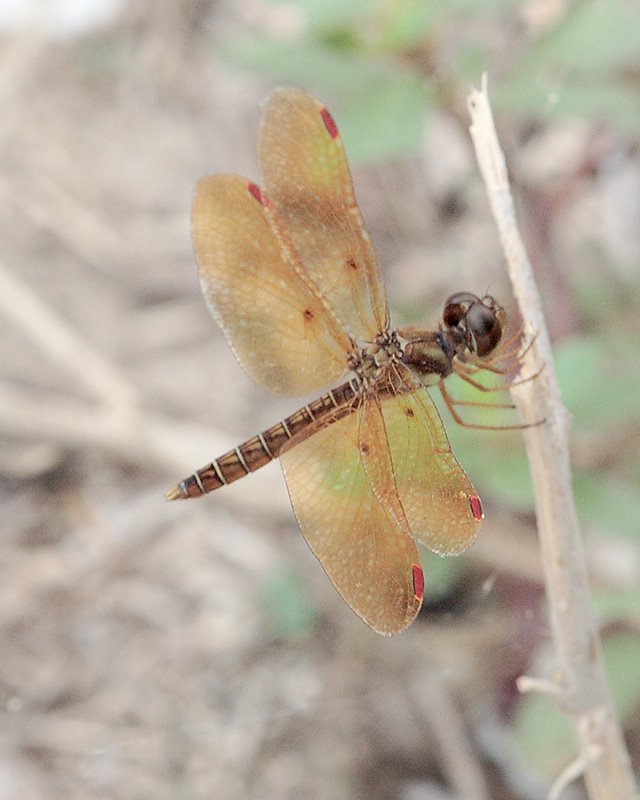
Eastern Amberwing
Well, I really enjoyed the Dragonfly class. I definitely feel a little overwhelmed. There are SO MANY dragonflies and damselflies. Many of them are very similar to one another with these small details distinguishing them.
As far as I'm concerned, I think the blue ones are the worst, because many dragonflies turn blue with age - they call it pruinescence- it is a waxy coating that develops with age.
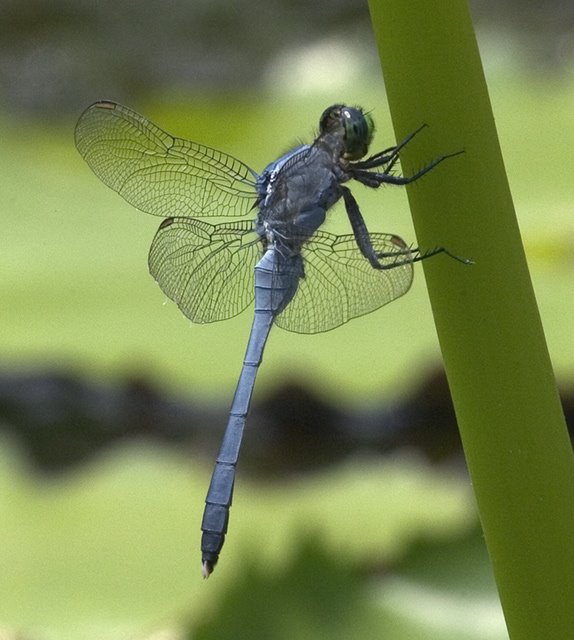
I'm hoping to go back and make my own notebook from my notes in class and his power point presentation. Dr. Abbott did an excellent job of going over a large number of species pointing out the distinctive markings and coloration. As I sat in class listening and taking notes, part of my brain said, "Oh my . . . . You'll never remember all this, too many details, too many species . . . .EEEK!" And I love his website, Odonata Central. If you already know roughly which species, you can go to the Field Guide. There you can see a sample photo or a gallery of photos to compare your specimen or photo (I'll be taking photos.) If you don't know which species, in the main Photo Gallery are thumbnails of each species.
 I have his book Dragonflies and Damselflies of Texas. I will probably do my "first guess" from those photos. I am finding after making this first best guess, that it helps a lot to go to the information pages and read about the specific identifying markers. Then I go to the website and compare my photos with the photo gallery. It helps when I can find one that is perched similarly to the one in my photo.
There was another book that people were using on the field trip: Stokes Beginner's Guide to Dragonflies. It is smaller in size and has larger photos. While not as comprehensive as Dr. Abbott's book, it is easier to carry around. He is working on a field guilde, I will probably purchase that when it comes out.
The field trips have been especially helpful. When you walk through dragonfly habitat with someone who knows what they are looking for, you actually see more different species.

The damselflies are so tiny, they are hard to see. Having a group of people all looking helps everyone see more individual species. Plus they had nets and captured some. After capture he had clear bags for us to study the differences between species before releasing them. One word of caution, don't stand very close to him . . . .a couple of times there were some close misses as he was trying to capture some dragonflies in flight. I did not take many photos the first field trip, partly because there were so many of us, I did not think I was getting close enough to get usable shots, and I wanted to concentrate on learning. However, those first shots came out better than I expected. So I took more shots on the second field trip. While there were others who were documenting the name of each species we saw, I find it difficult to lug around the camera and binoculars, take the photos, and write at the same time. So I'm trusting to my memory, checking the photos in the books, and hoping that I'm identifying these photos correctly.
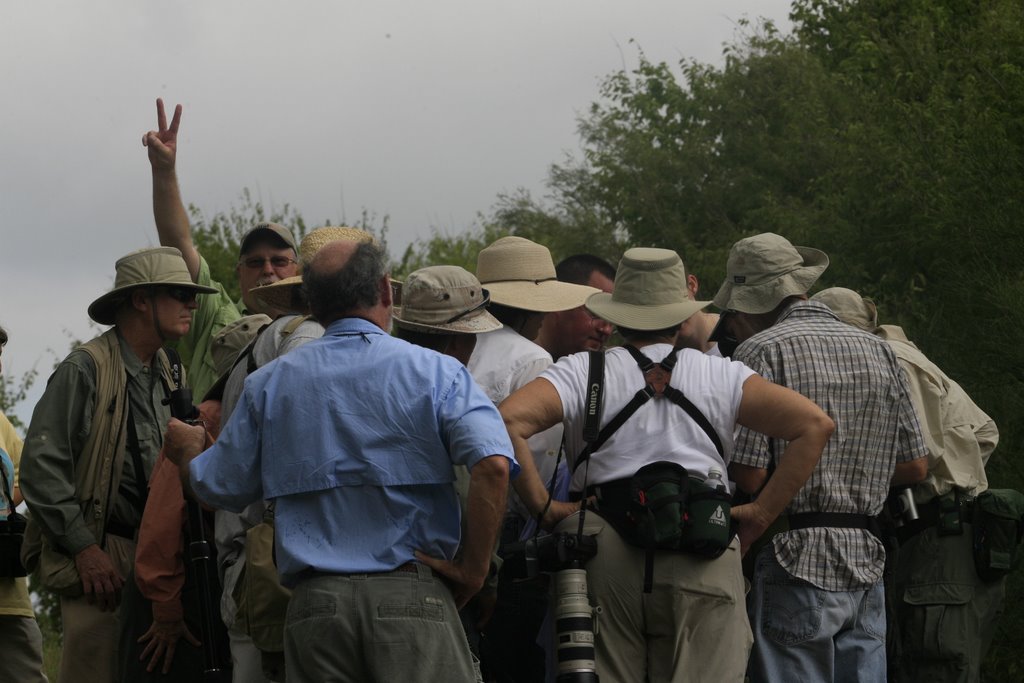 I took a few photos of the group clustered around examining one of the captured specimens. We were all eager to see all the details-color, size, markings,etc.
  And Dr. Abbott was so good at the details of each one.
 I've made a Dragonfly page on my website that has most of my dragonfly photos both from this class and from before.
Hummmm . . . .Should I get a butterfly net?
Thursday, September 21, 2006
State Parks, Toll Roads, Taxes, and Politics
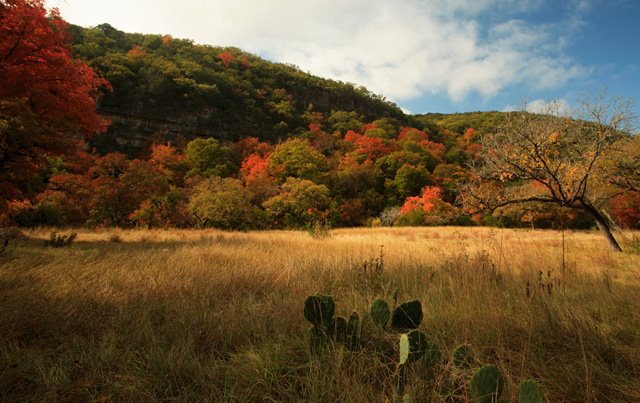
Tonight I went to my first Audubon Society meeting. (Now I may have gone to a meeting or a bird slide show as a child . . . but that was a long time ago.) I was looking forward to it. There was going to be a presentation by Texas Parks and WIldlife.
Sigh . . . . .
I came home depressed.
I've been visiting state parks since I was a child. I grew up in the flat panhandle of Texas. Palo Duro Canyon was a welcome scenic respite with its panoramic beauty, tall cottonwood trees, and flowing water in the midst of the dry prairie. The cottonwood trees of my childhood have died. I was there this year and they are cutting the rotting trunks down. Sadly, there don't seem to be new generations of cottonwoods coming up to take their place. While I don't know why there are not younger cottonwood trees, I suspect that the lakes in the watershed above have removed some of the water flow that fed these trees. Or perhaps the pumping of the aquifer for city water and irrigation has left the water table too low to nurture these water loving trees. With our family living in Amarillo, I've made frequent trips to Palo Duro Canyon throughout my adult years. It holds a special place in my heart.
Since moving to Austin, we've frequented the parks in the surrounding area - McKinney Falls, Bastrop, Pedernales Falls, Palmetto, Dinosaur Valley, Inks Lake, Enchanted Rock, Lost Maples, etc. While we don't buy a park pass every year, we have bought them frequently. We've hiked them, biked them, and camped in them. I have many special memories.

Walt Dabney, Director of State Parks, gave a presentation. It was a good presentation, emphasizing all the good and important facets of parkland - historical, scenic, recreation, and the economic value to the surrounding communities. So why was this presentation distressing? . . . . Sometime in the late 1990's tax money derived from the sale of sporting and camping equipment that had originally been earmarked for state parks was capped and the money diverted to other projects. Just as the costs for everything we do in our personal lives has gone up in price - so has the cost to operate and maintain state parks. The costs to provide personnel, repair, and maintain the facilities has risen dramatically, but the tax dollars to fund this seems to have been kept at a fixed rate. So . . . . . . facilities at many parks are in disrepair, historical buildings are decaying, and park hours and days of operation have been severely curtailed. The park service vehicles average about 10 years old, the tractors and mowers are being scavenged for parts to keep other ones going. We've actually lost 7 parks.
I know for a fact that there are still several special areas in Texas that deserve protection as parkland. Plus as our population continues to grow, we will need more park area to accommodate the additional people. And with land values continually increasing, land should be purchased now. Not only will it be cheaper to buy land now, but later those special places could easily be covered in houses, shopping malls, or business parks.
How did we as Texans allow our parks to get in this sad shape? Part of it is apathy - what is out of sight is out of mind. If we go to a state park, find it to be closed, or notice crumbling infrastructure, we may be dismayed, but we probably don't go home and write our representatives to protest.
But when the subject of taxes comes up, oh boy, the vocal people come out in droves. It seems that no one wants to pay any more tax than they have to . . . . tax reform and no new taxes are popular campaign slogans. And our country was founded in a way in a tax revolt. Remember Boston Harbor and that tea????? Remember that slogan, "No taxes without representation!" But I think sometimes we get so caught up in trying to save a buck, that we forget what taxes are for.
Taxes are designed to benefit the whole community. As a democracy, we get to vote directly on many issues - school bonds for example. But on other issues, we elect representatives to decide what tax dollars should be spent on and how people will be taxed to provide the money for the needed projects.
And in Texas we've been fighting about how to do taxes for a long time. We've been fighting over how to fund our children's education for years now. We're building our new roads as toll roads rather than raise taxes to pay for them. And I hear that this time, these roads will remain toll even after they are paid for. We live next to the newest of Texas' toll roads, nearing completion. There is a group of people fighting the toll concept. It is obvious that we don't want to add taxes to build these necessary roads, so I think toll is here to stay.
Let's see now - taxes build roads, fund some hospitals, provide Emergency Medical Services, Fire Departments, Police Departments, State Troopers, build schools, pay educators, buy textbooks, build jails, pay jailers, provide services for needy people, provide community library services, build parks, provide hike and bike trails, recreation centers with workout rooms, fitness classes, swimming pools . . . . . the list goes on and on and on. We may argue over how to allocate tax money among these things, but they are all important to us as a society.
So why did I come home depressed? Sometimes I feel like I am only one person. I have many things I am interested in and care about, but I only have a finite amount of time. The major problems with the state parks concern me a great deal - they are something I value highly. Often I feel like I am walking to the drum of a different drummer in terms of politics. During so much of my life the popular political tides did not reflect my beliefs. When it was "popular" to be Democratic and liberal, I was Republican and conservative. I don't feel that my values have changed that much, but now I find myself not in tune with the current popular political thinking. I do care about environmental issues and providing safety nets for people in need.
If the problems in our state parks disturbs you, (and it DOES disturb me - in terms of spending Texas is 49th in how much it spends on its parks!) take time to write your state representatives in the House and Senate. Write them a physical letter, not an email. Tell them about why you value your local state park and why you think that funding state parks is important. (And it is amazing the economic impact a state park has for the communities near it - tourist dollars from visitors from all over the United States benefits our economy.)
Our national Parks are a whole other story . . . . they need attention now also. Write your US Congressman and Senator to remind them that we still value our parklands and historical sites.
Wednesday, September 20, 2006
TexBirds, Tex Odes, and Citizen Scientists
I have recently joined the listserve Texbirds. While it definitely fills my mailbox, I find the information useful. I have followed up on a few things from the information. I went over to see a Mississippi Kite which had been sighted in the Round Rock area. While I did not get over there while they were nesting, I did get to see one. I've already mentioned the Hornsby Bend event I attended. I met Roxy, a member of the Travis Count Audubon Society there. She encouraged me to attend some classes sponsored by the Society. When I saw the dragonfly class I was hooked.
But another interesting element of the Texbird listserve is to realize t he research done by "citizen scientists." I've forgotten exactly where I saw that termnology, but it is an amazing concept. So much of scientific research involves tedious cataloging and observation hours out in the field. Many of today's scientists are professors with limited budgets and resources. But there are a lot of folks out there who are interested in the natural world, people who spend a lot of time learning about birds, insects, flowers, mammals, etc. Texbirds is one place where these people can record what species of bird was seen, at what location, at what date, at what time of day, etc. There are numerous bird counts going on right now due to the fall migration. Dedicated volunteers are manning sites and doing daily bird counts. And there are scientists who are using some of this information to further our knowledge of migration patterns, changing ranges of certain species, population studies, etc.
While my primary tasks over the last 25 years involved raising my children (yes, I did more than just that - I need to post my resume some day) , I've always been interested in science. My degree from the University of Texas is a Bachelor of Science. When my children were young, and I was involved with Girl Scouting and Boy Scouting, I always encouraged the children in my groups to explore and learn about the outdoors. On our family vacations we took the identification books and made our own lists of species we saw on different trips (BTW we computerized some of them - I bet we still have them!). Now as a nature photographer, I am hoping to share my love of the outdoor world with people who may not have the opportunity to spend as much time outside as I do.
Dr. Abbott who taught the dragonfly class is also using these "citizen scientists" to learn more about which dragonflies and damselflies are located where. I like this concept - ordinary but trained people out enjoying the natural world but also being active participants in furthering scientific knowledge. Hold that thought . . . . there will be more to come . . . .
But another interesting element of the Texbird listserve is to realize t he research done by "citizen scientists." I've forgotten exactly where I saw that termnology, but it is an amazing concept. So much of scientific research involves tedious cataloging and observation hours out in the field. Many of today's scientists are professors with limited budgets and resources. But there are a lot of folks out there who are interested in the natural world, people who spend a lot of time learning about birds, insects, flowers, mammals, etc. Texbirds is one place where these people can record what species of bird was seen, at what location, at what date, at what time of day, etc. There are numerous bird counts going on right now due to the fall migration. Dedicated volunteers are manning sites and doing daily bird counts. And there are scientists who are using some of this information to further our knowledge of migration patterns, changing ranges of certain species, population studies, etc.
While my primary tasks over the last 25 years involved raising my children (yes, I did more than just that - I need to post my resume some day) , I've always been interested in science. My degree from the University of Texas is a Bachelor of Science. When my children were young, and I was involved with Girl Scouting and Boy Scouting, I always encouraged the children in my groups to explore and learn about the outdoors. On our family vacations we took the identification books and made our own lists of species we saw on different trips (BTW we computerized some of them - I bet we still have them!). Now as a nature photographer, I am hoping to share my love of the outdoor world with people who may not have the opportunity to spend as much time outside as I do.
Dr. Abbott who taught the dragonfly class is also using these "citizen scientists" to learn more about which dragonflies and damselflies are located where. I like this concept - ordinary but trained people out enjoying the natural world but also being active participants in furthering scientific knowledge. Hold that thought . . . . there will be more to come . . . .
Mundane Things
I head out for New York City this time next week. I knew when I got home in July that I had a limited amount of time to get a lot done. Now I have a week to finish the most important tasks. While I have gotten a lot done the last two and one half months, there is still a lot undone on my to do lists.
Today needs to be a mundane day - going through mail, filing, throwing away, paying bills and doing paperwork that I have procrastinated on. I find myself wanting to work on the photography projects that also need to be done before I leave. I also find myself sitting at the computer trying to psyche myself up to get started on them. Sometimes it is hard to stay focused on the necessary, tedious, mundane tasks. The other facet of these mundane tasks is how easy it is to get the bulk of a task done, but not truly "finish" it.
This morning I asked God to help me get this set of paperwork tasks done. The undone paperwork hangs over my head and weighs me down. While I know I won't finish all of the backlog of paperwork things today - there are several paperwork tasks that really must be done before we head out for our next set of adventures. I've asked God to help me stay on target and finish these. And, hopefully, I'll get the photography tasks finished as well.
Today needs to be a mundane day - going through mail, filing, throwing away, paying bills and doing paperwork that I have procrastinated on. I find myself wanting to work on the photography projects that also need to be done before I leave. I also find myself sitting at the computer trying to psyche myself up to get started on them. Sometimes it is hard to stay focused on the necessary, tedious, mundane tasks. The other facet of these mundane tasks is how easy it is to get the bulk of a task done, but not truly "finish" it.
This morning I asked God to help me get this set of paperwork tasks done. The undone paperwork hangs over my head and weighs me down. While I know I won't finish all of the backlog of paperwork things today - there are several paperwork tasks that really must be done before we head out for our next set of adventures. I've asked God to help me stay on target and finish these. And, hopefully, I'll get the photography tasks finished as well.
Tuesday, September 19, 2006
Sigma 300-800mm Lens
I love to do wildlife photography. Going out into a wildlife refuge or a national park, learning where to find the wildlife, and getting to see God's wonderful creation gives me a natural high. Being a photographer, I want to take photos not only for my own personal memories, but also to share with others. When I first moved up from a digital point and shoot to a digital SLR, I bought the Canon 100-400 IS lens. For many situations, it worked beautifully. But . . . . for others, the wildlife was too far away to get quality photos. On my first trip to Bosque del Apache, I saw so many truly large lenses - talk about lens envy!!!!!
So I began to dream of a day when I too would have a large lens. It seemed far away.
I had an opportunity in South Texas to take some shots with a Canon 600mm lens with a couple of teleconverters and another opportunity to play with the Sigma lens. Even with the teleconverters, the duck in the distance that I shot with the 600mm lens was still very small - not the quality shot I was yearning for. In talking with the owner of the Sigma lens, he said that he had compared shots with the Canon lens and with a Sigma before he purchased. He felt that the Sigma lens produced a higher quality image.
From all those opportunities when the bird or coyote was too far away, I knew that bigger was likely to be better. Teleconverters not only reduce the amount of light coming into the camera, but they also put more layers of glass between your subject and your camera's sensor. Plus the autofocus does not work as well with the teleconverters. (And I have not had great luck doing manual focus with my digital SLR's. I have yet to add the focusing screen to my 5D-that could change my mind on manual focus.) So when the money became available, I went with the Sigma lens. I also bought a sturdy tripod for it and a Wimberly head.
The photo at the top of this blog was made on my porch with my Sigma lens. Other photos to reference for image quality for this lens:
My seals' webpage
The Bosque '05 photos
An Intimate Landscape at La Jolla
Monday, September 18, 2006
Heavenly Music
I feel very fortunate to be a member at Brentwood Oaks Church of Christ. We've had a unique opportunity recently. We are connected with the churches in St. Petersburg, Russia. One of the Russian Christians there is a musical composer. We've been privileged to be singing one of his songs, "My God and King" based on Psalms 84. The words and melody linger in my mind.
Two weeks ago on Wednesday evening, the composer, Konstantin Khiguln, his wife and another Russian young woman visited our chorus class. They sang for us. It was like hearing angel voices. This was all the more special because I can remember when some members of our congregation began going to St. Petersburg around 15 years ago. I remember a young American who had just become a Christian become educated at the Institute for Christian Studies (now Austin Graduate School of Theology.) He heard and responded to the call and went to live in Russia. Watching Konstantin lead us in learning his beautiful songs that Wednesday gave me a small sense of God's amazing power to spread his love to all of us. His joy in knowing Christ was radiant that evening.
This past Sunday evening the worship service centered on the work in Russia. One highlight was having Konstantin Zhigulin lead the congregation in "My God and King." This was followed by our Russian brothers and sisters singing some of these beautiful new hymns. And then a small group of local singers joined them for more of these new hymns.
For those of you in the Texas area, there are some more opportunities to hear these new and beautiful hymns:
Tues. Sept 19 - 8:00 P.M. Abilene Christian University Lectureship - General Session
- 8:30 P.M. Abilene Christian University Campus - Williams Performing Arts Center, Recital Hall
Wednesday, Sept. 20 - High Pointe Church of Christ, McKinney, Texas
Saturday, Sept. 23 - 7:00 P.M. Richland Hills Church of Christ, 24/7 Conference Room Richland Hills, Texas
Sunday, Sept 24 - 9:00 A.M. Duncanville Church of Christ, Duncanville, Texas
Sunday, Sept. 24 - 5:30 p.m. Pleasant Ridge Church of Christ, Arlington, Texas
The Russian and Austin area singers have made a CD that is available. Cost is $20.00. I highly recommend it. There is also a Russian language CD with some additional chamber music that Konstantin has written. If any of my readers are interested in ordering these CD's, contact me and I'll send you the email information.
Two weeks ago on Wednesday evening, the composer, Konstantin Khiguln, his wife and another Russian young woman visited our chorus class. They sang for us. It was like hearing angel voices. This was all the more special because I can remember when some members of our congregation began going to St. Petersburg around 15 years ago. I remember a young American who had just become a Christian become educated at the Institute for Christian Studies (now Austin Graduate School of Theology.) He heard and responded to the call and went to live in Russia. Watching Konstantin lead us in learning his beautiful songs that Wednesday gave me a small sense of God's amazing power to spread his love to all of us. His joy in knowing Christ was radiant that evening.
This past Sunday evening the worship service centered on the work in Russia. One highlight was having Konstantin Zhigulin lead the congregation in "My God and King." This was followed by our Russian brothers and sisters singing some of these beautiful new hymns. And then a small group of local singers joined them for more of these new hymns.
For those of you in the Texas area, there are some more opportunities to hear these new and beautiful hymns:
Tues. Sept 19 - 8:00 P.M. Abilene Christian University Lectureship - General Session
- 8:30 P.M. Abilene Christian University Campus - Williams Performing Arts Center, Recital Hall
Wednesday, Sept. 20 - High Pointe Church of Christ, McKinney, Texas
Saturday, Sept. 23 - 7:00 P.M. Richland Hills Church of Christ, 24/7 Conference Room Richland Hills, Texas
Sunday, Sept 24 - 9:00 A.M. Duncanville Church of Christ, Duncanville, Texas
Sunday, Sept. 24 - 5:30 p.m. Pleasant Ridge Church of Christ, Arlington, Texas
The Russian and Austin area singers have made a CD that is available. Cost is $20.00. I highly recommend it. There is also a Russian language CD with some additional chamber music that Konstantin has written. If any of my readers are interested in ordering these CD's, contact me and I'll send you the email information.
Sunday, September 17, 2006
Dragonfly Field Trip
Roseate Skimmer

Checkered Setwing

Dr. Abbott took us out in the field at the Brackenridge Field Laboratory. While the day was warm and muggy, I very much enjoyed walking around. I brought my camera and tripod rather than binoculars. While I was out there, I was regretting the decision because it was heavy and awkward to lug around. Binoculars seemed the better and lighter choice. And I did not have the close focus binoculars. Dr. Abbott took pity on me and loaned me his binoculars. At first the dragonflies were too far away for the equipment I brought. But because I am a photographer at heart, I did take a few photos. I'm glad now I did. Some of them came out better than I expected.

We got to see a dragonfly naiad emerging. When we first saw him, he was coming out of the exoskeleteon. With the photos you can see him blowing up his wings.
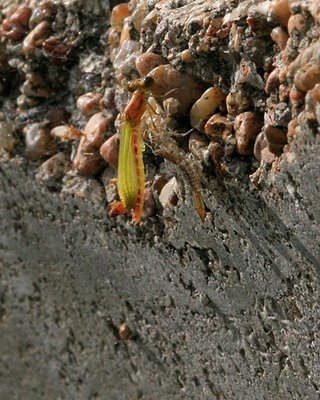
The pictures were taken just a few minutes apart.

Another recently emerged naiad in the same concrete pond, blowing up his wings.
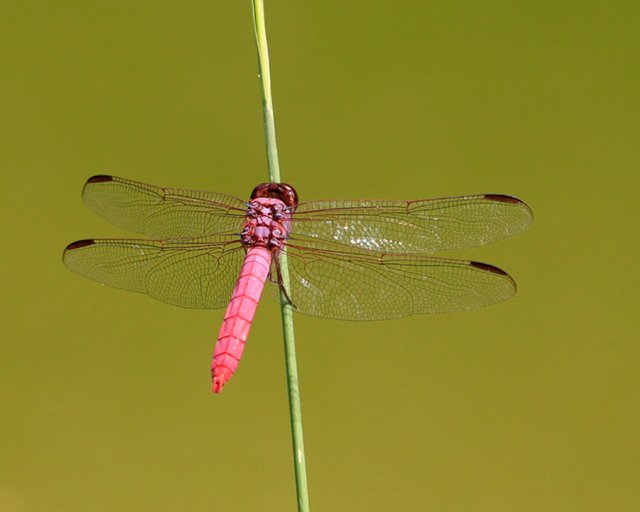
Checkered Setwing

Dr. Abbott took us out in the field at the Brackenridge Field Laboratory. While the day was warm and muggy, I very much enjoyed walking around. I brought my camera and tripod rather than binoculars. While I was out there, I was regretting the decision because it was heavy and awkward to lug around. Binoculars seemed the better and lighter choice. And I did not have the close focus binoculars. Dr. Abbott took pity on me and loaned me his binoculars. At first the dragonflies were too far away for the equipment I brought. But because I am a photographer at heart, I did take a few photos. I'm glad now I did. Some of them came out better than I expected.

We got to see a dragonfly naiad emerging. When we first saw him, he was coming out of the exoskeleteon. With the photos you can see him blowing up his wings.
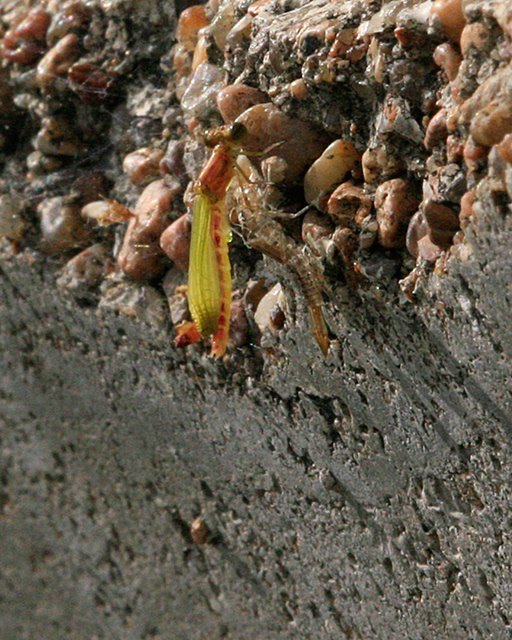
The pictures were taken just a few minutes apart.
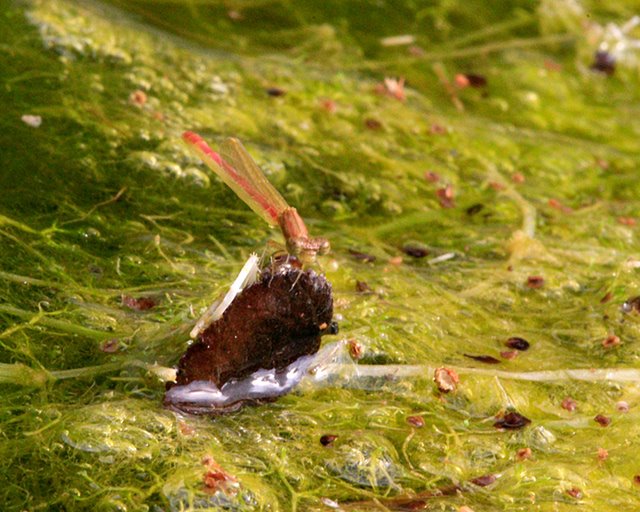
Another recently emerged naiad in the same concrete pond, blowing up his wings.
Wednesday, September 13, 2006
Dragonflies and Damselflies
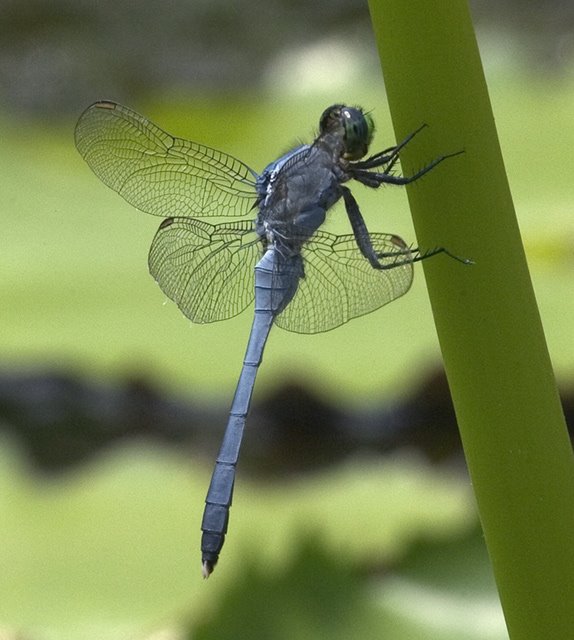
After going to the events at Hornsby Bend a few weeks ago, I decided to look up the classes offered by the Travis County Audubon Society. When I saw the dragonfly identification class, I was very interested. While I have not taken a lot of dragonfly photos, I knew that I needed more skills to identify the ones I had taken. And a simple insect identification book is really pretty useless - SOOOOOOOO many insects! Plus I did not know the first thing about the differences between dragonflies, damselflies, darners, skimmers, etc.
While I learned many things tonight, identifying the first set of my shots -sigh . . . we'll cover those Saturday (I think) At least I know they are males . . . . I did not buy the Dragonflies and Damselflies of Texas book because I wanted to see which dragonfly book I already had. Lesson in frustration to come home and not be able to identify the first one you try . . . .
But back to what I DID learn. Dragonflies are fierce predators. I have only seen them flying around my yard and perched various places. But we got to see a dragonfly larvae catch and eat a small fish! They normally eat mosquitoes and biting flies! (That means we should LIKE them.) There are a few instances of them being able to eat a small hummingbird, but that is rare.
We went over basic physiology and reproduction. And then came the identification. It was WONDERFUL. He went through slide after slide and told us what to look for in each identification (hence why I was so frustrated when I couldn't identify the two I tried tonight-but it will be better when I have the book!)
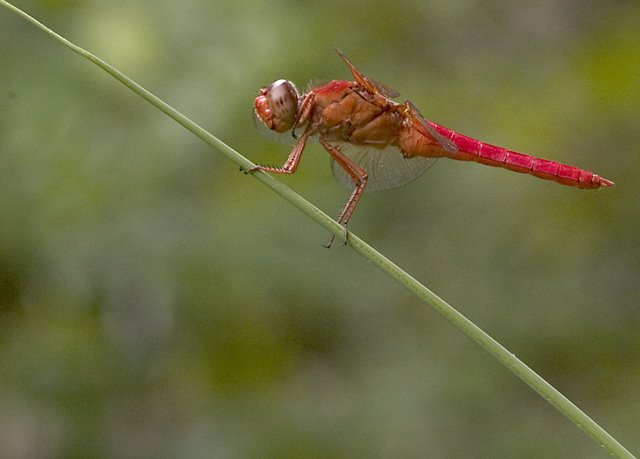
I had gone through and pulled all my dragonfly shots into one area on the computer before the class. I was not too impressed, these were taken a couple of years ago. Most of them I had not worked. But after having seen his shots (and his were great), some of mine are better than I thought.
And the teacher of the class John C. Abbott- the writer of the definitive book on Texas dragonflies, a world expert and a professor at UT whose specialty is dragonflies! What a privilege!
Tuesday, September 12, 2006
Steve Irwin
I have to confess I don't watch many documentaries or wildlife shows (I probably should, there is some great stuff out there.) And I have to confess that I probably have not seen many of Steve Irwin's shows. When I first heard the sad news on Chris Nystrom's blog, I was not sure who this person was. Almost every website I visit has mourned the loss of this extraordinary individual.
As Christians, we know that life is fragile, that death can come at any time. But as humans, we live as though we will live forever. When death takes someone young like Steve, our first thought is that he was robbed of time here on earth. I can't help but think of his family and the young children left fatherless. Being older (and wiser - yeah, right . . . ) I wonder at the foolishness of the risks he took. And yet, he has left such a legacy for his children. He has fostered the love of nature, a sense of adventure, and a loving spirit. Many people who have lived long lives have not experienced even a quarter of what Steve did in his short life. He used his time on earth fully, not only living exhiliarated in God's creation, but sharing that exhiliaration with the rest of the globe.
It is so easy to live a mundane existence, living from paycheck to paycheck, carefully saving for a future that may be cut short. It is easy to fall in a rut driving to and from work only seeing the cars and people around us. While I fret about money issues, I find myself grateful that while my adventures don't come anywhere close to Steve's, we have had opportunity to go out in the RV and have our own adventures. Many of Steve's obituaries talk about how he lived life to the fullest, dying doing what he loved best. I believe that God wants us to enjoy his magnificent creation. People like Steve help all of us experience and appreciate the wonders of our world. In memory of Steve, go out and have an adventure of your own!
I found this posted at one of the websites and thought it worth sharing.
THE CROCODILES ARE CRYING
Endless visions fill my head – this man – as large as life
And instantly my heart mourns for his angels and his wife
Because the way I see Steve Irwin – just put everything aside
It comes back to his family – it comes back to his pride
His animals inclusive – Crikey – light the place with love!
Shine his star with everything he fought to rise above
The crazy-man of Khaki from the day he left the pouch
Living out his dream and in that classic ‘Stevo’ crouch
Exploding forth with character and redefining cheek
It’s one thing to be honoured as a champion unique
It’s one thing to have microphones and spotlight cameras shoved
It’s another to be taken in and genuinely loved
But that was where he had it right – I guess he always knew
From his fathers’ modest reptile park and then Australia Zoo
We cringed at times and shook our heads – but true to natures call
There was something very Irwin in the make up of us all
Yes the more I care to think of it – the more he had it right
If you’re going to make a difference – make it big and make it bright!
Yes - he was a lunatic! Yes - he went head first!
But he made the world feel happy with his energetic burst
A world so large and loyal that it’s hard to comprehend
I doubt we truly count the warmth until life meets an end
To count it now I say a prayer with words of inspiration
May the spotlight shine forever on his dream for conservation
…My daughter broke the news to me – my six year old in tears
It was like she’d just turned old enough to show her honest fears
I tried to make some sense of it but whilst her Dad was trying
His little girl explained it best…she said “The crocodiles are crying”
Their best mate’s up in heaven now – the crocs up there are smiling!
And as sure as flowers, poems and cards and memories are piling
As sure as we’ll continue with the trademarks of his spiel
Of all the tributes worthy – he was rough…but he was real
As sure as ‘Crikey!’ fills the sky
I think we’ll miss ya Steve…goodbye
RUPERT McCALL 2006
Books by Rupert McCall
As Christians, we know that life is fragile, that death can come at any time. But as humans, we live as though we will live forever. When death takes someone young like Steve, our first thought is that he was robbed of time here on earth. I can't help but think of his family and the young children left fatherless. Being older (and wiser - yeah, right . . . ) I wonder at the foolishness of the risks he took. And yet, he has left such a legacy for his children. He has fostered the love of nature, a sense of adventure, and a loving spirit. Many people who have lived long lives have not experienced even a quarter of what Steve did in his short life. He used his time on earth fully, not only living exhiliarated in God's creation, but sharing that exhiliaration with the rest of the globe.
It is so easy to live a mundane existence, living from paycheck to paycheck, carefully saving for a future that may be cut short. It is easy to fall in a rut driving to and from work only seeing the cars and people around us. While I fret about money issues, I find myself grateful that while my adventures don't come anywhere close to Steve's, we have had opportunity to go out in the RV and have our own adventures. Many of Steve's obituaries talk about how he lived life to the fullest, dying doing what he loved best. I believe that God wants us to enjoy his magnificent creation. People like Steve help all of us experience and appreciate the wonders of our world. In memory of Steve, go out and have an adventure of your own!
I found this posted at one of the websites and thought it worth sharing.
THE CROCODILES ARE CRYING
Endless visions fill my head – this man – as large as life
And instantly my heart mourns for his angels and his wife
Because the way I see Steve Irwin – just put everything aside
It comes back to his family – it comes back to his pride
His animals inclusive – Crikey – light the place with love!
Shine his star with everything he fought to rise above
The crazy-man of Khaki from the day he left the pouch
Living out his dream and in that classic ‘Stevo’ crouch
Exploding forth with character and redefining cheek
It’s one thing to be honoured as a champion unique
It’s one thing to have microphones and spotlight cameras shoved
It’s another to be taken in and genuinely loved
But that was where he had it right – I guess he always knew
From his fathers’ modest reptile park and then Australia Zoo
We cringed at times and shook our heads – but true to natures call
There was something very Irwin in the make up of us all
Yes the more I care to think of it – the more he had it right
If you’re going to make a difference – make it big and make it bright!
Yes - he was a lunatic! Yes - he went head first!
But he made the world feel happy with his energetic burst
A world so large and loyal that it’s hard to comprehend
I doubt we truly count the warmth until life meets an end
To count it now I say a prayer with words of inspiration
May the spotlight shine forever on his dream for conservation
…My daughter broke the news to me – my six year old in tears
It was like she’d just turned old enough to show her honest fears
I tried to make some sense of it but whilst her Dad was trying
His little girl explained it best…she said “The crocodiles are crying”
Their best mate’s up in heaven now – the crocs up there are smiling!
And as sure as flowers, poems and cards and memories are piling
As sure as we’ll continue with the trademarks of his spiel
Of all the tributes worthy – he was rough…but he was real
As sure as ‘Crikey!’ fills the sky
I think we’ll miss ya Steve…goodbye
RUPERT McCALL 2006
Books by Rupert McCall
Saturday, September 09, 2006
Bird Indentification - Part 2
I posted a request for habitat information about the bird Fernando posted. Thickets . . . .
Someone else posted an excellent treatise as to what to look for on this bird . . . .
But what I find interesting - and relevant to my other post . . . . I've seen and identified kingbirds in New Mexico and the panhandle of Texas. So when I saw this bird . . . . my first thought was western kingbird - I've seen them before. . . . . And the bird had the pale yellow breast and dark head and feathers. It was familiar. But it is in the details, apparently kingbirds have black tails, not rufous colors.
Back to the spiritual comparisons- often we read passages of scripture and our familiarity can blind us to new truths or sometimes lead us to reject someone else's ideas. As humans we also like being "right."
I kept clinging to my ID as a kingbird, because that bird was familiar to me(and despite the other guys long treatise on why it could not possibly be a KINGBIRD) there were similarities. I can see why I thought the bird was a kingbird . . . . but I can also see at this point why it probably isn't. Even my second guess did not agree with the more experienced birder.
While I've been playing with identifying birds for 25 years, I have not birded as vigorously or as extensively as many birders. Some birds are easy to identify - others more difficult. I think I'll keep the title "Nature Photographer" rather than birder. But even as a nature photographer, I need to be able to accurately identify what I am photographing. So I'll keep on with practicing my birding skills.
Someone else posted an excellent treatise as to what to look for on this bird . . . .
But what I find interesting - and relevant to my other post . . . . I've seen and identified kingbirds in New Mexico and the panhandle of Texas. So when I saw this bird . . . . my first thought was western kingbird - I've seen them before. . . . . And the bird had the pale yellow breast and dark head and feathers. It was familiar. But it is in the details, apparently kingbirds have black tails, not rufous colors.
Back to the spiritual comparisons- often we read passages of scripture and our familiarity can blind us to new truths or sometimes lead us to reject someone else's ideas. As humans we also like being "right."
I kept clinging to my ID as a kingbird, because that bird was familiar to me(and despite the other guys long treatise on why it could not possibly be a KINGBIRD) there were similarities. I can see why I thought the bird was a kingbird . . . . but I can also see at this point why it probably isn't. Even my second guess did not agree with the more experienced birder.
While I've been playing with identifying birds for 25 years, I have not birded as vigorously or as extensively as many birders. Some birds are easy to identify - others more difficult. I think I'll keep the title "Nature Photographer" rather than birder. But even as a nature photographer, I need to be able to accurately identify what I am photographing. So I'll keep on with practicing my birding skills.
Birding and Bird Identification
Being raised in the Church of Christ, I am quite familiar with going back to chapter and verse to prove a point. As a group we have moved from legalism toward grace, and so these arguments occur less.
However, it was interesting this week to watch the birding world's version of legalism:
I joined Texbirds this week. I get email throughout the day as to bird counts, bird sightings and other Texas birding news. I've even posted a couple of birds that I've seen in my yard for identification.
On Wednesday Fernando posted a bird on his website for us to identify. Since I'm familiar with a bird similar to this, I sent him an email saying I thought it was a western kingbird. He was kind of enough to post a tally of the identifications he received:
14 votes for Brown-crested Flycatcher
12 votes for Great-crested Flycatcher
4 votes for Ash-throated Flycatcher
3 votes for Western Flycatcher
I've looked through 3 of my bird identification books since then comparing these birds. (I've got a few more I can use . . . . it has aroused my curiosity - I WOULD like to know which bird this is and why.) If it is truly a crested variety, then its crest is not up . . . . . Many birds you make an id based on where you saw the bird. If I was out in West Texas or New Mexico - flat prairie - it would be a no brainer - Western Kingbird. However, if the shot was taken in a forested or thicket area then it could be the Great-crested Flycatcher.
So even though it is a great bird shot . . . .the birders can't agree on the identification . . . .
Since one of my good friends debates with me on identification of birds we see, I am going to say that I think humans like to debate over small details. And in birds most of the time it HAS to be one species . . . but that does not count the birds that can interbreed and have hybrids making identification MUCH more difficult. It also does not take into consideration that juvenile birds also look different - making identification harder. One set of birds that I posted for identification turned out to be juvenile starlings - they don't look anything like the adult version! I also find that some of the sparrows and finches look so much alike that it is hard for me to tell who is who at my bird feeder. Sometimes I find that I want to know which sparrow I'm looking at. Other times I am content to enjoy the constant coming and going from the feeder. Sometimes life is too short to debate over the small things. (Does that mean I'll never be a "true" birder?)
However, it was interesting this week to watch the birding world's version of legalism:
I joined Texbirds this week. I get email throughout the day as to bird counts, bird sightings and other Texas birding news. I've even posted a couple of birds that I've seen in my yard for identification.
On Wednesday Fernando posted a bird on his website for us to identify. Since I'm familiar with a bird similar to this, I sent him an email saying I thought it was a western kingbird. He was kind of enough to post a tally of the identifications he received:
14 votes for Brown-crested Flycatcher
12 votes for Great-crested Flycatcher
4 votes for Ash-throated Flycatcher
3 votes for Western Flycatcher
I've looked through 3 of my bird identification books since then comparing these birds. (I've got a few more I can use . . . . it has aroused my curiosity - I WOULD like to know which bird this is and why.) If it is truly a crested variety, then its crest is not up . . . . . Many birds you make an id based on where you saw the bird. If I was out in West Texas or New Mexico - flat prairie - it would be a no brainer - Western Kingbird. However, if the shot was taken in a forested or thicket area then it could be the Great-crested Flycatcher.
So even though it is a great bird shot . . . .the birders can't agree on the identification . . . .
Since one of my good friends debates with me on identification of birds we see, I am going to say that I think humans like to debate over small details. And in birds most of the time it HAS to be one species . . . but that does not count the birds that can interbreed and have hybrids making identification MUCH more difficult. It also does not take into consideration that juvenile birds also look different - making identification harder. One set of birds that I posted for identification turned out to be juvenile starlings - they don't look anything like the adult version! I also find that some of the sparrows and finches look so much alike that it is hard for me to tell who is who at my bird feeder. Sometimes I find that I want to know which sparrow I'm looking at. Other times I am content to enjoy the constant coming and going from the feeder. Sometimes life is too short to debate over the small things. (Does that mean I'll never be a "true" birder?)
Thursday, September 07, 2006
The first breath of fall
August is always a hot month in Central Texas. Temperatures over 100 degrees are common. This August was especially hot. Generally the coming of September brings just a hint of cooler weather. This September has been more generous than usual. Yesterday morning and this morning, I awoke to temperatures in the upper 60's. While I sat on the porch most mornings throughout the summer, this cool air is so welcome.
We'll have some more hot weather, but I plan to enjoy these cooler temperatures while they last.
We'll have some more hot weather, but I plan to enjoy these cooler temperatures while they last.
Monday, September 04, 2006
Horses for Writers

At Lone Star Con several years ago, I attended a panel of writers who were also horse people. They talked about all the mistakes writers make when having horses in their novels or short stories. Some of them simple things such as when the calvary marches over barren stone mountain passes, where are the wagons carrying the hay and feed. Another common mistake is having the horse act more like a motor car, pushing over more territory, too fast, without including the necessary rest and recoup time.
My friend, Bettye Baldwin, has just published Horses for Writers dealing with these issues and many more. It covers everything you would want to know about horses. I would recommend it for anyone who loves horses. In some ways it is an anything you want to know about horses, but were afraid to ask book!
Baby Birds

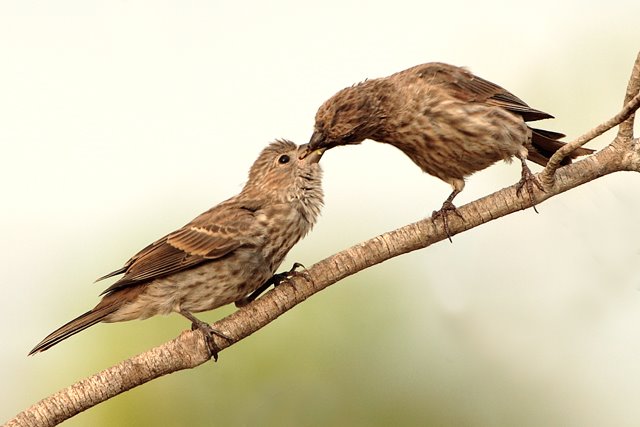
I've had bird feeders out for a number of years now. This year we've been home during the summer. I've kept the feeders going. This past month I've been rewarded by seeing the fledged baby birds coming with their parents to the feeders. Not only are they "cute," but watching the interaction is fun. One of the first babies I noticed was a baby cardinal. The baby was on the ground, fluttering his wings begging his mom for food. I saw this same behavior this past week only with finches. The baby was on a branch, fluttering those wings (trying to look helpless????) with his beak open.

And, of course, mom fed it. However, it was not too long before the baby flew down and started feeding himself from the feeder. Not so "helpless" after all.
Sunday, August 27, 2006
Owl Prowl and Frog Frolic
I signed up for Texbirds recently. I'd heard about it several years when I was birdwatching in the Rio Grande Valley. I signed up because I had an unknown bird that I could not find in my bird books. (I still need to post about that one . . . later) Warning: If you sign up for this list, you will get LOTS of emails. But I have found it interesting to hear about bird sightings all over the state.
One of the posts that caught my attention: Hornsby Bend Partnership Celebration. I'd been reading about the Hawkwatch that was counting the migrating hawks at Hornsby Bend. It was a multi hour event, but the big drawing factor for me was the Owl Prowl.
I went last night . . . . We walked for about 2 hours. We heard a brief owl calling early on as well as some frogs. One of our guides was excellent at simulating owl calls, but they went unanswered. But it was beginning to look as though we weren't going to get to hear the owls. And then as we neared the end of the walk, it came: Whoooo Whooooo Who Who Who Whoooooo!!! (Ya gotta get the rhythm right here!) And then an answering Whoooo Whoooooo Who Who Who Whoooooo!!!! The pair called back and forth, and at one point called at the same time! They were close . . . . While we did not see them, it was well worth the time spent tromping around near the Colorado River in the dark.
One of the posts that caught my attention: Hornsby Bend Partnership Celebration. I'd been reading about the Hawkwatch that was counting the migrating hawks at Hornsby Bend. It was a multi hour event, but the big drawing factor for me was the Owl Prowl.
I went last night . . . . We walked for about 2 hours. We heard a brief owl calling early on as well as some frogs. One of our guides was excellent at simulating owl calls, but they went unanswered. But it was beginning to look as though we weren't going to get to hear the owls. And then as we neared the end of the walk, it came: Whoooo Whooooo Who Who Who Whoooooo!!! (Ya gotta get the rhythm right here!) And then an answering Whoooo Whoooooo Who Who Who Whoooooo!!!! The pair called back and forth, and at one point called at the same time! They were close . . . . While we did not see them, it was well worth the time spent tromping around near the Colorado River in the dark.
Tuesday, August 01, 2006
Friday, July 07, 2006
Arriving home
When you first get home from a long trip, there is much to be done. For one thing, all the things you did not get finished before you left are still waiting for you. There are weeds in the flowerbed (they're still waiting for me.) There is overgrown grass - (Henry usually does the mowing.) The pantry and refrigerator are either empty or filled with items that are now out of date. (This time Jonathan had cleaned out my refrigerator -- that was nice to come home to). It also means a trip to the grocery store is top priority. There are the friends you need to get together with.
Then there is mail . . . . . have I said how much I HATE MAIL!!!!!!! I tend to come home to a month's worth of mail. And I have a post office box as well as my home mailbox. So that means I get two sets of bulk mailings. My initial sort looks something like this:
Throw away bulk mailings
Shred the credit card offers
Bank Statements
Brokerage Statements
Bills
Bulletins
Catalogs
Magazines
Newsletters - Christian Chronicle, various children's homes, European Bible, etc
Mail addressed to my deceased mom : Theta, Ratcliff, Harvard, charitable hopefuls, etc
Stock Annual Reports
Mutual fund quarterly reports
Stock Class Action Suits mailings (I don't ever join those, but they mail them to me
anyway. But I have a hard time throwing them away thinking I should read them in
case I should want to reap some benefit.)
Breckenridge Colorado realtors hoping I want to buy or sell property there (look at
before throwing away - keeps me updated on what my Breckenridge properties'
current value is)
Mail for the kids that I need to get to them
When I'm on top of my game, several of these categories should go straight to the file box. This year I have not been on top of my game. Knowing I would be home a while this time, I knew that I needed to get caught up with the six months of filing that had stacked up. As of August 13th - I am close to being caught up.
Some mail is easy to file - it has its place, no decisions required. Some mail is deceptive. You know it is eventually a throw away item. But some of it you want to read or browse - or think you SHOULD read or browse. There is more of it than I will EVER have time to read or browse. Unfortunately, I have a hoarder's mentality . . . . . When I am tired, it is worse. At the beginning of a filing session, I'm throwing away things, sorting and filing. At the end, my unfiled, maybe I'll need this or want to look at this , or the I don't know what to do with this sets of stacks gets larger and fewer things are thrown away.
One partial solution for those items that I might want to look at, but don't have time right now is to find a place to store them . . . . one year later it is MUCH easier to throw it away. Unfortunately, once stored, they are out of site, out of mind, and take up space somewhere. Now to train myself to throw it away now . . . . . could happen . . . . . . . sadly, I've got a long way to go in terms of throwing things away.
Then there is mail . . . . . have I said how much I HATE MAIL!!!!!!! I tend to come home to a month's worth of mail. And I have a post office box as well as my home mailbox. So that means I get two sets of bulk mailings. My initial sort looks something like this:
Throw away bulk mailings
Shred the credit card offers
Bank Statements
Brokerage Statements
Bills
Bulletins
Catalogs
Magazines
Newsletters - Christian Chronicle, various children's homes, European Bible, etc
Mail addressed to my deceased mom : Theta, Ratcliff, Harvard, charitable hopefuls, etc
Stock Annual Reports
Mutual fund quarterly reports
Stock Class Action Suits mailings (I don't ever join those, but they mail them to me
anyway. But I have a hard time throwing them away thinking I should read them in
case I should want to reap some benefit.)
Breckenridge Colorado realtors hoping I want to buy or sell property there (look at
before throwing away - keeps me updated on what my Breckenridge properties'
current value is)
Mail for the kids that I need to get to them
When I'm on top of my game, several of these categories should go straight to the file box. This year I have not been on top of my game. Knowing I would be home a while this time, I knew that I needed to get caught up with the six months of filing that had stacked up. As of August 13th - I am close to being caught up.
Some mail is easy to file - it has its place, no decisions required. Some mail is deceptive. You know it is eventually a throw away item. But some of it you want to read or browse - or think you SHOULD read or browse. There is more of it than I will EVER have time to read or browse. Unfortunately, I have a hoarder's mentality . . . . . When I am tired, it is worse. At the beginning of a filing session, I'm throwing away things, sorting and filing. At the end, my unfiled, maybe I'll need this or want to look at this , or the I don't know what to do with this sets of stacks gets larger and fewer things are thrown away.
One partial solution for those items that I might want to look at, but don't have time right now is to find a place to store them . . . . one year later it is MUCH easier to throw it away. Unfortunately, once stored, they are out of site, out of mind, and take up space somewhere. Now to train myself to throw it away now . . . . . could happen . . . . . . . sadly, I've got a long way to go in terms of throwing things away.
Monday, July 03, 2006
Wave Magic at La Jolla
As I've participated at the various photography websites over the years, I've seen some beautiful photos taken as time exposures of ocean waves. In my journeys to California, I've made attempts at several places. Most of them are fun for me, a few people like them, but my efforts have not been competition quality. But I am happy to say that all the practice runs taught me things that finally came together at La Jolla.

During the convention, I went over to La Jolla three different nights to do photography. My emphasis the first night was on the seals so I only had my big lens. But as it got close to sunset, I repositioned my big lens and started shooting the waves. Unfortunately, I did not bring my remote shutter release - so many of the shots were blurred and unusable. At the end I started used the timer which helped some. But I got a few shots I was pleased with using the larger lens and getting a more intimate view of the rocks and waves.
The second day I came with my landscape zoom (28-105mm) lens and tripod - a much smaller. Henry came with me this time. I've learned to shoot aperture priority at the highest f/stop for the lens to get the deepest depth of field possible. Then I make exposure adjustments as I go along based on the histogram and what I see on the back of the camera. I've also learned that the rocks must be extremely sharp for this to work. So I focus on the rocks. Even so, from one shot to the next even without changing settings the exposures tend to shift. The remote shutter release is very important so I don't jar the camera during these longer exposures.

I make sure I get several different views - one for the larger picture.

But I find that I am most interested in getting the details in the rocks and waves - the intimate landscape.

On Monday I get one more opportunity to photograph at La Jolla. I've concentrated my photography over at the Children's Pool. I wanted something different. So I headed over where people snorkel and do their afternoon swims - a couple of blocks over. It was a totally different environment and I kept changing positions trying to get shots that might work.

The evening light fades. This is my last night on the Pacific this trip. Tomorrow is the fourth of July - and there will be NO parking around here. Besides Wednesday is the day we leave to go back to Texas. We'll have stuff to stow. I hope I get to come back to this site. I had wanted to snorkel with the seals and see the fish. I discovered that there is a sea cave to explore. And now that I've seen the photos - of course, there is more stuff I would like to try. Lord willing, we'll be back.
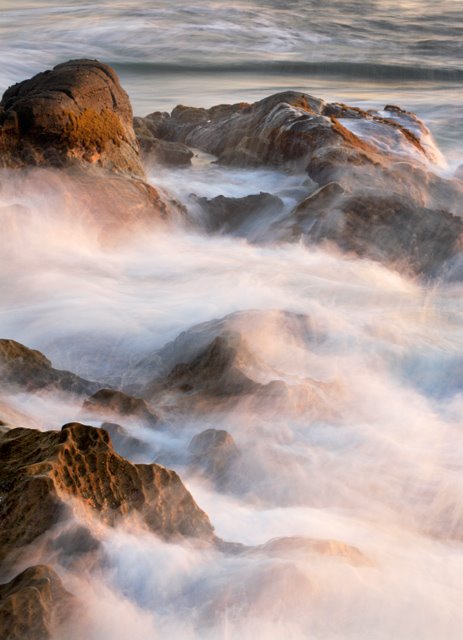
During the convention, I went over to La Jolla three different nights to do photography. My emphasis the first night was on the seals so I only had my big lens. But as it got close to sunset, I repositioned my big lens and started shooting the waves. Unfortunately, I did not bring my remote shutter release - so many of the shots were blurred and unusable. At the end I started used the timer which helped some. But I got a few shots I was pleased with using the larger lens and getting a more intimate view of the rocks and waves.
The second day I came with my landscape zoom (28-105mm) lens and tripod - a much smaller. Henry came with me this time. I've learned to shoot aperture priority at the highest f/stop for the lens to get the deepest depth of field possible. Then I make exposure adjustments as I go along based on the histogram and what I see on the back of the camera. I've also learned that the rocks must be extremely sharp for this to work. So I focus on the rocks. Even so, from one shot to the next even without changing settings the exposures tend to shift. The remote shutter release is very important so I don't jar the camera during these longer exposures.
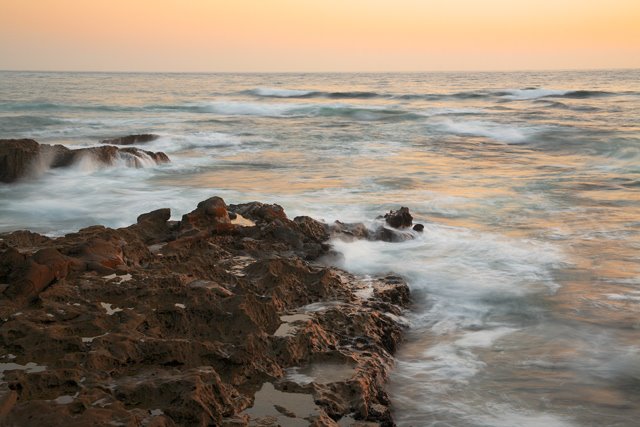
I make sure I get several different views - one for the larger picture.
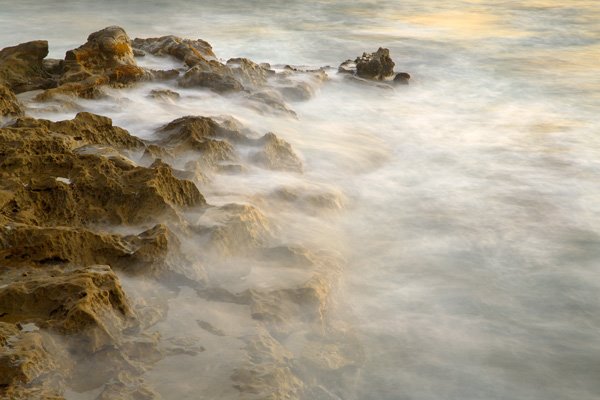
But I find that I am most interested in getting the details in the rocks and waves - the intimate landscape.

On Monday I get one more opportunity to photograph at La Jolla. I've concentrated my photography over at the Children's Pool. I wanted something different. So I headed over where people snorkel and do their afternoon swims - a couple of blocks over. It was a totally different environment and I kept changing positions trying to get shots that might work.
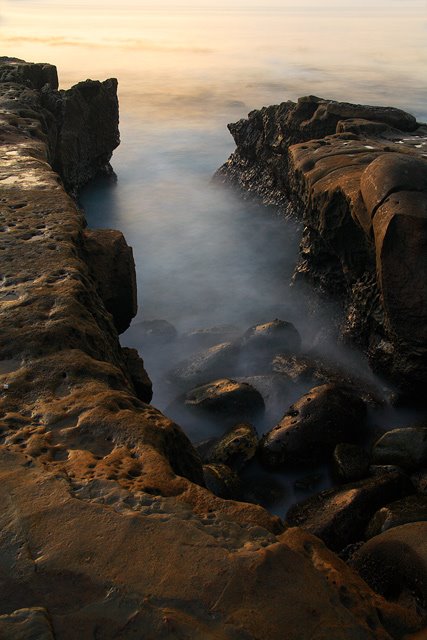
The evening light fades. This is my last night on the Pacific this trip. Tomorrow is the fourth of July - and there will be NO parking around here. Besides Wednesday is the day we leave to go back to Texas. We'll have stuff to stow. I hope I get to come back to this site. I had wanted to snorkel with the seals and see the fish. I discovered that there is a sea cave to explore. And now that I've seen the photos - of course, there is more stuff I would like to try. Lord willing, we'll be back.
Morning Aerobics at a Con
The first morning I had gone to a Tai Chi class led by Stephen Barnes, a novelist and television writer. I found it interesting and wanted to go to the second one. While he said something about having another class on Sunday, the program said Monday. So I showed up on Monday all ready for another lesson in Tai Chi . . . . .
I got an exercise class all right . . . . Belly dance was not on my life list of things to do . . . . hum . . . . . .
Most of us were in "street clothes" or con attire. She conducted it just like an aerobics workout - only with middle eastern music - and a different set of moves. I stayed until the new moves and my back decided to disagree - about half an hour.
I got an exercise class all right . . . . Belly dance was not on my life list of things to do . . . . hum . . . . . .
Most of us were in "street clothes" or con attire. She conducted it just like an aerobics workout - only with middle eastern music - and a different set of moves. I stayed until the new moves and my back decided to disagree - about half an hour.
TV News - from Westercon
New Voyages
One of the panels I went to talked about something new for Star Trek fans. A man in New York state is filming episodes to complete the original five year mission from the original Star Trek. They have built a complete set . . . . . at Ticonderoga, New York. It has a new cast playing the familiar roles. However, the second episode has Walter Koenig and the third episode - yet to be shot will have George Takei taking on the role of an older Sulu. This is a new concept - these episodes are being aired over the internet. The third episode has picked up a real TV producer who is planning to shoot in high definition. Most of the actors have real day jobs, and this is a work of love. I haven't yet seen an episode - Henry has downloaded them for me. But the review I heard at the con makes me think I'll enjoy them. Because this is all volunteer work - don't expect episodes to come out frequently.
Eureka
A new TV series will air on Tuesday night on the SciFi channel. The official blurb: "Nestled in the Pacific Northwest, Eureka is a seemingly ordinary town whose residents lead ordinary lives … at least to the naked eye. Shrouded in secrecy, the picturesque hamlet is actually a community of scientific geniuses assembled by the government to conduct top-secret research." At the SciFi panel they showed clips and previews. I think it will be worth watching at least the first few episodes.
Garth Marenghi's Darkplace
They showed clips from this - It will be shown on SciFI beginning July 27. Filmed in the 1980's, it apparently has never been aired - or perhaps it was filmed to look like it was filmed in the '80's. Definitely looks strange. I'm not sure it will be on my watch list more than once, but I know I've got friends in the science fiction world that will watch this.
Dr. Who
SciFi is negotiating to get the second season of the newer version of Dr. Who. We've got it on Tivo, but I have not watched it yet. Most fans of the original Dr. Who seem to like the new one.
Saturday night movies:
After going to the website, some of the trailers make sense now.I will have to say many of these movies that were mentioned as upcoming for Saturday Night Movie night - don't thrill me. They sound more like the "B" movies from my childhood. But once again some people LIKE this kind of stuff. This is from my notes, there is better info on the website.
Cyclops - Roger Corman
Supergator Roger Corman film
Screech - deadly bird flu
Yetti - curse of the snow demon - college football team struggles to survive . . .. .
Lake Placid II - sequel to 1999 thriller . . . . .
Beyond Sherwood forest - slay creature slaying poor and innocent
Stan Lee - Lightspeed - guy who travels faster than anyone else
Harpies - female wing monsters
Ron Moore - Batle star spin off set 50 years before . . . . .
Other news:
It looks as though the SciFi channel will be showing "Dead Like Me" perhaps with cleaned up language. From the website, first episode, July 18. They also talked about showing the original "Nightstalker" complete with episodes that were never aired. For those that actually like reality shows - on Thursday night "Who wants to be a Superhero?" Count me out on that one.
In development:
I'm just going to post my rough notes. These are series in development. They may not ever make it to our TV screens.
In development:
Kip Stanley Robinsons - Mars
Tale of 2 cities
Mini series base on Myst
Remake of Thing
Ringworld Pilot live action anime witchhunter robin
Urban arcane
Own pilot for Time Tunnel 3or 4 versions pilots made nothing happened
Lots in developmnet but whether we see
developing Steven Baxter ???? - Times' Ice novel series - very preliminary
Surface and Invasion - Threshold - all cancelled by networks -
Surface in daytime block - new episodes - not likely
Maybe pick up Threshold , Invasion - genre series - sci fi will look at if cheap enough to pick up
For those of you wondering about the wrestling now on SciFi - ratings went down beginning in 2006. Wrestling in theory is bringing in those coveted younger viewers. SciFi is owned by NBC and connected with USA Network. For those of us that have been enjoying some of the good science fiction on TV, I guess we either need to be vocal (which is not really very effective - the networks don't tend to listen) or we need to pass the word around about the shows that are good, that we enjoy.
One of the panels I went to talked about something new for Star Trek fans. A man in New York state is filming episodes to complete the original five year mission from the original Star Trek. They have built a complete set . . . . . at Ticonderoga, New York. It has a new cast playing the familiar roles. However, the second episode has Walter Koenig and the third episode - yet to be shot will have George Takei taking on the role of an older Sulu. This is a new concept - these episodes are being aired over the internet. The third episode has picked up a real TV producer who is planning to shoot in high definition. Most of the actors have real day jobs, and this is a work of love. I haven't yet seen an episode - Henry has downloaded them for me. But the review I heard at the con makes me think I'll enjoy them. Because this is all volunteer work - don't expect episodes to come out frequently.
Eureka
A new TV series will air on Tuesday night on the SciFi channel. The official blurb: "Nestled in the Pacific Northwest, Eureka is a seemingly ordinary town whose residents lead ordinary lives … at least to the naked eye. Shrouded in secrecy, the picturesque hamlet is actually a community of scientific geniuses assembled by the government to conduct top-secret research." At the SciFi panel they showed clips and previews. I think it will be worth watching at least the first few episodes.
Garth Marenghi's Darkplace
They showed clips from this - It will be shown on SciFI beginning July 27. Filmed in the 1980's, it apparently has never been aired - or perhaps it was filmed to look like it was filmed in the '80's. Definitely looks strange. I'm not sure it will be on my watch list more than once, but I know I've got friends in the science fiction world that will watch this.
Dr. Who
SciFi is negotiating to get the second season of the newer version of Dr. Who. We've got it on Tivo, but I have not watched it yet. Most fans of the original Dr. Who seem to like the new one.
Saturday night movies:
After going to the website, some of the trailers make sense now.I will have to say many of these movies that were mentioned as upcoming for Saturday Night Movie night - don't thrill me. They sound more like the "B" movies from my childhood. But once again some people LIKE this kind of stuff. This is from my notes, there is better info on the website.
Cyclops - Roger Corman
Supergator Roger Corman film
Screech - deadly bird flu
Yetti - curse of the snow demon - college football team struggles to survive . . .. .
Lake Placid II - sequel to 1999 thriller . . . . .
Beyond Sherwood forest - slay creature slaying poor and innocent
Stan Lee - Lightspeed - guy who travels faster than anyone else
Harpies - female wing monsters
Ron Moore - Batle star spin off set 50 years before . . . . .
Other news:
It looks as though the SciFi channel will be showing "Dead Like Me" perhaps with cleaned up language. From the website, first episode, July 18. They also talked about showing the original "Nightstalker" complete with episodes that were never aired. For those that actually like reality shows - on Thursday night "Who wants to be a Superhero?" Count me out on that one.
In development:
I'm just going to post my rough notes. These are series in development. They may not ever make it to our TV screens.
In development:
Kip Stanley Robinsons - Mars
Tale of 2 cities
Mini series base on Myst
Remake of Thing
Ringworld Pilot live action anime witchhunter robin
Urban arcane
Own pilot for Time Tunnel 3or 4 versions pilots made nothing happened
Lots in developmnet but whether we see
developing Steven Baxter ???? - Times' Ice novel series - very preliminary
Surface and Invasion - Threshold - all cancelled by networks -
Surface in daytime block - new episodes - not likely
Maybe pick up Threshold , Invasion - genre series - sci fi will look at if cheap enough to pick up
For those of you wondering about the wrestling now on SciFi - ratings went down beginning in 2006. Wrestling in theory is bringing in those coveted younger viewers. SciFi is owned by NBC and connected with USA Network. For those of us that have been enjoying some of the good science fiction on TV, I guess we either need to be vocal (which is not really very effective - the networks don't tend to listen) or we need to pass the word around about the shows that are good, that we enjoy.
Saturday, July 01, 2006
Science Fiction/Fantasy Conventions
I've been going to science fiction conventions (cons) since the early 1970's. Being married to a science fiction writer means I've been to a lot of them. Large cons, small cons, gaming cons, film cons, costume cons - there's a wide variety.
This weekend we're at Westerncon - this year named Conzilla in San Diego. While it has been smaller than I expected, it has been rich in panel discussions.
In the hallway this morning, I overheard this snippet of conversation- the fun thing about a con is you see all the crazy people - just like me! And that is true in many ways. Last night was the masquerade - so in the hallway were Arabian sheiks, belly dancers, Sand people (Star Wars), wizards, Hogwarts professions and students, a guy with a helicopter beanie, etc. There has been a children's track - Hogwarts themed. They did not do that when my kids were little.
While I go to be supportive to Henry, I also like a good con. Many of the panels give you things to think about that in my "normal" life, I probably would be too mentally lazy to explore.
My Saturday schedule
10:00 - Tai Chi with Stephen Barnes
11:00 - Basic SF Library
12:00 - Technology of Writing (Henry was on this one)
3:00 - Logistics of LARP - Live Action Role Play (I ended up in there by accident- it had so few people - I decided to stay)
4:00 - Raising the Dead: Remaking Old TV and Movies
5:00 - The Science of Art
Sunday
1:00 Star Trek: The New Voyages (more on that later)
2:00 - KaffeKlatch: Sheila Finch
3:00 - Writing for TV
4:00 Art Show as Marketplace
5:00 Writing from a Non Human Point of View (Henry was on this one)
Monday
10:00 Tai Chi - er, no, this ended up being an aerobics class done belly dance style . . .
11:00 SF/F and Spirituality/Religion/Ethics
3:00 Television Series that Died Too Soon
Tuesday
11:00 But It's British! Comparing British vs American Genre Television
12:00 The (Sometimes) SciFi Channel
2:00 The Economics of E-books
I don't fill all my time at panels. I like to browse through the dealer room. Sometimes there are fascinating things there. This time the highlight was an artist who had been to China and learned the fine art of creating wood carved dragons. They were very impressive (and expensive). I always go to the Art Show, but rarely buy anything. But I enjoy looking at the creative work. This year I took my computer each day, to catch up on my blogs that were in my head, but not yet written and to do some initial sorting on the photographs I was taking each evening.
This weekend we're at Westerncon - this year named Conzilla in San Diego. While it has been smaller than I expected, it has been rich in panel discussions.
In the hallway this morning, I overheard this snippet of conversation- the fun thing about a con is you see all the crazy people - just like me! And that is true in many ways. Last night was the masquerade - so in the hallway were Arabian sheiks, belly dancers, Sand people (Star Wars), wizards, Hogwarts professions and students, a guy with a helicopter beanie, etc. There has been a children's track - Hogwarts themed. They did not do that when my kids were little.
While I go to be supportive to Henry, I also like a good con. Many of the panels give you things to think about that in my "normal" life, I probably would be too mentally lazy to explore.
My Saturday schedule
10:00 - Tai Chi with Stephen Barnes
11:00 - Basic SF Library
12:00 - Technology of Writing (Henry was on this one)
3:00 - Logistics of LARP - Live Action Role Play (I ended up in there by accident- it had so few people - I decided to stay)
4:00 - Raising the Dead: Remaking Old TV and Movies
5:00 - The Science of Art
Sunday
1:00 Star Trek: The New Voyages (more on that later)
2:00 - KaffeKlatch: Sheila Finch
3:00 - Writing for TV
4:00 Art Show as Marketplace
5:00 Writing from a Non Human Point of View (Henry was on this one)
Monday
10:00 Tai Chi - er, no, this ended up being an aerobics class done belly dance style . . .
11:00 SF/F and Spirituality/Religion/Ethics
3:00 Television Series that Died Too Soon
Tuesday
11:00 But It's British! Comparing British vs American Genre Television
12:00 The (Sometimes) SciFi Channel
2:00 The Economics of E-books
I don't fill all my time at panels. I like to browse through the dealer room. Sometimes there are fascinating things there. This time the highlight was an artist who had been to China and learned the fine art of creating wood carved dragons. They were very impressive (and expensive). I always go to the Art Show, but rarely buy anything. But I enjoy looking at the creative work. This year I took my computer each day, to catch up on my blogs that were in my head, but not yet written and to do some initial sorting on the photographs I was taking each evening.
La Jolla Seals - Natural Drama and Human Controversy
Someone called my attention to one of the younger seals who is off by himself and not moving. Over the next few days, I return for other ocean shots. This little one is in trouble. The only people who can rescue him have to have special licenses - and even so there are restrictions on what they can do. If he is still making efforts to get out to sea, they have to leave him alone. This pup probably won't make it.

I photographed one seal injury that I saw while I was shooting.

But when I scanned my shots back at the RV, I noted another injured seal. While this is a normal resting position for a seal (especially after bouncing up from the sea), this injury may be slowing him down. Whether a cut from hauling himself up over sharp rocks or an injury from another animal or hazards in the sea, he'll probably have to heal on his own. Just as life can be rough for humans and their situations, life is rough in the wild, also.
On one of my other visits I find that these seals are controversial. La Jolla Friends of the Seals stations people to help protect and provide information about the seals. Unfortunately, there are those who begrudge these animals their place in the sand. It turns out that the seawall was built in 1931 to provide a pool for children to play in. The wall encouraged the beach to grow, and was modified after a drowning occurred. The sand filled in the pool. It is my belief that the majority of people enjoy the close proximity of the seal rookery with its opportunity to watch both adults and baby seals. Certainly, the seals and other marine life at La Jolla Cove bring many tourists with their dollars to benefit the economy of this area. And there are other much larger beaches nearby for humans. It is sad to know that a few individuals come on a regular basis to harass the seals (a federal offense) in hopes of getting them to find another place to rest.
While sad about the seal issues, I enjoy each of my visits to this area. I am fortunate to come back two other evenings with a different camera set up to try to capture the ocean waves in an artistic fashion. While I have not had time to process very many of the shots, I am pleased with the results. Some will be entered in the major competitions I enter each year. I am hopeful.
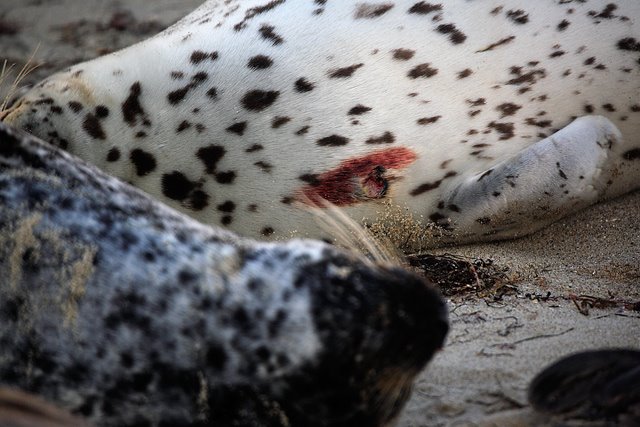
I photographed one seal injury that I saw while I was shooting.
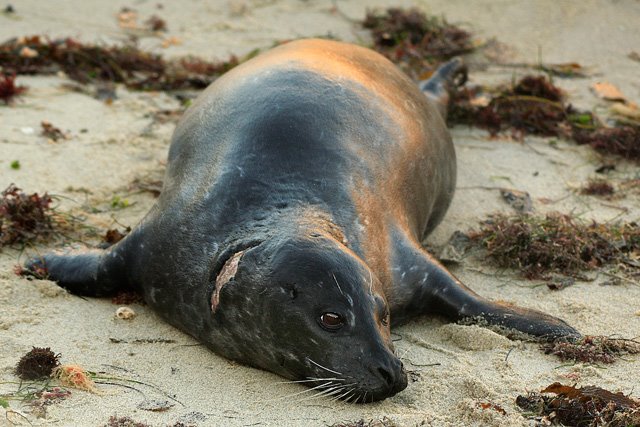
But when I scanned my shots back at the RV, I noted another injured seal. While this is a normal resting position for a seal (especially after bouncing up from the sea), this injury may be slowing him down. Whether a cut from hauling himself up over sharp rocks or an injury from another animal or hazards in the sea, he'll probably have to heal on his own. Just as life can be rough for humans and their situations, life is rough in the wild, also.
On one of my other visits I find that these seals are controversial. La Jolla Friends of the Seals stations people to help protect and provide information about the seals. Unfortunately, there are those who begrudge these animals their place in the sand. It turns out that the seawall was built in 1931 to provide a pool for children to play in. The wall encouraged the beach to grow, and was modified after a drowning occurred. The sand filled in the pool. It is my belief that the majority of people enjoy the close proximity of the seal rookery with its opportunity to watch both adults and baby seals. Certainly, the seals and other marine life at La Jolla Cove bring many tourists with their dollars to benefit the economy of this area. And there are other much larger beaches nearby for humans. It is sad to know that a few individuals come on a regular basis to harass the seals (a federal offense) in hopes of getting them to find another place to rest.
While sad about the seal issues, I enjoy each of my visits to this area. I am fortunate to come back two other evenings with a different camera set up to try to capture the ocean waves in an artistic fashion. While I have not had time to process very many of the shots, I am pleased with the results. Some will be entered in the major competitions I enter each year. I am hopeful.
La Jolla - the Seals
On our first pass through San Diego, my sister-in-law, Martha showed me La Jolla cove and the seals. Naturally I was dying to come back with my camera and big lens. After we get settled into our new campground. I dig out my 300-800mm lens with its big tripod. Henry is going to stay at the RV to do his mental preparations for the con. I say a mental prayer that God will help me find a parking spot close to my destination (lots of people go watch both the seals and sunset here - parking is VERY limited!). With the weight of the camera equipment, I COULD carry it several blocks, but it would not be my first choice. When I get there, God is VERY good, I find a place right next to the viewing area for the seals. One of the tricks for parking around the La Jolla ocean front is similar to finding a parking spot at a mall. Watch for the people who are walking to their cars to leave or who are packing their stuff back into their cars. Put on your blinker and wait for the spot. This seems to be commonplace and the drivers behind you are prepared for it.
So I lug my lens in its case and the big tripod over to the small seawall to the best viewing area. The walkway is narrow, but there IS room if I put two of the tripod legs through the railing.

When the seals haul out, they ride the waves as far as possible and then bounce into their resting spot.

They go bounce, bounce, bounce . . .
collapse on the sand, catch their breath and go bounce, bounce, bounce into their spot. It reminds me of when I climb a big long hill or a tall flight of stairs - I have to stop and rest before I can go on. As they are bouncing, their bodies contract such that they look a little bit like bouncing balls. My goal was to try to capture some of this "action."
I enjoy watching the strategy of the seals as they choose the rock or the beach as their destination. They'll ride a wave, head back out and ride a bigger wave - using the wave's energy to get them where they want to be. My big lens is giving me a close view.
The seals use this area as a resting place and a rookery. They need so much time each day out of the water resting either

on the sand

or rocks.
To get these shots I'm using my big SIgma lens. I am a traffic hazard on the narrow seawall, blocking the foot traffic just a little. People have to ask me to readjust the lens positioning so they can get around me. They don't seem to mind and I certainly don't begrudge the time it takes to move out of the way. I'm planning to spend a couple of hours here enjoying the seals.
As sunset approaches, the number of seals coming in has diminished. So I reposition my lens to try to capture the wave action on the rocks.
So I lug my lens in its case and the big tripod over to the small seawall to the best viewing area. The walkway is narrow, but there IS room if I put two of the tripod legs through the railing.
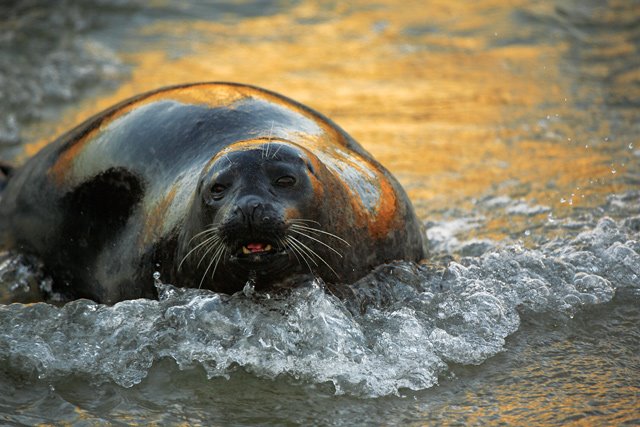
When the seals haul out, they ride the waves as far as possible and then bounce into their resting spot.
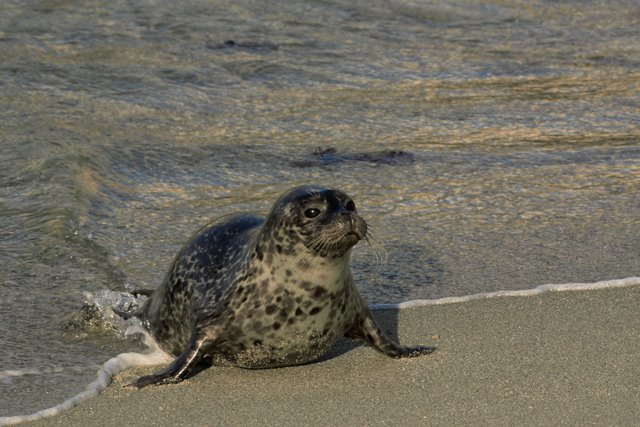
They go bounce, bounce, bounce . . .
collapse on the sand, catch their breath and go bounce, bounce, bounce into their spot. It reminds me of when I climb a big long hill or a tall flight of stairs - I have to stop and rest before I can go on. As they are bouncing, their bodies contract such that they look a little bit like bouncing balls. My goal was to try to capture some of this "action."
I enjoy watching the strategy of the seals as they choose the rock or the beach as their destination. They'll ride a wave, head back out and ride a bigger wave - using the wave's energy to get them where they want to be. My big lens is giving me a close view.
The seals use this area as a resting place and a rookery. They need so much time each day out of the water resting either

on the sand
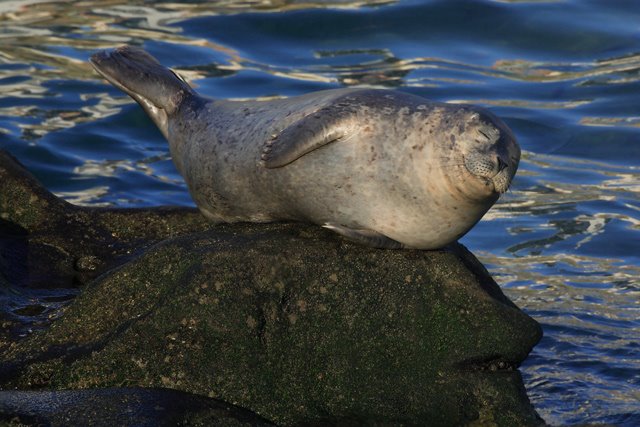
or rocks.
To get these shots I'm using my big SIgma lens. I am a traffic hazard on the narrow seawall, blocking the foot traffic just a little. People have to ask me to readjust the lens positioning so they can get around me. They don't seem to mind and I certainly don't begrudge the time it takes to move out of the way. I'm planning to spend a couple of hours here enjoying the seals.
As sunset approaches, the number of seals coming in has diminished. So I reposition my lens to try to capture the wave action on the rocks.
Friday, June 30, 2006
Moving Day
Sometimes, I sneak up on an event. Life can be uncertain, and we've had trips we planned that either did not happen or did not happen as we planned. This year life has been more difficult to predict - what with Henry's dad's ill health, my daughter's wedding, etc. So, for several reasons, I had not actually booked our accommodations for the convention. Sometimes, we leave our RV and stay at the convention hotel. Sometimes, we park the RV at the hotel. Sometimes we stay at an RV park and commute. Our next event is Westercon over the fourth of July weekend. Organized people would have made sure they had reservations. Campland on the Bay was booked up over the fourth from the first part of our stay. I was hoping for a cancellation. But after we arrived for our stay I realized that was unlikely so I called around and ended up booking us at an RV park supposedly in El Cajon.
As it became time to leave Campland, I found I had mixed emotions. I'm sure it was a zoo over the fourth - tons of people, packed - it is a popular place. But we spent 9 nights there - it had become a little like home. Our second spot had us overlooking one of the "parks". This was a very family oriented campground - lots of people of various income levels - tents to high end RV's. I enjoyed watching the families having fun together. Plus we were right next to the bay, close driving distance to the ocean.
Our new campground turned out to be 25 or so miles east - I think I saw an elevation marker of 1000 feet on the highway on the way here. Need I say - it is HOT during the day here. It is a much smaller and quieter place. Note to self: when they warn you about ants: BELIEVE THEM! Henry has done a commendable job putting the comet around the tires. We never got the Vaseline for the electric cord - we probably should have. He has sprayed every ant trail both inside and outside the RV. I sleep most of the night without ants crawling on me. At least they are not the dreaded fire ants!
As it became time to leave Campland, I found I had mixed emotions. I'm sure it was a zoo over the fourth - tons of people, packed - it is a popular place. But we spent 9 nights there - it had become a little like home. Our second spot had us overlooking one of the "parks". This was a very family oriented campground - lots of people of various income levels - tents to high end RV's. I enjoyed watching the families having fun together. Plus we were right next to the bay, close driving distance to the ocean.
Our new campground turned out to be 25 or so miles east - I think I saw an elevation marker of 1000 feet on the highway on the way here. Need I say - it is HOT during the day here. It is a much smaller and quieter place. Note to self: when they warn you about ants: BELIEVE THEM! Henry has done a commendable job putting the comet around the tires. We never got the Vaseline for the electric cord - we probably should have. He has sprayed every ant trail both inside and outside the RV. I sleep most of the night without ants crawling on me. At least they are not the dreaded fire ants!
Thursday, June 29, 2006
Wisdom
We went to one of the "restaurants" at the park for lunch. The day was hot, not much breeze going through the seating area. A lady across from us was being treated for heat exhaustion - first by her husband, later by the park medic. The rangers came to check on the situation. We watched them box her lunch and she was taken in the medic's vehicle for further treatment. We were doing OK . . . . . we were drinking lots of water, we had our hats . . . . but we knew we were tired, we knew we were underpowered . . . yes, it was HOT - Texas hot. We had gotten a feel for what the Wildlife park was like. I genuinely hope to come back. Future ideas - bring the RV - escape during the heat of the day to the air conditioning, nap, and return for the late afternoon and evening happenings at the park. The photography trip and the overnight at the park are on my list. But this time, the wise thing was that we had seen the highlights. Tomorrow was moving day, and Saturday was the convention. We walked through the aviary near the exit and called it a day.
Zoos vs Wildlife refuges
I've gone to the raptor programs at the Arizona Desert Museum in Tucson. These are educational in showing the birds in their native terrain doing natural behaviors. Each bird had probably 10 minutes to demonstrate what he could do. The show here at the Wild Animal Park started with a series of birds - some exotic, some native, running full speed through the "stage" area. Our hostess was a knowledgeable lady, but there was definitely a show-biz feel.

I thoroughly enjoyed the flight of the peregrin falcon (I've photographed them elsewhere at raptor programs), the macaws, the incredible parrot mimic and the other birds in the show. And on another day, I might plan to go to all the shows to see the different birds that perform each time. But it definitely had more of a feel of a performance -staged area, large stadium seating, even a trained mouse running behind the hostess done with humor as its goal.
I really want to praise the San Diego zoo. It is truly a world class facility. It has the research and medical personel, buildings, and equipment to save species on the brink of extinction. My first view of a condor was at this zoo. It is still a great place to take your children for them to experience animals whose natural homes are far across the sea. I really appreciate the conservation emphasis and education throughout the park. But it does have the feel of a theme park - like Sea World or Six Flags with animals as the theme.
Henry and I have been visiting both national parks and national wildlife refuges over the last few years. Seeing wild animals in their natural environment, learning when and where to find them, rising at dawn on bitter cold mornings, and staying out till sunset, have definitely spoiled us. Because of some types of wildlife shots, I still plan to visit the zoos both in the Texas area and elsewhere. I've gotten wonderful hummingbird shots and raptor shots at the Desert museum. But the thrill of catching a glimpse of an animal showing up where you expected it to be is a much more profound experience than seeing an animal in a realistic confined area. Children usually do not have the patience to wait for the animals in the wild - the zoo is great for them. But, I'll keep heading out the wildlife refuges, knowing that zoo photography is challenging in its own way, just as is finding animals in the wild in photogenic locations and lighting.

I thoroughly enjoyed the flight of the peregrin falcon (I've photographed them elsewhere at raptor programs), the macaws, the incredible parrot mimic and the other birds in the show. And on another day, I might plan to go to all the shows to see the different birds that perform each time. But it definitely had more of a feel of a performance -staged area, large stadium seating, even a trained mouse running behind the hostess done with humor as its goal.
I really want to praise the San Diego zoo. It is truly a world class facility. It has the research and medical personel, buildings, and equipment to save species on the brink of extinction. My first view of a condor was at this zoo. It is still a great place to take your children for them to experience animals whose natural homes are far across the sea. I really appreciate the conservation emphasis and education throughout the park. But it does have the feel of a theme park - like Sea World or Six Flags with animals as the theme.
Henry and I have been visiting both national parks and national wildlife refuges over the last few years. Seeing wild animals in their natural environment, learning when and where to find them, rising at dawn on bitter cold mornings, and staying out till sunset, have definitely spoiled us. Because of some types of wildlife shots, I still plan to visit the zoos both in the Texas area and elsewhere. I've gotten wonderful hummingbird shots and raptor shots at the Desert museum. But the thrill of catching a glimpse of an animal showing up where you expected it to be is a much more profound experience than seeing an animal in a realistic confined area. Children usually do not have the patience to wait for the animals in the wild - the zoo is great for them. But, I'll keep heading out the wildlife refuges, knowing that zoo photography is challenging in its own way, just as is finding animals in the wild in photogenic locations and lighting.
The Gorillas
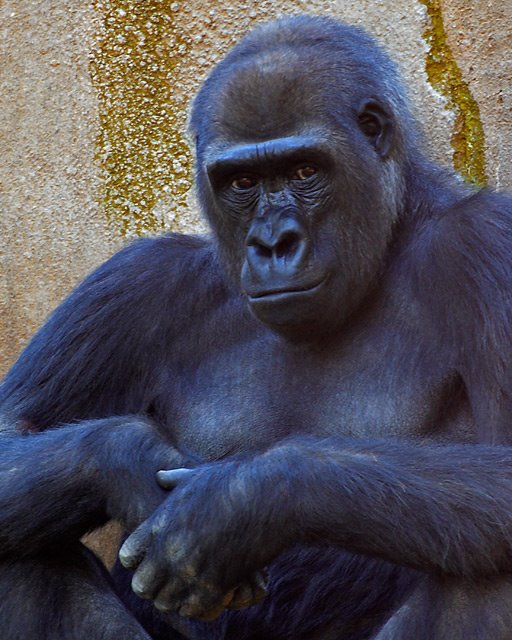
I could tell that while the zoo would be open until 9:00 p.m. Henry and I were not going to make it for an entire day. The gorillas were my next stop. To my delight, I found an open space - NO GLASS where I could sit, observe, and photograph. This exhibit was the highlight of my day. Once again the value of patient observation paid off. At first, the gorillas that were out, sat conspicuously with their backs toward us. Polite behavior-gorilla style. It is a social no-no among gorillas to stare. I had my camera with my 100-400 lens set up on the tripod. Yes, I had to dodge groups of day camps and child care facilities that would stand right in front of me. But I began to have a feel for what to look for.
There were two "caves" and several gorillas would come and go. Two silverback males came out. I waited, watched, and hoped for photographic opportunities. They came. A female came and sat within my photographic range - shaded, no major light issues. I got a few profile shots where I will attempt to combine two shots so that both the background has detail and the gorilla has detail, one of the problems of shooting at mid-day with full sun and shadows.
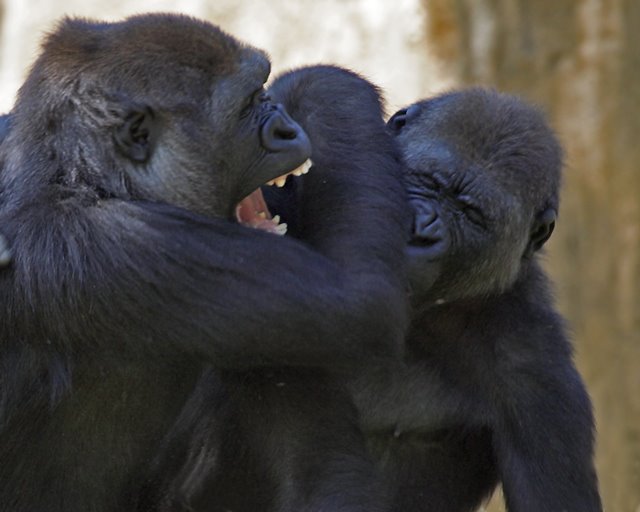
Then the fun really began! Two young gorillas began a wrestling match! What a joy to watch as they chased each other, leg wrestled, mock bit each other. These are the kind of action shots that I see that win and place in the major contests. Due to the lighting, I was shooting with a higher ISO than is my first choice. But my initial screening gives me hope that I have some useable shots. I stayed until it was time for the bird show.
San Diego Wildlife Park
Never having made it to the larger San Diego Wild Animal Park - it was on my list. It was Henry's last day of freedom before moving day and his final preparations for the con. I gave him every opportunity to back out, but he was interested. I definitely debated leaving the camera gear behind and just going out to enjoy the park. Wisely, Henry encouraged me to go ahead and bring it. He started the day carrying my tripod. I'm trying very hard to carry my own gear - even the heavy lens and tripod. I do go out on excursions without Henry - I need to be able to manipulate my own equipment. By making it a practice to carry my own stuff around, I feel like I am building endurance for those days when I have to hike and haul it.
The Wildlife Park is 25-30 miles north of San Diego - off I-15. We left earlier than the day before, but it is far enough from the coast that it was already hot. Walking on concrete walkways the day before left my calves stiff and uncooperative.
I headed us toward the Wgasa Bush Line Railway system. Well, it looks like a rail, but there is only one rail - like those car rides that you "control", but it keeps you on the track. Thankfully there was not a long line and we got on quickly. As I read the literature, I had noted that you can Sleepover at the zoo.
We passed close to the safari tents - yes, they appealed to me. Yes they are tents, but they have decent enough looking beds. The sitting area around the tents overlooks the large animal enclosures. You would go to bed and wake up hearing these magnificent animals. Because of the proximity of the Kilimanjaro Safari walk, I'm wondering if you are allowed to take the walk in the early morning when the animals are more active. As we went around the park on the rail - I could see the tracks where the Photo Caravan Safari takes you. That also would be on my list if I get to come back. While you are standing the entire time, you are actually with the animals. Some great photo opportunities!

This photo is an overview from the rail. You can see the safari tents in the distance and the track for the Photo Caravan Safari. I enjoyed the train ride, but the large paddocks seem to be in the process of being redone. Some areas had large areas of bare dirt that was being shaped for future grass. They told us that they are also redoing the routing of the "train." We were on the original track. They are expanding it into two routes and will eventually pull up the rail route we were on.
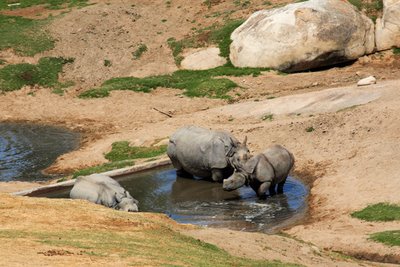
It was impressive to see a number of rhinos soaking themselves in their ponds. They are planning to preserve the California wildlands and native grasses and trees on the hills - so there is probably a limited amount of future development for more large enclosures. We were too far away from most of the large animals - and the animals we passed more closely were more in fenced enclosures. Not great for photography.
The brochures and signs touted this open area as a trip to Africa. Hum . . . . yes, the animals are right, but the vegetation and terrain don't match my inner view of Africa. With friends living in Africa right now, a real visit to Africa (Zambia to be precise) is in my dreaming process. With God's provision, I hope to make it there sometime in the next couple of years - both to teach ladies' Bible class (with a translator) and to take some genuine African wildlife photos.
The Wildlife Park is 25-30 miles north of San Diego - off I-15. We left earlier than the day before, but it is far enough from the coast that it was already hot. Walking on concrete walkways the day before left my calves stiff and uncooperative.
I headed us toward the Wgasa Bush Line Railway system. Well, it looks like a rail, but there is only one rail - like those car rides that you "control", but it keeps you on the track. Thankfully there was not a long line and we got on quickly. As I read the literature, I had noted that you can Sleepover at the zoo.
We passed close to the safari tents - yes, they appealed to me. Yes they are tents, but they have decent enough looking beds. The sitting area around the tents overlooks the large animal enclosures. You would go to bed and wake up hearing these magnificent animals. Because of the proximity of the Kilimanjaro Safari walk, I'm wondering if you are allowed to take the walk in the early morning when the animals are more active. As we went around the park on the rail - I could see the tracks where the Photo Caravan Safari takes you. That also would be on my list if I get to come back. While you are standing the entire time, you are actually with the animals. Some great photo opportunities!
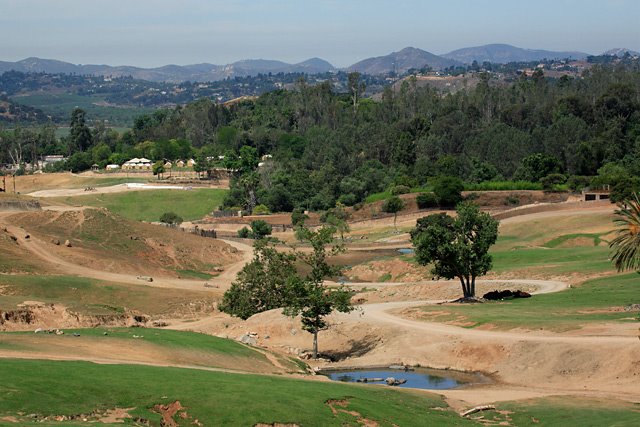
This photo is an overview from the rail. You can see the safari tents in the distance and the track for the Photo Caravan Safari. I enjoyed the train ride, but the large paddocks seem to be in the process of being redone. Some areas had large areas of bare dirt that was being shaped for future grass. They told us that they are also redoing the routing of the "train." We were on the original track. They are expanding it into two routes and will eventually pull up the rail route we were on.

It was impressive to see a number of rhinos soaking themselves in their ponds. They are planning to preserve the California wildlands and native grasses and trees on the hills - so there is probably a limited amount of future development for more large enclosures. We were too far away from most of the large animals - and the animals we passed more closely were more in fenced enclosures. Not great for photography.
The brochures and signs touted this open area as a trip to Africa. Hum . . . . yes, the animals are right, but the vegetation and terrain don't match my inner view of Africa. With friends living in Africa right now, a real visit to Africa (Zambia to be precise) is in my dreaming process. With God's provision, I hope to make it there sometime in the next couple of years - both to teach ladies' Bible class (with a translator) and to take some genuine African wildlife photos.
Wednesday, June 28, 2006
Koalas - and other Australian marsupials
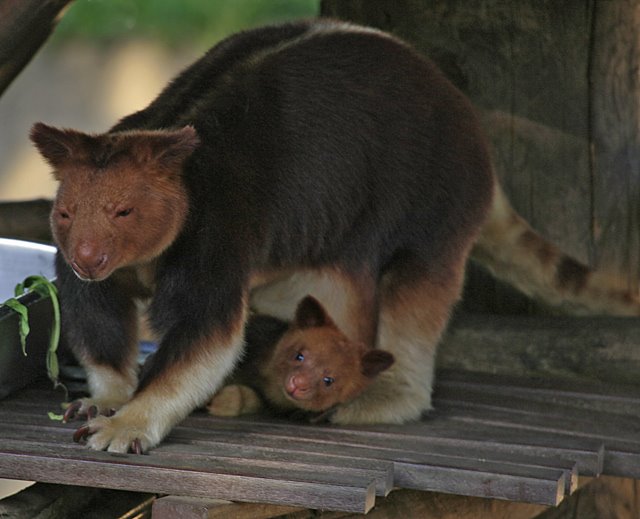
When I brought Thomas to this zoo as a small child, San Diego was the only place to see Koala bears. I remember seeing one - in his tree sound asleep. The breeding program must be working well. There were four sleeping koalas in their trees and four more sleeping on treelike platforms behind glass. There was also a ever so cute marsupial with her baby looking out of his pouch. The setting and background will prevent this photo from winning a prize . . . but the shots are keepers - CUTE baby!
The bus guide told us that koalas sleep all day because their primary food, eucalyptus leaves are toxic. They need to rest to be able to tolerate the toxins. Hum . . . . . I'm having trouble getting my brain wrapped around the idea that the only thing they eat is also poisonous. Once again, I'm hanging around, this time not only because I'm tired and moving isn't fun, but because I'm interested in the animals here. I'm rewarded when one of the outdoor koalas rouses and begins to forage on the convenient eucalyptus leaves around him. A faint familiar eucalyptus aroma brushes the air.

I'm even lucky enough to catch a shot of one of the indoor koalas in the one second his eyes are open. Background - what background - it is a beige wall - he is on a platform - nothing natural. Maybe someday, I'll attempt a digital art piece with this shot of a koala that appears awake and alert.
The Polar Bears

Our legs were getting tired and sore. (yes . . . I've said that before - forgive the whining - sometimes I don't think we act grown up when we are hot, tired and sore.) The camera equipment felt like it had gained 30 pounds. But we kept going. Back at the bottom we waited for our first express bus ride back up.
I noticed a blue heron - certainly a visitor to the zoo, also - in a favorable spot to photograph. One of the shots of him is one of the best of the day. Our next stop was near a dipping dots salesman. Super cold, especially delicious, they provided energy to walk slightly up hill to the polar bears.
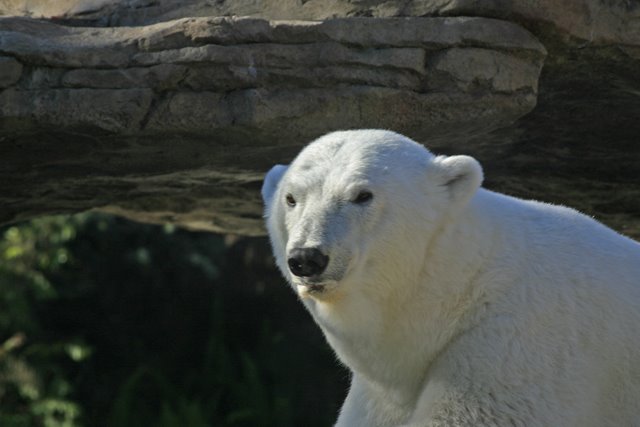
Earlier in the day we had seen two of the polar bears from the bus - frolicking in the water. By late afternoon, one of them was sound asleep by the wall - our vantage point showed us his huge feet. But I did get a few shots from his buddy. But I had just moved my camera, when the hidden treat was found. Not great shots, but better than some others during the day.
Decision time - climb up the short hill to catch the bus - or go down the longer way. Down - no brainer.
The Hippo
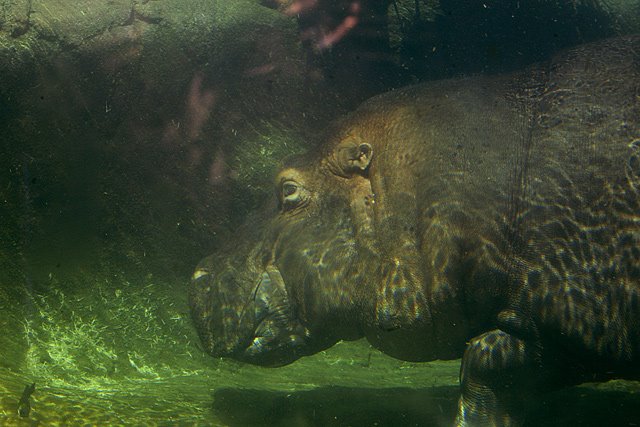
I knew that coming from Hutto, Texas, home of the Hutto Hippos, that my trip to the zoo would be incomplete without seeing the hippos. We had found the cute pygmy hippos. But I wanted to see the full sized ones. I was not confident that I would get a great hippo shot, but I knew I wanted to see them. The hippos have a nice glassed viewing area. But what is special is that you can view the hippo underwater. Now, being tired, we sat and watched the hippo - certainly not his most attractive end . . . . He was asleep, non moving. But the advantages of hanging around an animal worked in our favor. Without warning, he turned around, and swam off to the other end of his pond. This was a marvel to behold. He makes his way through the water like a giant blimp - half walk, half swim, fully submerged locomotion. His movement was remarkably graceful - a slow motion dance. We were lucky enough to watch him sail through the water twice. Didn't I say we were tired . . . . . we hung around a little longer and were rewarded as he hauled himself out of the water. When the hippo is resting with only the top of his head out of the water, you really don't get the full image of how huge he is. When he was totally out of the water, he is a huge rolly polly blob. However, knowing my hippo triva, while he was moving slowly and cumbersomely today, I know that he is actually capable of fast locomotion on ground. These gentle looking giants can be quite fierce. And, amazingly, my underwater-through the glass shot came out better than I expected.
The Aviary

We went through several of the aviaries. They are lovely places to spend time, complete with waterfalls and RAIN! I was in place to take some bird shots when to my surprise the rain came! My first thought was that it would be quick, but then I realized here was my expensive camera in a full rain! I stepped back. But I did manage an interesting bird shot with real rain for an effect.

It was afternoon, still hot, and we were tired. So we spent some time in one of the aviaries. I noticed that most people stroll through, glance around, and leave. While you do see some of the birds that way, I have found that if you linger, standing or sitting quietly, the birds come out and reveal themselves. Some come out of curiosity, to check you out. Others are just doing their bird thing, looking for dinner. Spending time just waiting will reward you with birds you might not have seen. I even got to see the birds "find" the dead mice left for their dinner.
My photography did not seem to be going well. In the aviary, the lighting differences from the sunlit areas to the shadow were too much for the digital camera's range. My goal was not memory snapshots of the zoo animals, rather competitive artistic shots. My gut feel was that I should shift my mental goal from getting great award winning shots to just enjoying my visit to the zoo.
The Baby Flamingos
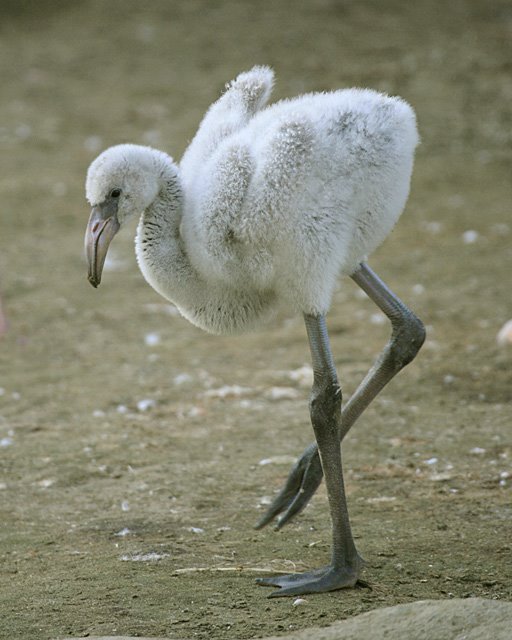
One of my first stops was to check out the baby flamingos. I had never seen these before. I was most surprised when I saw one of these white fully creatures SWIM over the deeper water and then wade onto the bank. I am more familiar with herons, egrets, and cranes. They have wading feet with three large toes. I had always assumed that flamingos with their long legs were wading creatures. But after watching this swimming baby, I took note of the flamingo feet - they're WEBBED! Now I still believe flamingos spend more time wading than swimming with those incredibly long legs. But I think I'm going to do some research, because the babies certainly swim. Of course, early afternoon sun was too bright for great white fluffy flamingo baby shots.
After stopping for lunch, I was now going out to explore at the worst time of day for photography, a recipe for frustration. We headed for the primates. It was fun to watch the mom's and babies. But besides the lighting issues, glass and wire enclosures made photography futile.

One of my last stops when we left for the day was to check out the baby flamingos again. MUCH better lighting.
San Diego Zoo - Starting the Day
I had learned from my first visit to the San Diego Zoo twenty years ago that a ride on the bus tour is the best place to start. This zoo is a large zoo built on hills. Even able-bodied people need to use strategy to most efficiently explore this place. They have escalators and an express bus that will take you from the bottom of the central valley back up to the top. The goal is to walk down and ride up. Plus the bus gives you an overview of what the zoo has, where the different animals are, and how to get to the areas you are most interested in. We were lucky - the size of the waiting area tells me that sometimes one has a long wait. Our wait was short. The buses are double deckers with the outside viewing on top. Naturally I wanted to be on the top for a better view. The waiting area for the outside is a little deceptive - there is another waiting area above - so once you get to climb the stairs you have one more wait. The buses arrive fairly quickly - maybe 5-15 minutes apart.
The seats on the top of the bus were tight quarters for full sized people loaded with tripod, camera vest, camera with long lens, etc. But we managed. While we were waiting, I cleaned the outside of my lens - something I am doing regularly these days in the futile hope of preventing dust spots and fuzz in my shots. The only photo I was tempted to take on the ride was when we passed the giraffes. The lens would not focus . ..it was cloudy . . . I thought it was the young boy. But I kept checking and he really was not in the frame. Hum . . . . . I looked at the lens. ARGHHHHH! There was condensation on the INSIDE of the lens. Visions of a frustrating day immediately ran through my mind. Thankfully, Henry noted that it WAS diminishing. By the time we were off the bus, my lens was still clean and the condensation was gone. Now to begin our exploration!
The seats on the top of the bus were tight quarters for full sized people loaded with tripod, camera vest, camera with long lens, etc. But we managed. While we were waiting, I cleaned the outside of my lens - something I am doing regularly these days in the futile hope of preventing dust spots and fuzz in my shots. The only photo I was tempted to take on the ride was when we passed the giraffes. The lens would not focus . ..it was cloudy . . . I thought it was the young boy. But I kept checking and he really was not in the frame. Hum . . . . . I looked at the lens. ARGHHHHH! There was condensation on the INSIDE of the lens. Visions of a frustrating day immediately ran through my mind. Thankfully, Henry noted that it WAS diminishing. By the time we were off the bus, my lens was still clean and the condensation was gone. Now to begin our exploration!
Subscribe to:
Posts (Atom)