Saturday, February 04, 2006

Winter Solitude

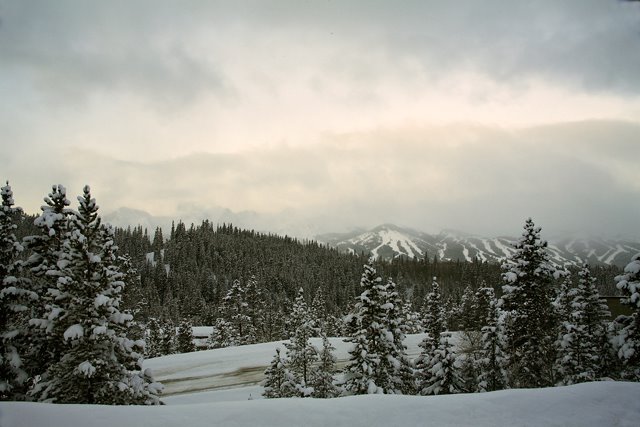
We left Breckenridge on Wednesday. After staying five weeks at the condo, there was much to pack up and load back into the car. And a doctor's call sent me to his office to get my shoulder checked before we could leave - one more thing to slow us down. But we did get off - and headed toward the western side of Rocky Mountain National Park. Instead of taking the fast paced, stressful I-70, we headed north out of Frisco and went through Kremling - leaving the populated areas of Dillon, Silverthorne, Frisco, and Breckenridge behind. It was snowing on our first pass through Rocky Mountain National Park. The highest peaks were hiding behind snow clouds. As we headed out of the park, we passed an area where the snowmobile trail paralleled the road complete with snowmobilers sharing the road with us. We found a hotel in Grand Lake Village - a small rustic town. I almost think that at this time of year the snowmobiles outnumber the cars - as there were snowmobiles to rent EVERYWHERE. It turns out there is a large trail system in the national forest just north of town. You could probably spend days exploring all of them. Grand Lake is obviously doing well financially based upon the well kept building and upscale souvenir shots, but this is not their big season. Our first search for restaurants found many of them "closed." We settled for the restaurant across the street from our hotel, Bear's Den & Paws Pub. The trout almondine was good and we ate there a couple of times during our stay.

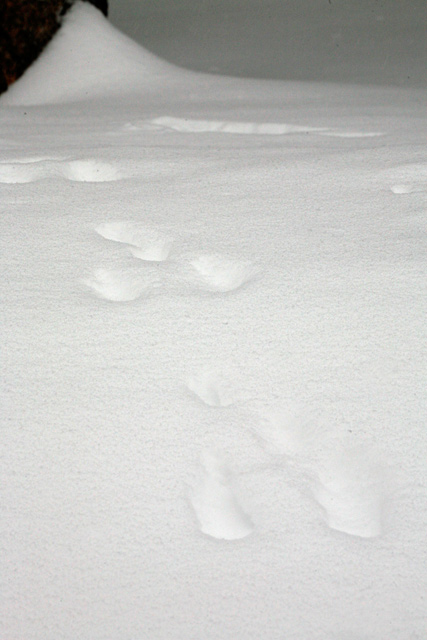
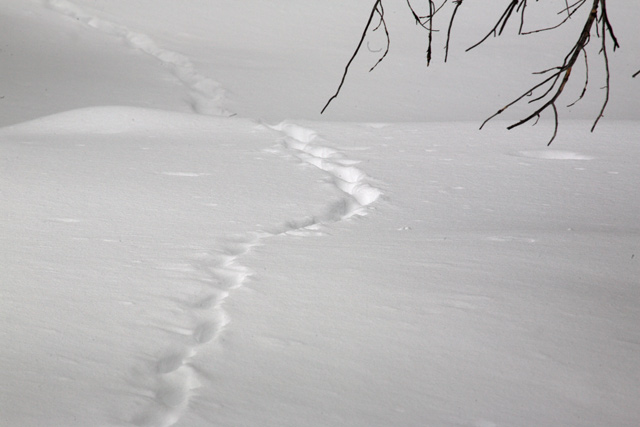
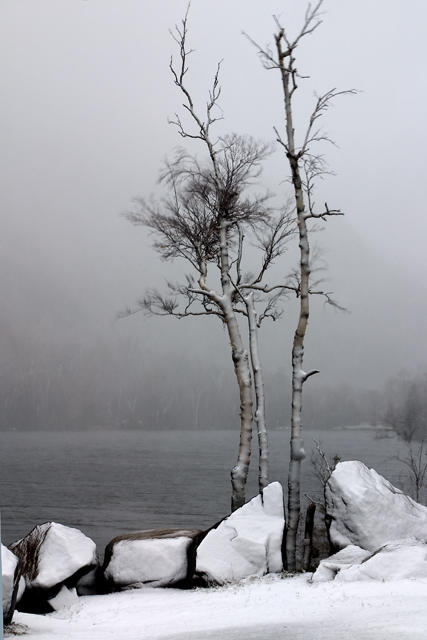
It was snowing when we went to bed, and I was looking forward to getting out at dawn, hoping for a colorful mountain sunrise. We got out early and were the first ones to make tracks on the snow in the park - that is, the first human tracks . . . . . Over the next few days we had a lot of fun studying the animal tracks in the snow. The west side of the park gets much more snow and moisture than the eastern side. As a result, the snows are deeper in the winter, and many of the parks animal residents either hibernate or move down below to winter. Birds were few and far between - I think I saw only three or four during the days we were there. Our most common animal siting were the moose that frequented the road.


However, there were lots of animal tracks. Snowshoe hare was the most common,


followed by the moose that crashed through the snowberms along the road.


But we also saw some smaller tracks that were harder for us to identify.


We saw one series that were most likely coyote, complete with a trail "marker".


We saw tracks that were probably weasels and squirrels. I decided that it would be fun to photograph the tracks perhaps to identify later.

While there were a few people driving through, snowshoeing, or cross country skiing, Henry and I pretty much had the park to ourselves. We could hear the wind whistling through the trees, watch the snow devils across the frozen beaver swamps, and enjoy the falling snow.

Monday, January 30, 2006

The Dipper Revisited

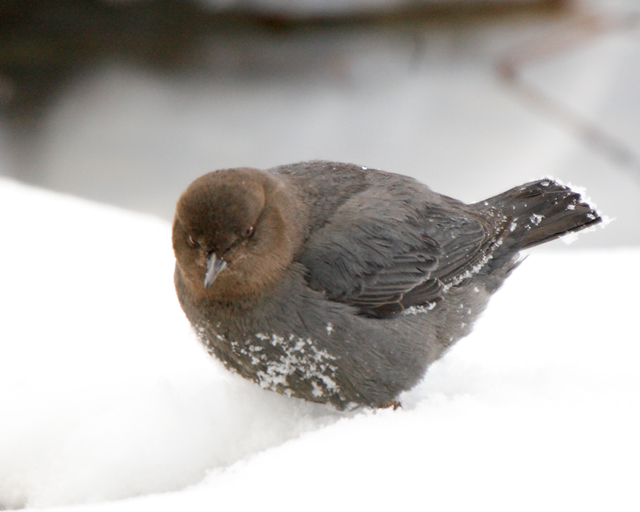
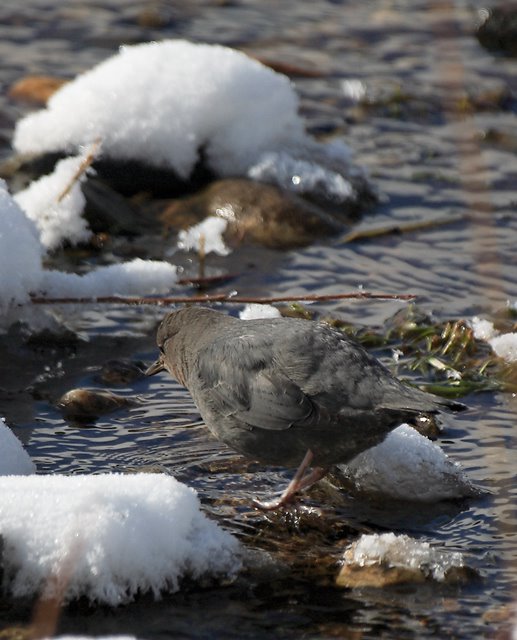
Visiting the different wildlife refuges, we have learned that often you will see certain birds (or other animals) at the same area each time you visit or make the "rounds." Once we found the spot in the creek where the dipper was feeding, we saw him regularly there. And of course, we kept going back both to enjoy watching him and for me to try to get that award winning photo. The weather in Breckenridge this year was cold and snowy. I kept hoping for a day that would have just the right combination of sun angle or high light clouds. I wanted photos of the dipper with enough lighting for a sharp, crisp photo and with the lighting at my back so I was not shooting into the sun and fighting the silhouette effect. I had one more chance with better lighting. I put my teleconverter on and spent probably an hour moving upstream with the dipper. While these are not "prize winning" or commercial quality shots, I am pleased, because I got a set of intimate shots of a very shy creature. Plus I got the enjoyment of watching his antics. I was so surprised to see him disappear underneath the ice at the edges of the water. I even saw him go under an ice bridge and surface on the other side. Because I spent so many days watching and observing, I feel an affinity with this individual dipper. I find myself searching other icy creek beds hoping for a glimpse of another dipper.

Friday, January 20, 2006

Four Degress (Fahrenheit) Sunrise

We've had a lot of snow over the past several weeks. I've been checking the forecast to see if it is worth while to get up at sunrise and get out. Today looks promising. I wake up around 6:00 - check the sky - I can see stars . . . . a good sign. I check the temperature - 4 degrees - that's pretty cold.

Because of my arm, Henry is going out with me - I can manipulate the camera and the smaller tripod, but if I need my big lens and heavy tripod, I need help. So we throw our clothes - tons of layers for me, not so many for Henry - he just sits in the car working on his writing. For me, one layer of thermal underwear, wool socks, one long sleeved T-shirt, wool sweater, ski pants, wool hat, fancy mittens that allow my hand to stay warm, but have my fingers available to work with the camera, and my ski jacket. I wait until the last minute to put on the sweater and coat - too hot inside otherwise. And on my shoes go my YAKTRAX - a product that I just love. It is like little chains for my shoes. I don't slip anymore!

Next decision - where to go? I head for an overlook that has been productive recently. The sun is not up yet and the clouds over the mountains show promise for a spectacular sunrise. Only issue is there are also clouds to the east that may obscure the first light.


There it is - the first light on the mountain, but it is off in the distance, not lighting the clouds I had hoped for. Too far away and not bright enough for the magic I'm hoping for. Decision time . . . Yes, I'm going to move where I can be closer to the mountain peaks that are getting the sun.


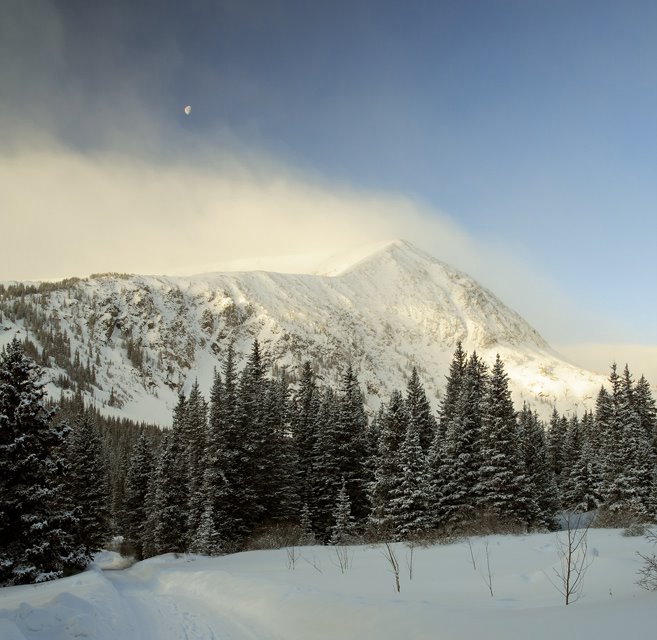
So we head over to Hoosier Pass and I am hoping to still catch that early lighting. We get as far as Quandry Peak - yes, I like that blowing snow.

With two feet of snow in just the last few days, there is a lot of powder for the wind to blow. Sun looks good on it, too.

When we get to the top of the pass, I know it is going to be a good morning. Trees laden with snow, interesting weather on the peaks, the wind whipping up the fresh powder snow. Yes, it is cold, but, oh, how exciting and rewarding.

Thursday, January 19, 2006

The Dipper


Back when we were camping in our truck camper with the kids above Silverton, Colorado, we saw our first dipper.


We saw this cute bird that kept submerging himself in the icy cold, rushing waters of South Mineral Creek, jumping from rock to rock inbetween. He was easy to identify as a "dipper."

I've been trying to find good photographic spots around Breckenridge. (Yes, I know all of Breckenridge is scenic, but I've been trying to find magic, undiscovered places.)

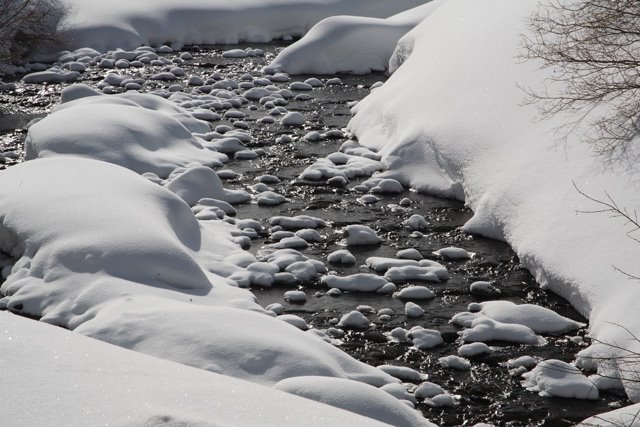
I went up a road called Tiger Run and had found a creek that has areas with running, unfrozen water.


I'd been intrigued by the areas with running water surrounding rocks with caps of snow.


We've startled a beaver and watched him quickly dive out of site. One morning there was a mallard couple swimming and foraging. And we've consistently seen a dipper in this area.


I've had opportunites on three different days to photograph the dipper that frequents this area. None of the photos are competition quality. But I've had more fun watching. The first day he spent a lot of time running along the ice along the edge of the creek.


I had a lot of fun watching him fish one day. At the base of a beaver dam, I watched him catch a small fingerling trout. He bounced it on the ice until it quit wriggling and then swallowed it whole.


It is fun to watch him hop out of the water after he has been foraging on the bottom. Sure looks cold to me!

Today I watched him flip rocks searching for food underneath them. The fun ended when another dipper flew in. My dipper chirped and began to chase the intruder away. I saw him land some distance upstream. The visibility for viewing is not as good there. So I gave up for the day.

Because we know this dipper feeds here regularly, I will come by regularly in hopes that one day I'll get the right lighting, a good photogenic position, and perhaps even the catching of a fish! Whether I ever get an award winning photo of this cute creature, I get a lot of enjoyment spotting him and observing him.

Saturday, January 14, 2006

Falling

I really love winter. I love snow and icicles and cold weather. I like walking in crunchy snow. I do NOT like walking on ice. There is a reason for this. One year when I was walking home from dinner with Thomas and Stephanie, I fell on a slippery porch on the east side of our River Mountain Condo. My head hit the brick floor with such a thud that the store worker in the stockroom came out to check on me. The kids insisted I go to the emergency room. No concussion, no problems the rest of the trip.

On another trip, Debra and I were walking in downtown Breckenridge - our last window shopping before leaving. My foot slipped out from underneath me and I landed on my back. When I got back to the condo garage, it was hurting bad enough, I started crying. Even though it was time to leave, we headed over to the emergency room. It was snowing out and I was the driver . . . .so he gave me one set of meds to take while driving and another one to take before I went to bed. By the next day it was much better.

On Thursday, we were headed over to a restaurant a couple of blocks from the condo. We've walked this stretch regularly the last few weeks. The parking lot looked like packed snow - which is pretty easy to walk in. The problem - underneath the two to three inches of snow was a layer of ice. When my foot started sliding, I tried to break my fall. But, of course, I landed flat on my back, shoulder hurting. Several people stopped to help, including a policeman. My first choice was to continue on to the restaurant, eat my lunch, and then go to the doctor.

The x-rays showed a possible tiny crack in my shoulder - the right arm just does not work very well. But at least I am not in pain, and each day it seems a little better. But, I suspect my skiing is over for this season.


Henry got me a pair of Yaktrax - like chains only for your shoes. I wore them for the first time today. Definitely better traction in the packed snow.

Do I still love a Colorado winter????? You betcha!

Thursday, January 12, 2006

Catching Up

I had several things I had planned to blog over the last 3 weeks. Things have been busy . . . . . . So I am going back and posting - I should be caught up in a day or so . . . . . . So if you want to follow our adventures, take time to scroll down and catch up on the latest Melton adventures!

Sunday, December 25, 2005

Christmas Day

We woke up and had another small Christmas with Evelyn and Gene. Gene is doing better - so the family has decided to let them have a chance to stay independent.

We leave Amarillo around noon on Christmas Day. We've never travelled on Christmas Day before. While there are gas stations open - restaurants were pretty much all closed. In Amarillo, the only thing open was a sitdown Sushi restaurant. Since we got off around lunchtime for our 8 hour drive to Breckenridge - we got things at the convenience gas station to get us started. The gas stop at Clayton (with so much closed, I was not taking any chances of running out of gas!) provided meaty burritos. And another convenience store in Colorado Springs provided the low carb energy bars that have been a staple on my low-carb diet.

We get to Breckenridge in time to hit another convenience store to have breakfast items - cereal, milk, juice, etc.

Because of Gene's illness, we did not know whether we would make it to Breckenridge this winter. But as we drop into Breckenridge from Hoosier Pass - it feels like we are coming home.

Saturday, December 24, 2005

Christmas Eve

We arrived in Amarillo on the 23rd. When we saw Gene first thing Christmas Eve morning, we knew we were headed to the emergency room. His left eye was swollen like a tennis ball to the point he could not open it. A call to the physician on call led us to the hospital emergency room in case complicated tests were necessary.

The hospital was quiet on Christmas Eve. I went to the coffee shop to get coffee (and hot chocolate for Henry) all around while we waited for Gene to be seen. We were fortunate that the diagnosis was either an allergic reaction or the beginning of shingles. We got in early, were seen quickly, and were ready to leave by the time everyone had drunk their coffee. Definitely a blessing to get Gene back home rather than have another hospital stay at Christmas time.

Our niece, Staci, had a wonderful Christmas party for the whole family. While we have not made a practice of going to Amarillo for Christmas, there is something very special to be surrounded by loving family and friends at Christmas. I will have some good memories from this Christmas.

Thursday, December 22, 2005

Christmas Cards on the Road

We only stayed in the Austin area a few days. We went by the Hubbard Museum of the American West to see my photos that made the exhibit. Then we spent four days at Bosque del Apache. We explored three other lesser known wildlife refuges in New Mexico.

But I knew that it was time to get the Christmas cards printed and delivered. I had done the preliminary designs in Amarillo. When we were in Austin we packed up the printer and the extra ink cartridges. One of the evenings at the Bosque I started printed out the cards. But, unfortunately, I ran out of a couple of colors of ink. So the next day at the mid-day break from photography we went back to Socorro where we were spending the night. We drove all around town looking for the office supply store we had located on the web. Turned out it was on the square. It was a cute little store with a little bit of everything. My printer requires 8 different colors of ink. They had two colors - not enough demand to stock all the colors. Naturally they were not the colors I needed. The other small complication in the first print run were some strange yellow spots. ARGHHH! But I did get enough printed to get one batch mailed off in Socorro.


When we drove through Albuquerque, we found the Office Depot near the interstate, and I stocked up. That night in the Comfort Inn in Las Vegas, we hauled all the stuff up the stairs to our room. And began the print process again. This time I was successful in getting all the cards printed and mailed off in Las Vegas.


And, for those that want to know, this Santa is VERY special - my kids know their daddy is the REAL Santa Claus!

Tuesday, December 20, 2005

A Photographer's Winter Morning


Early morning is a special time. Symbolically it is the start of a new day. While I am not a "morning" person, sunrises are worth getting up for. As a photographer, getting to your photographic spot well before dawn is important. Part of the experience is seeing the world turn from a dark, black and white place in a crescendo of brilliant colors. That first hint of glow in the east is a promise of a new beginning. And the sky joyfully gets brighter and brighter until the glory of the sun finally breaks the horizon in a golden burst.

The early morning is also a good time to view animals. We had a chance to go back to Bosque del Apache in New Mexico. In the winter months thousands of snow geese, sandhill cranes, and other water fowl migrate here to spend the winter. Arriving at the refuge before dawn allows one to experience these beautiful creatures' morning rituals.

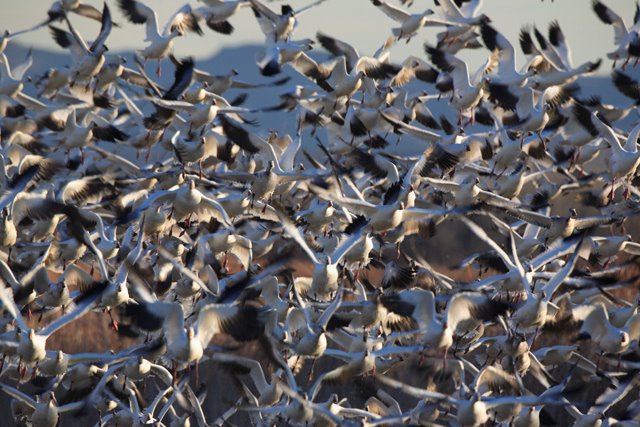
The snow geese stay together in flocks of several thousand. They come and go in a noisy group of powerful, beating wings and loud, honking calls. This year they seemed to make one initial move before dawn filling the sky in the distance with beautiful white graceful V-shaped lines. So our first task each morning was to discover which pond they had chosen. Our first morning was the coldest, the ponds had a layer of ice. We found many of the snow geese asleep on top of the ice. The beautiful golden rays of the rising sun gave them almost a heavenly lighting. It was fun to watch them wake up, go through their morning grooming rituals, and then doze off again, floating in the water with their heads tucked under their wing.


As a photographer, I wanted to capture their incredible take off. I discovered that you do have a few moments warning. Something will startle them, they all begin honking. Sometimes it is a false alarm and they settle back in to splashing and grooming. But other times, that caucophony of sound is the signal, and they all leave the pond at once.


Each day I positioned myself in a different place to try to capture the magic of thousands of birds in close proximity taking to the air at once. I tried slow shutter speeds to catch an artistic blur and I tried faster shutter speeds to get sharp details on each bird.


The sandhill cranes have a total different morning regimen. The frantic flight of the geese leaves them undisturbed. The cranes leave for the feeding grounds in family groups of two to five. They run across the ice or water in order to gain enough momentum for flight.


There are also signs to watch for to be prepared to capture their take off. You will see a group begin to stretch their necks out together in one direction. It is almost as though they have to psyche themselves up. If you are patient and quick with your shutter finger, you can catch them in the act of running and slipping clumsily on the ice before they are finally airborne in an incredible graceful flight. Because so many congregate on the ponds, you have plenty of opportunities to practice your panning and your eye-hand coordination to capture their beauty and grace.

Thursday, December 08, 2005

Independent Living

It is a natural desire to be independent. Two year olds express their indepence as they use the word "NO." High school kids can hardly wait to turn 18 - longing for indepence from their parents. They have to learn that being fully responsible for themselves can be challenging. And they make mistakes-and learn from them, and continue to grow and develop.

When people live long enough, they reach what we sometimes call the "declining years." As a culture we value independence, taking care of ourselves. Especially for people who lived through the depression years, being independent and not needing "help" is an important part of their self-esteem. But old age robs us of many dignities - and independence is one of them. Role reversal is difficult for both generations. For the aging, it is difficult to admit that you don't remember well enough, you don't see well enough, and you don't hear well enough. We have a mental image of ourselves - an idealized one - where we can do everything needed. But sometimes the reality is that age has robbed us of some abilities that we had when we were younger.

For the caregiving generation, it is difficult to know how to handle some things. My mother-in-law, Evelyn, so much wants to be able to do everything herself. And she has always been a capable, hard working individual. But at this period, she is up several times during the night with Gene. It is hard for her to remember all the things that are on the caregiving schedule for Gene. And the schedule is complex - first thing in the morning, blood sugar reading, one pill before breakfast, breakfast, 9 more pills, using the vital signs monitor, something that resembles a bath, shaving, lunch, mid-afternoon pill, supper, after supper pills. Not to mention, getting shoes on his feet, foot massages, keeping the feet propped up, therapeutic exercise, deep breathing, monitoring the fluids he gets during the day, and following a diet restricted by so many physical problems.

My quandry today is how much should I just do the things to keep things optimal for Gene's possible recovery and how much should I step back and see how much Evelyn is actually capable of doing. Are my assumptions incorrect, can she really do more than I think? (They did better using the monitor this morning than I expected - I left them alone to see what would happen.) If I let her do all of it for several days, will she get too tired? I truly don't want to hinder her ability to care for herself in the long run, and yet, I know that the physical care for Gene at this point has the potential to ruin the good health she has now. It would be easier if they were not fretting because they feel like they are imposing on us. It would be easier if they had had more realistic goals concerning their old age. They truly intended to take care of themselves until the very end in their own home without involving their children in their care. A noble goal, but very few people are lucky enough to achieve that.

How do you communicate these issues, how do you help them understand that this is the natural cycle of life, how do you help them come to terms and be fully at peace?

While I was beginning this entry, Evelyn came in. I had a chance (once again) to try to talk with her about some of these issues. We both had tears in our eyes.

Wednesday, December 07, 2005

Routine

Well, we've been here in Amarillo 3 1/2 weeks now. We've settled into a routine that seems to be working. I'm trying to do three meals a day with fresh fruits and vegetables. So far I've been pretty good about sticking with my diet (except for Thanksgiving Day). I weighed at Curves last week and it looks like I've lost 5 lbs since I got here.

I have always believed that every age has its challenges. I remember when my kids were babies - and everyone thinks babies have it so easy - because everything is taken care of for them. But some of my friend's babies had colic - that is NOT easy. Infants get sick and can not tell you where it hurts. Teething is painful and makes them fretful. Learning to walk is also a challlenge- toddlers fall down many times before they get the hang of walking. The twos and fours are times of learning to assert oneself and still learn the discipline of obedience. The school years bring the joys of friendship and the pain of rejection. My kids are now in their young adult years where they are establishing their own patterns for living - which is another set of challenges.

Here with Evelyn and Gene, I'm getting to watch again the frustrations of aging. The other day Gene told me he had some advice for me: "Don't let yourself get old." While we laughed together, the sad reality is that if we are fortunate to live long enough - we WILL get old. There are things we can do along the way to take care of ourselves - like we maintain our cars - diet, exercise, mental exhertion. But there are so many other factors we have no control over - our genetics, accidents, the illnesses we have- that make each person's old age different. My inlaws were active people - when they first bought the lake house, they had a big garden, they took the boat out on the lake, they walked to and from my sister-in-law's house. But with each passing year, activities began to slow down. They walk slower, they don't try to do as much. It is a gradual process.

How will I fare in old age? I'm already telling my daughter some things for her to remember when I get there. I hope that I can maintain a good attitude, minimize the complaining, and be cooperative with what my children think. My inlaws have set a good example - they face each day and take them as they come.

We are in good spirits for the most part. Right now Gene seems to have a good day and then the next day he doesn't seem as well, and then he'll have another good day. Today started out as a "bad" day because he fretted about something over night and did not get much sleep. However, this evening he surprised us big time by coming out on his own to the den where Henry and I were. He spent 30-45 minutes visiting with us out there. He was not even huffing and puffing when he got there. Definitely a count your blessings moment.

Saturday, November 26, 2005

Thanksgiving

I was planning to spend one of the holidays with Henry's family this year - we've always lived far enough away that getting back to Amarillo was difficult. We had the largest gathering of family in a long time, and it was a sweet day. But also bittersweet, because Henry's dad was too sick to come. We have a wonderful family photo, but we were missing two . . . . Henry and his dad. I've thought about using my photoshop skills to take a photo of Gene at the house and try to work it into the shot. And I had meant to take a photo of Henry after he got over to our niece's house - so the lighting and background would be easy. But it has been a difficult choice - do I really want to take photos of Gene at this final stage of his life? Do I really want photos to remind us of how weak and feeble he has become.

And yet, when some of us gathered at the house with Gene Thanksgiving evening, I took photos. He's had time with these grandchildren- and he's had time recently with all of his children. As photographer, I have helped document the memories of these last times with Gene. I look at him and find myself being grateful for these last minutes in his presence. I have been grateful that I've had opportunity to try to make him physically comfortable.

Today I also got to spend time with Debra and her fiance, Jonathan. After the week in the hospital and the worry over how to best care for Gene, it was a pleasure to share memories of places we shared with my mom. Thankfully, Jonathan was patient. My mom would have been especially pleased at how much he enjoyed the trip to the ranch and some of the strange plants that grow there. Because I drove, Jonathan and Debra sat in the back - leaving the front passenger seat empty. How fanciful of me to think how appropriate that was - as that is where my mom would have been sitting. Surely some part of her joined us today - as Debra relived things we did with her grandmother. Even if only in our memories.

Thursday, November 17, 2005

Life Musings

Henry's dad, Gene, is in the hospital right now. At 85 (almost 86), things can happen very quickly. While he had slowed down a lot over the last couple of years - he and Evelyn have been able to stay in their home, drive to church on Sundays, and maintain independent living. Three weeks ago, Gene was in the hospital for gall bladder and pancreas issues. Saturday he was admitted to the Cardiac Care Unit. We have both heart issues and kidney issues at this point. Most of our news has not been good. But as I have encouraged others to do: I want to list the things I am grateful for.

1. We have excellent doctors - we have confidence that they are competent and that they are trying to do everything that they can for Gene.

2. The nursing staff have been helpful, friendly, and are taking very good care of Gene.

3. Debra encouraged me to get started with Curves and work on my weight this year. I have the energy to do the things I need to do here.

4. Our preacher, Roger, sent me an email yesterday - his prayer: the perfect will of God for Gene. What more could I ask of God, but for his perfect, wise divine plan for Gene to unfold?

5. Gene was alert and much like his old self tonight. I even got him to crack a smile and chuckle a couple of times.

Life is uncertain - we will enjoy the time we are getting to spend with the family up here - and we will be grateful for the days that we can talk with Gene and spend time with him.

Friday, November 11, 2005

Lost Maples - Day Two


While the morning started out cloudy, I was quite pleased because I have learned that the filtered light provides more even lighting for foliage. You have to frame your shot without the sky, but with the magic of photoshop the colors come out much better without the sun washing them out or creating deep shadows.

Over the next couple of weeks, I will be posting some of my shots from this trip on my website:
Lost Maples Photos

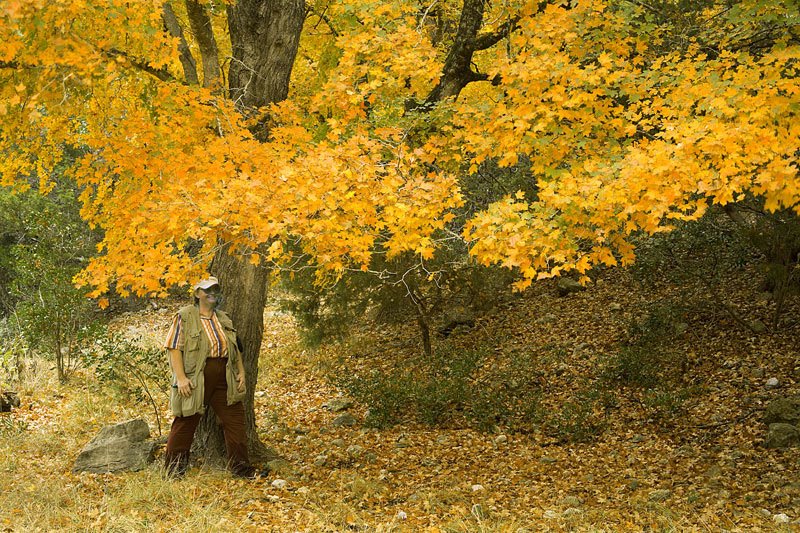
For several reasons, I've been doing a lot of self-portraits lately. For one thing, I am trying to explore the income possibilities of stock photography. I need to improve my skills in photographing people. Things I learn in taking my portraits and the post processing will help me with other projects. For another, I am the one model who is always available (ha! ha!) Since I have lost so much weight, the Curves people have been asking for a photo - and I wanted a good one for them. Getting back to the stock photography - they seem to want "real" people - so since I am a "real" person - some of the shots I am doing will get sent to Alamy Images. We'll see if any of them sell.

Tuesday, November 08, 2005

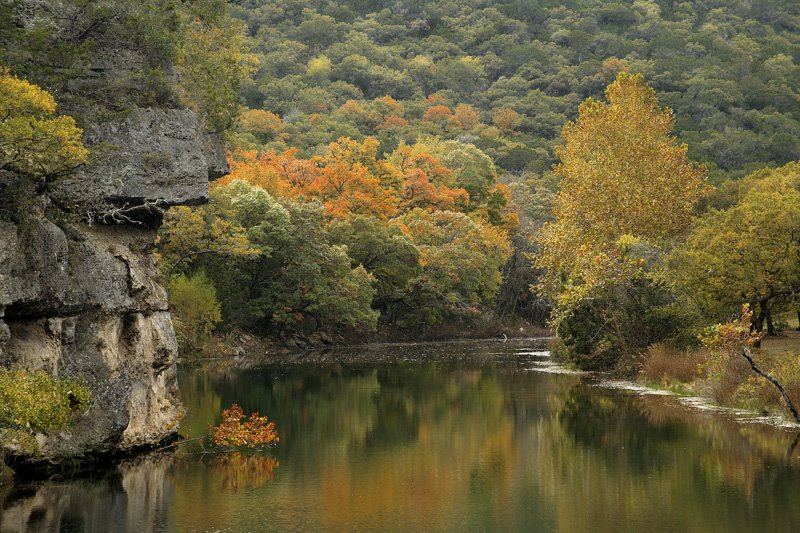
Lost Maples


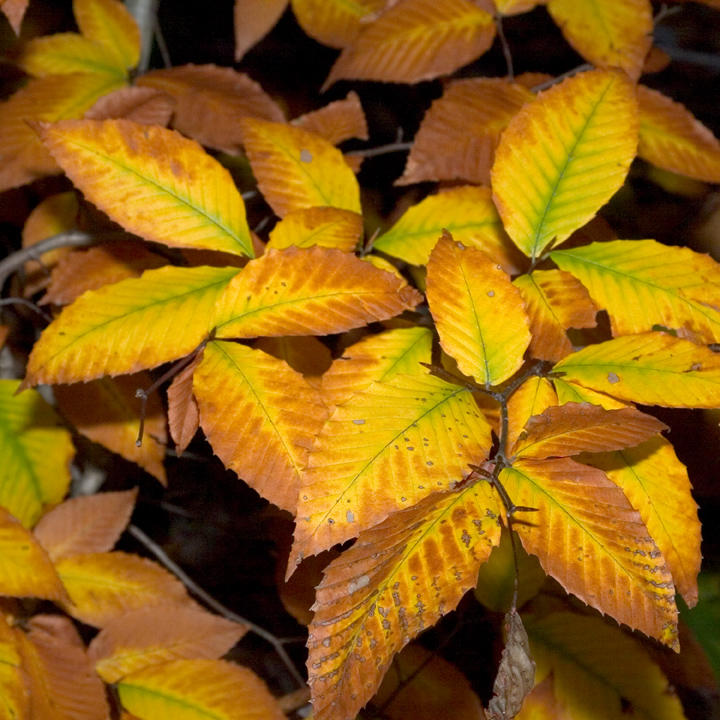
Living in the Austin area, I miss some of the brilliant colors that I remember from fall in Amarillo. In the Austin area, the fall colors are muted. There is yellow-brown, red-brown, brown . . . . . . My tallow trees (not native) have a pretty yellow and pink color. And the china-berry trees also are yellow.

While I had visited Lost Maples before, we had never gone in the fall. The color comes and goes quickly. While the kids were in school, there were too many activities going on to take off to see the maples here. But this year was my opportunity. I had been told that around Halloween is the peak time. When I first called to get reservations (November 1st), the park told me that the trees were still green - next week would be better. When I called the state office to make reservations, they said the 7th and 8th was too early - it would be another week (and no there were no available reservations THAT week). So I decided to go ahead and come this week. The reports said there was color in the canyons. I was planning to take the long hikes - so surely I would find some nice locations for fall photographs.

As we drove into the park, the first things I saw were the young maples around the visitor center in full color. Ahhh - fall color. I was able to extend our initial reservation through Thursday - so we were set.


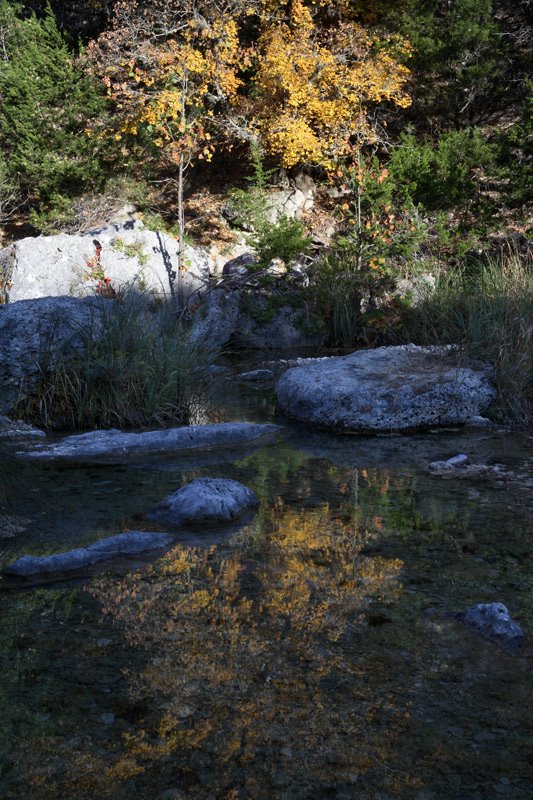
The first afternoon, I took part of the Maple Trail. This trail follows the creek and comes back through the maple grove. I chose to stay along the creek both directions looking for reflective shots in the afternoon sunlight.

Wednesday, October 26, 2005

Wednesday


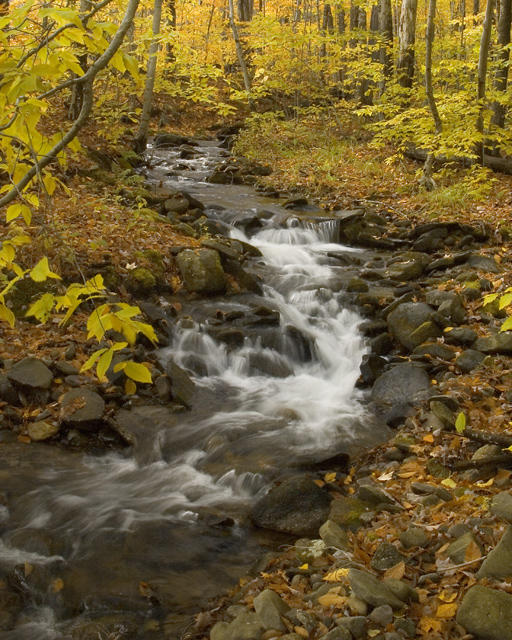
As I started my drive today, I could see some blue sky peeking out from behind the clouds. I started my drive going down the Hudson River on the east bank. As I began to see the Catskill Mountains, they "called" to me. So as the sky was definitely clearing, I crossed the Rip Van Winkle Bridge and headed into the Catskill Park. As my elevation changed - so did my weather. I went from fall - to snow covered winter scenes-and then back to fall. My focus for the day seemed to be to find waterfalls and streams surrounded by fall foliage.

It was a good day.

New York


I woke up to rain this morning. Not unexpected, but still disappointing. Since taking photographs in rain is not a lot of fun, I decided to explore some new territory. I headed west into New York State. I crossed over the bridge at the far south end of Lake Champlain. The mountain on the west was beautifully colored -well worth coming back for on another trip in better weather. I drove north following the shoreline. I then headed into the Adirondack Mountains. As I went up in elevation, the rain turned to snow. I got a few winter pictures, but I was not really dressed for snow. While my suitcase was heavy, I really had packed light planning to layer. I was thinking fall, not blizzard. I drove through the Lake Placid area - seeing the ski jump site and some of the other Olympic facilities.


But hours driving in snow without my four wheel drive vehicle (think security blanket) left me a little tense. I made my mental plans to stop when it got dark. I made it to Utica just after dark.

Monday, October 24, 2005

Vermont

While it seems a little strange to be in New England struggling with weather issues from a hurricane in Florida, such is life. I will be trying to find fall color until Thursday when I will fly back to Texas to attend a friend's wedding. Naturally the weather forecast all week is rain, snow, clouds, more rain. I am used to this. After all, while only the STRONGEST winter storms bring rain to Death Valley, it has rained on me every time I've been there!

I got up this morning to a gray sky. I took the time to rearrange my baggage so that each night I would only carry in small needed items - NOT the big bulky suitcase. I got all my camera gear out in easy reach in the car and cleaned the sensor and the lens I use most frequently. I had picked up some information yesterday at the Vermont Visitor's Center. After checking out the routes that still had color as of October 20, I headed north up highway 5 following the Connecticutt River.


I saw a side road marked "Old Connecticutt River Road" and took it. There was some lovely foliage with reflections on the smoothly moving water.


Closer to Windsor, I found a waterfall just begging me to photograph it. While I shot it from a couple of angles, looking at the shots closer tonight, I wish I HAD stood in the middle of the road . . . . On the other hand, from the middle of the road, you did not see the bottom of the waterfall. I DID want the fall foliage as part of the shot, but my nit with my favorite shot is that one of the branches crosses the waterfall. I have some new techniques to try on some of these shots, but for now I am posting my initial processing.

I followed the route listed in the brochure most of the day. After turning on Highway 4, I plotted the route again. The recommended route turned south on 100A. I had no need to make a loop and staying on 4/100 seemed to follow the river. I took another turn on some side roads and was rewarded with some shots that may work out. I had seen Texas falls on the map. I could not remember if Henry and I had been there, so I headed in that direction. Highway 125 is marked as scenic. I definitely agree, a narrow curving road through the mountains. While I got to Texas Falls while there was still light, I chose to enjoy them and not fight the fading light. But I also chose to spend the night nearby in hopes that the sky will be brighter in the morning.

I found my motel and my dinner at the next town. I've caught up with my blog and I'm hoping for clouds with only a little rain (I CAN hope, can't I?). I'm going to study the map a little more to choose a general route for tomorrow.

Sunday, October 23, 2005

After the Convention - Heading for Adventure

After the Alamy meeting on Saturday, I walked around the Time Square area. Every other trip to New York, I have attended a Broadway show. I walked the theater district, but I did not find anything that jumped out at me. While I would like to see Brooke Shields, she is appearing in the musical "Chicago." I have seen the Broadway play once as well as the movie. Since I really don't like the premise, I was not tempted. I chose to eat at a French restaurant I had passed. Then I headed back to the hotel to finish the Photography blogs.

I tried to find a way to rent a car from the city to start my explorations. When the first car rental place said no to dropping the car off elsewhere, I was tired enough that the train ride to Connecticutt sounded like the best option. Sunday morning was the dreaded "moving day." I repacked my belongings - how did it get so heavy . . . . . . I must be more tired than I thought. Fortunately, Penn Station was one block away - two blocks to get to the entrance I thought was the right one. Stairs . . . . . I made it up stairs with those same belongings several days ago. As I stood there pondering whether to walk around to another entrance, a kind gentleman said, "May I help you?" With a sigh, I said yes and watched him walk those heavy bags down the steps. I got my ticket purchased and did not have long to wait. Down the escalators with those big bulky bags . . . . .Finally, on the train - one bag stored by the door, the other two in the overhead shelf. AHHHHHH. I pulled out the items I thought I would use - my Bible, my journal, my computer, my ipod . . . . About an hour down later, I realized that all I really needed was the IPOD. The station stops were short - so I loaded everything else back - so I could get off fairly quickly.

After the stop where they switched to a diesel engine (from the electric one I presume), I decided that lunch might be a good idea. I negotiated my way to the dining car (which was at the back of train.) While it was just a simple heated chicken sandwich, it tasted mighty good. At last we got to Hartford, where to my dismay it was down the stairs with the big suitcase to get off the train. The conductor was offering to help people . . . .sigh . . . . the big bag DID get off the train with me. From there it was not difficult to get to the taxi and then off to Bradley to get a rental car. My taxi driver was one of the most talkative ones I've ever had. He was from Africa and loves being in the States because we are free. He dropped me off at Budget. I asked for four wheel drive - they gave me a Trailblazer much like my trailblazer at home - complete with a Texas tag! Later in the afternoon, I realized that while it is a SUV, it is NOT four wheel drive. There is snow on the ground at the higher elevations in Vermont. But at least I have the ground clearance and the confidence to take this vehicle on dirt roads that I would not have wanted to take a car on.

I drove north through Massachusetts, enjoying the fall colors around me. I headed west in Vermont on highway 9. I immediately head out on those little dirt roads hoping for some little streams. All I found the first day was some very pretty foliage next to the road. I kept taking little roads - and finding myself looping. As it got dark, I headed back to Brattleboro for supper and a Motel 6.

Saturday, October 22, 2005

A Victory for Me

This is the third year I have submitted photos to the Hubbard Museum of the American West's Photo Exhibit. Last year I had two photos that made the exhibit. I received a letter today that notified me that four of my images made it this year!

While these are "baby steps" in the process of trying establish a career as a photographer, I am very grateful that my work will be displayed. It is a beautiful museum and the photos last year were outstanding. I am also eager to learn which photos were chosen. Hummmmm . . . when I can make it to Ruiodoso to see the exhibit?

Rights Managed vs Royalty Free

Well, before this event, I was sceptical of Royalty Free marketing. When I posted my first images at Alamy, I listed all of them as RIghts Managed. And while I still remain skeptical of the "penny" stock agencies, I am now more convinced that I need to market my photos both ways.

The panel I went to this morning had an incredible array of stock photography companies represented. I was especially thrilled to hear the representatives from Getty and Corbis talk about their company, their strategies, and how it works. But the entire panel was impressive - so much knowledge and skill to learn from at one time!

Interestingly enough, the sales price for Royalty Free images is going up - there is a big demand for this type of image. But there is still a demand for Rights Managed. Big companies sometimes want exclusivity for the images they use in an advertising campaign. Between Tom Grill's session yesterday and the information presented today, I have a better idea which of my images should be marketed as Royalty Free and which should be Rights Managed. And I have a plan to shoot several sets of images specifically for the Royalty Free market. To put it simply . . . . images that are unique, difficult to classify, and expensive to obtain should be Rights Managed. Images that are strongly conceptual, can be used in many ways for many products should be marketed as Royalty Free. Go to an agency such as Getty or Alamy and browse the Rights Managed and Royalty Free images. I think you'll spot the difference.

Turning Your Images into Gold - Marketing your photos to the Consumer

I found this session extremely informative. Because nature photography is my first love, I think this is a direction I would like to explore. I can visualize some of my best work framed on someone's wall.

The moderator was Jeff Sedlik. He runs his own business and distributes posters himself. He did a great job presenting the pros and cons of doing it yourself versus being represented by an agency.
Jeff Sedlik
Jeff Sedlik - Jazz and Blues Master

Martin Lawlor from Bruce McGraw Graphics (I'll add a link here when I find a good one for his company) and Phil Jackson from Bruce Teleky - American Vision Gallery (an art print poster distributor) both gave presentations using photos they market.
Bruce Teleky - American Vision Gallery

The highlights of information from this:I gathered that when you are marketing posters from these big entities - they would prefer to have an exclusive arrangement with you. They have many distribution channels and are already connected with the big retail chains, home interior networks, furniture stores, etc.

When targeting consumers, you are talking about posters, framed prints, greeting cards, mugs, t-shirts, calendars, mousepads, bags, etc. Branding your name will help increase sales of these products.

When thinking of prints for home decorating, one interesting aspect is thinking in terms of pairs of photos that can be displayed together.

One of the advantages of going into the retail market is that it diversifies your income stream. At Kathy Adam's Clarke's "How to Survive Your First Five Years", she talked about having many different ways of generating income (pieces of a pie so to speak) in order to earn your living with photography.

There will be a pdf that I am looking forward to receiving. While I won't pass much of that on - as I consider that it might be proprietary and was intended for those of us that paid to attend the seminar, you can get information about these kinds of companies from the book, "The Photographer's Market."

John Lund finished the presentation. I immediately recognized his work - think the dogs playing poker. He has done an excellent job finding innovative ways to market his work.
John Lund

While I don't know yet if my work is high enough quality, I am certainly planning to explore this area of photo marketing.

PhotoPlus Expo - More Interesting Booths

Phototek
I’ve been doing some still life photography in various rooms of my house. When my daughter, Debra was away at college I used the desk in her room to set up flower shots. I had heard about special light “houses” or light boxes and I knew that some people constructed their own. I saw several lights at booths, but the one I liked best was at Phototek. I chose one 24X24X36. It came with a black and white liner and I bought the additional “wide angle” one so I could do horizontal shots. I already have two studio lights – so I did not buy their lights.
Phototek

WestCott
When I first bought studio lights, it was an experiment – so I bought just about the cheapest ones my local photo store (Precision Camera) had. I discovered that I would indeed use them. I also discovered the room I was working in got very hot. I tried bouncing the light off the ceiling, as well as shooting with them directly. I bought plastic diffusers (which never seemed to fit correctly) and I tried shooting through white material. So one of the things I was looking for was an upgrade for my lighting.
I did look at AlienBees, but they are strobe lights. The helpful staff there told me that I would need a flash meter to set my exposure. Sigh . . . . . one more thing to learn to use. I am spoiled by my in camera meters. I had been by the Westcott booth and drooled over one of the lights they had. They had a professional model and their rep was extolling the virtues of the cool lighting. She was cold. I priced it the first time and walked away . . . . . But after checking out AlienBees, and knowing there was a show discount . . . . . I went back and got their Spiderlight TD5. I bought one with a “kit” because I already have a reflector that I can use to balance the light. Perhaps next year I’ll get a second one. I got the light, a bracket, a soft box and a lightstand. And then of course I saw some portable backgrounds (made similarly to the fold up reflectors) that I would see myself using a lot.
Westcott

AlienBees Flash Units
Whereas I looked at their lights and perhaps one day I will go that direction, the item they have that I do drool over is the portable power system. I did some bluebonnet portraits this year and tried to use my car inverter to power my lights. Something did not work the day I tried it . . . . but at least the sun cooperated. The power systems look like they might work with my existing lights and perhaps my new one. (And I did fill out the card to win a set of their lights . . . . . .)
AlienBees

Lee Filters
While I did not spend much time drooling here (I already have Lee ND gradient filters). I like their filters MUCH better than the Cokin filters I started with.
Lee Filters

Friday's Sessions

The first session I attended was "Your Picture How to Get Published."
The moderator was W.H. Hunt with panelists, Elizabeth Blondi, Kathleen Klech, Jodi Quon, and Kathy Ryan. One was photo editor for Conde Nast's Traveller magazine. One was photo editor for the New Yorker magazine. It was interesting that it is amazingly easy to get your portfolio in to these people. They all preferred prints (even prints you have made yourself) over CD's. They each presented photos from photographers that had impressed them and that showed how that led to an assignment with their magazine. I was impressed both by the creativity and that many of these photos would not win at many of the online contests where I have been participating. While most of my work does not really fit the needs of these publications, I learned about a new contest to enter at the Santa Fe Workshops.

Next on the agenda was: Turning your Images into Gold
Moderator was Jeff Sedlik, Panelists Martin Lawlor - Bruce McGaw Graphics, Phil Jackson - Bruce Teleky (art print, poster distributor) and John Lund (Animal Antics - everyone has seen his dogs playing poker images)

This session really fits the photography that I do. Jeff Sedlik got started when his first child was two - as a way to plan for college. You can market yourself - printing your own and finding distributors or you can license your work. It seems that many of the companies want to carry your work exclusively. And you get a better percentage if you go directly to them rather than through a stock agency. (You can have other work out for stock.) So I'm glad I learned that early in the process. Home decorating is a big part of this business model. So you want to think of photo pairs and "suites." I will certainly follow up on the information from this panel because I think my photos might fit with their needs.

My last session was "Maximizing Stock Photography Income" by Tom Grill
This guy was amazing. He conveyed a lot of information in a short period of time. Some of my friends and family will rue this day as I am likely to start bugging them to ask as models as I try to implement some of the ideas. While many of these shots may not be my favorite thing to do - they could certainly provide an income stream that would allow me to pursue the outdoor photography that is my first love. Concept photography has been mentioned to me before and is critical to getting your work used for advertising purposes.
Tom Grill

I took time to attend the special event: An Intimate Conversation with Three of Photography's Icons: Joel Meyerowitz, Douglas Kirkland, and Elliott Erwitt
Joel Meyerowitz spent 8 months documenting the cleanup at the World Trade Center. He went every day. His current project: he will be photographing all of New York's Parks. Like another professional photographer I have met, boldness is one of his characteristics - his story of how he was able to get in to the Trade Center site is a lesson in persistance. Douglas Kirkland is a celebrity photographer - you will recognize some of his photos of famous people. Looking at how he used lighting in his work is amazing. Elliot Erwitt's work shows the power in black and white photography. He was a street photographer and his photos are well worth studying.

I will come back and add more to this post when I have more time.

Friday, October 21, 2005

PhotoPlus Expo - More Interesting Booths

Interesting booths

PhotoStockPlus.com
A place to sell your images online. A form of stock photography – they charge you for a website to show your photos – within a network where buyers come looking. . . . .
They also allow you to showcase images from event photography – they will do the prints and ship them right to your clients.
Photo Stock Plus

Santa Fe Center for Photography
Project Competition Dec 1st deadline
Portfolio Reviews - a juried portfolio review event $495 Deadline for entries Dec 1st
The Singular Image


CPAC Imaging Pro
I met Susanne C - she was impressed with this program. It is designed for portrait photographers to do retouching. It had a nice system for changing out backgrounds. And of course, smoothing out facial skin, removing blemishes, etc. I liked the demo, but if I understood the salesperson – it was too high priced for me to buy right now.
CPSAC Imaging Pro

Portrait Weavers
I really enjoy the tapestry throws I have bought or been given over the years. Portrait Weavers allows you to take one of your photographs and have it woven into a throw, a pillow or a tote. You can even make wall hangings
Portrait Weavers


Palm Beach Photographic Centre
11th Annual International Festival of Photography & Digital Imaging
This is too near the NANPA event, but it looked interesting.
Palm Beach Photographic Centre

FastBack Creative Books
I got to look at a couple of their sample books. The quality looked very nice. They offer both hard bound and paperbacks. You can design your own book – or you can pay extra for them to design it.
FastBack Creative Books

ColorVision
ColorVision had a booth. Since a Spyder screen calibrater is in my future, I picked up their brochure.


Bergger Digital High Definition Fine Art Papers
I’ve just started playing with putting my images on textured specialty papers. So I was interested in their PN33 textured cotton paper. I also picked up materials on PN61, another textured paper and Pn62 – a cotton rag paper.
Bergger Digital

Premier Imaging Products
Premier Imagaing Products also had papers that captured my interest. My favorite was their Luster Rag. But I also liked their Textured 300g, the Canvass Matte, and their smooth velvet.
Premier Imaging Products

MPIX
I’d already heard great things about this printing company. I got to see sample prints from their metallic paper. I will definitely try this out with some of my work. They will also mount photos on either canvas or matte which produces a nice finished product. I got small samples of their prints – which was nice so I can look at it more when I get home.
MPIX

Thursday, October 20, 2005

Aperture - Apple's New Photo Program

Henry, my husband had told me ahead of time that Apple was planning a big announcement at this photo conference I was planning to attend. He saw the informational releases Wednesday. Since I have been pretty disappointed with Iphoto at this stage of my photographic development, I was pretty sceptical about a "new" version of Iphoto. In my experience Iphoto was clunky, it did not like the number of photographs I shoot, everything moved so slowly. . . . . .

But when I got to the Exhibition Hall and saw the demonstration of Aperture - I have to say I'm impressed. It works right from your original RAW files without changing your original image (an important thing for some of the contests I enter that require the original!) It seems to work well to help you group your similar shots as well as shots from a given shoot.

My favorite part was the Loupe that is built in. I've been using Graphic Converter to run a slideshow to help me choose my best shots to work on. I usually take a sequence of shots - and then try to find the one that has the sharpest focus as well as the best exposure. With the loupe tool, it is very easy to get close into each shot of a series to find the one with optimal sharpness. You can also set up "Light Tables" with your best images.

The tool to remove those pesky dust specs was also very easy. With photoshop's healing brush, you must first sample an area and then remove the spot. With aperture you just choose the right brush size and click - the spot is gone.

There are built in tools for the RAW conversion - white balance, levels. And it is easy to move your shot over to Photoshop for additional processing or combining images.

I have a newer Mac laptop, so I am assuming it should run quickly on my computer, but I was impressed at how quickly the demonstrator could move from one image to the next - certainly not possible on Iphoto and certainly easier than going through an entire slideshow of shots on Graphic Converter.

With a $500 price tag, I am not rushing out to buy it right now . . . . . but I'm certainly going to go drool more tomorrow.

PhotoPlus Expo

For my photograhy friends, I am going to post some blogs from the PhotoPlus Expo in New York City.

I got into New York Wednesday and got settled into my hotel. I found my way to the convention center fairly easily and got my name tag. I headed off to my first eagerly awaited seminar only to find that I did not have my "ticket" nor was my name on the registered list . . . . . At the NANPA summit everything was included in the price except for the pre event and post event activities. So I went back to the main floor, found the additional line, priced it, swallowed very hard and bought my tickets! After all, the seminar topics were what made me choose to come to this event. In for a penny, in for a pound. Fortunately, I have a supportive husband who when called later in the day - confirmed that this was exactly what I should do.

I went to my first meeting - late, but really enjoyed George Lepp's presentation. While I have the Panorama Factory on my Windows laptop - it is cumbersome to transfer the files over - so most of my panorama sequence shots are still on DVD's waiting processing. He recommended Panorama Maker from www.Arcsoft.com - which runs on both Windows and Mac. I'll be looking into that program.

He also showed some of the features of Adobe Photoshop's CS2. Since I seem to be doing fine with the first CS, I had not been ready to upgrade . . . . .but the High Dynamic Range feature (HDR) that will take a minimum of three images with different exposures and combine them easily makes the new version tempting. And, of course, he also showed how to do something similar with layer masks - I did learn a new technique . . . . .

The other program that tempts me is Helicon Focus. Designed in the Ukraine, it is marketed in the United States for Windows machines. But it allows you to shoot a sequence of "macro" shots and combine them to get the entire flower in sharp focus - a much deeper depth of field than an lens setting. It can also be used on landscape shots. I was very impressed. However, it is an expensive program - and only for Windows - so it is not immediately on my buy list.

While I am not ready to buy a digital projector - I was certainly impressed with the Canon SX50 he was using. Amazing color and resolution.

Wednesday, October 19, 2005

Morning Flight


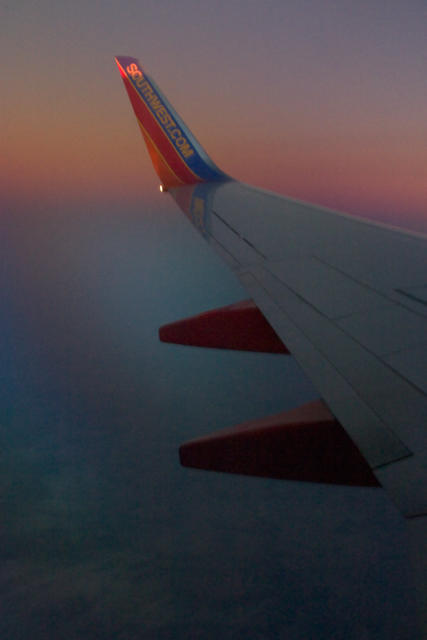
It was a beautiful morning to be flying at dawn.

Monday, October 17, 2005

Professional Progress

I'm excited to report that I have gotten my foot in the door with a professional stock photo agency. I currently have 13 images at Alamy Images:
Stock photography by Mary Ann Melton at Alamy

I will be going to New York City this week for the PHOTOPLUS EXPO 2005. While it will be fun to see all the newest photography equipment, I think I am more interested in the sessions. I am particularly interested in the sessions dealing with stock. With so many choices these days - Royalty Free Images, Rights Managed, and Licensed and with so many photographers out there trying to earn money, it will be interesting to hear what these industry professionals have to say.

Since I also love New York City . . . . . . I will enjoy this outing.

Saturday, September 24, 2005

Hurricane Rita - Thankfulness

At this point the worst of Hurricane Rita has passed. I am grateful that it entered land in less populated areas. Even the damage in Port Arthur and Beaumont seems to minimal considering the size and strength of the storm. At the present time, there are no reported deaths.

I believe that many people prayed to God to minimize loss of life and property damage before Rita hit land. And I believe that God answered those prayers.

My scripture today:

"May God be gracious to us and bless and make his face shine upon us, that your ways may be known on earth, your salvation among nations."

God was gracious, we had ample warning, people evacuated, and the storm hit in a way that there was minimal loss of life and minimal property damage. May God be praised for this welcome outcome.

Friday, September 23, 2005

God's Power - Hurricane Rita

I've been using the One Year Bible as a source for personal devotions. Whereas I may not read from it every day, it is a part of my routine. I have been amazed at how sometimes the scriptures I see fit what is going on in the world around me and how they give me inspiration for prayer.

Yesterday as Hurricane Rita built in power over the Gulf my scripture was from Psalm 65. The verse that caught my attention and that I included as part of my prayer said:

You answer us with awesome deeds of righteousness . . . . .
who stilled the roaring of the seas, the roaring of their waves, and the turmoil of the nations.

I prayed that God would stillk the roaring waves of the hurricane driven seas.

While the hurricane grew in power to one of the strongest Category 5 storms on record, it moved over cooler waters. Wind speed went from 175 mph now to 140 mph (Thursday at 11:00 p.m.) God has also sent a cold front that is redirecting the storm away from the most densely populated areas. While I am sure that there will be property damage and some loss of life, I am praying tonight using vs 7 as my scripture base:

Lord God of Heaven, still the roaring of the seas, the roaring of the waves. Please minimize the both the property loss and the loss of life from this storm.

Sunday, September 18, 2005

God's Time


As humans, we measure time in seconds, minutes, hours, days, weeks, months, years. We usually have time estimates as to how long a given task will take. When we get ill, one of our first questions to our doctor is usually how soon will I be well and functioning normally.

Life itself presents many challenges to us as we live it day to day.

As kids, we can hardly wait get our first bicycle, go to school, finish high school etc.

As parents, it is so easy to think such things as:

"I will be SO glad when we are out of diapers."
"I'll be SO glad when he can use words to TELL me what is wrong."
"I'll be so glad when I'm out of college and have a real job."

Today at church one of our families asked us to pray for a crisis situation with their fourteen year old grandson. For many families, teenage years can be rough years. Between individual internal biochemistry issues, emotional problems, puberty, and the need to become independent and individual from parents, this time frame leaves a lot of wounds. One of our favorite words of comfort to people going through such rough times is often: "God's time is not our time."

I was thinking about that today as I was driving in the car. A word picture of this came into my mind. My grandfather bought a farm and farmed it while I was small. We still own that farm and most visits home to my family included a trip to check on the farm and crops. In addition, when the kids were young, I had many vegetable gardens and I planted fruit trees and grapevines.

When you are planting radishes, it takes about three weeks from planting to harvest.
When you are planting corn, wheat, and milo, it takes four to six months from planting to harvest.
When you are planting fruit trees, depending on the size tree you buy, you are looking at getting your "first fruits" in 3-5 years- and several more before it becomes a bountiful harvest.
When you are planting pecan trees, it generally takes 10 years or more (our pecan trees took over 15 years before they started producing.)
The "farmers" who plant forests for lumber are looking ahead 20 years for a harvest of the seedlings they are planting.
Saguaro cactus don't reach "maturity" for 100 years.
Redwoods and sequoia trees live for thousands of years.

So often as we go through the teenage years, the early adult years, we expect God's answers to our prayers to be immediately answered. Human hearts and psychology are very intricate. Even with God's great and almighty power, the best answers to our prayers for human growth and development take years of cultivation, water, and nuture to bear fruit.

So next time you are wrestling with one of life's difficult human challenges - are you really looking for a "radish"? God is looking to create the beauty of a forest, or a tall saguaro, or the stately grace of the redwoods and sequoia trees. Jesus told us about the lily that toiled not, neither did it spin, yet it was beautifully arrayed. Are we not more important to God? While my human desires and lack of patience want a speedy resolution, I've learned that waiting for God's longer more well thought out answer always gives me special blessings and usually an answer beyond anything I could have thought up for myself.

Saturday, September 17, 2005

TV Thoughts

Chris asked what shows had caught my attention. Since I'm hoping some day to be a published Christian writer whose blog might some day come under scrutiny, I had some reservations about publicly listing what shows I'm going to explore. Among the Christians I know, there are a wide variety of tastes and beliefs. Even in the 21st Century, I hear arguments that science and religion must be in conflict. The Harry Potter books and movies are also controversial in the Christian world. I have good friends on both sides of the fence. Some find Harry Potter to be delightful fantasy-a fun and harmless use of imagination that has encouraged many children to enjoy the wonderful world of books again. Other Christians find the witchcraft elements - however unbelievable to be a dangerous and perhaps sinful influence on young minds.

Because of our involvement in the Science Fiction community these past 30 years, I can say truthfully that while there are atheists and agnostics in that community, there are also faithful Christians who both write and read science fiction. There is a group at World Con each year that makes sure there are worship services. Some years there are even Jewish services.

I have found over time that I like many fantasy books - some include magic, but not necessarily "witchcraft." Some of these have magic as an innate ability (Marion Zimmer Bradley's Darkover books and Katherine Kurtz Deryni series for example). Others are more like Superman in that the planet where the story originates has special geology or chemistry, or plants, etc that give the characters their "super" powers. Terry Pratchett's Ringworld series with his amazing suitcase are light, funny and I find them delightful to read.

Some writers, however, explore darker aspects of both human nature, and good versus evil. Some I can read and enjoy when good triumphs over supreme evil because there are noble and good characters. Some books are just too dark with no "redeeming" qualities.

I read some books because I have met the author or heard the author speak on panels. When I am impressed with someone, I will try to read one of their books. I was impressed with Ellen Kushner's presentation at one of the World Fantasy Conventions. She has a wonderful show on PBS radio. I also saw Delia Sherman on panels and was impressed. While I made it through their book "The Fall of the Kings," I can't recommend it as Christian reading - too dark, and way too much evil. I look for redemption and I don't remember finding any. It really left a bad taste in my mouth. I'm not sure I will pick up another book written by either of these ladies.

I'm sure that after a few episodes, some of these shows will drop quickly off my radar. I intended to watch all of Battlestar Galactica. But Henry lost interest quickly in the show. After I mentioned that I was finding it dark, he went ahead and deleted it from the TIVO. I probably would have waded through it, just because there are some impressive things about the show. But the plots had some pretty dark elements - and the filming style accentuated this "darkness." Being a continuing series, I would want to pick back up where I left off. But there are other shows that I find so much more enjoyable that I'm not sure I want to spend my time watching humanity struggle to survive. Life has enough difficult and painful moments, I want my TV to be relaxing and fun - not to add stress.

So . . . . . . here's my initial list:
"Ghost Whisperer"
"Out of Practice" (Henry Winkler ande Stockhard Channing - HAVE to give it a shot. I saw Winkler on Broadway - NOT Fonzie anymore!)
"Threshold" (Brent Spiner - another have to see what he's up to)
"Three Wishes" (Amy Grant . . . . it seems to be in conflict with two other shows already set up, I'll have to figure out what the conflict is - perhaps I'll watch that one "live".)
"Night Stalker"
"Invasion"
"Bones"
"Supernatural"

I've seen the first episode of "Supernatural." It seems to be going down the "scary" side. While it seems to have "good" characters fighting evil, the evil is pretty intense. It may fall off the radar quickly due to the "darkness element."

I don't care much for most sit coms - and I don't have any interest in "Reality TV" at all.

Other continuing shows that I like Monk, Medium, Veronica Mars, Smallville (although it wandered off onto the dark side last year), I have not watched any Wildfire yet, but the episodes are sitting there waiting for me. I saw the pilot for the 4400, but I need to see the first season(s) for the new episodes to make sense. I've seen a few Numbers, but not enough to have formed an opinion.

Since I don't get TV Guide anymore, I may have missed some promising shows, but this was what my initial search pulled up. And as Stargate and Stargate Atlantis are wrapping up their season, I'm glad to have some new shows to try out.

Disaster Preparation

I have to agree with my friend, Bettye's viewpoint in her Save Yourself blog that being prepared for emergencies is a personal responsibility. Most of us are procrastinators and because disasters and emergencies are infrequent happenings for most of us, we grow complacent. I know that I periodically fix up a first aid kit, put it in the car and forget about it. When the kids were small, things would get used - and then not always get replaced. At home recently, Henry cut his foot, I had to go out to the RV to find everything I needed, I had not recently replaced bandaids and Neosporin in the house. I always have food in my pantry, but I don't go and regularly clean out the cans that have probably been around several years. So whereas we would eat . . . . . some of the cans might have food that might not be edible. We have a pond in the back yard, but I don't have any water purification supplies (like backpackers use). We did recently purchase a generator - Thomas' house fire provided a good excuse. It is small, loud, and I doubt that we will have a lot of fuel on hand because gasolene "ages" attracting water and clogging carbuerators.

Here's an updated list from the California emergency planning for disastrous earthquakes . . . . . . updated since Katrina.

For the full article from the Los Angeles Times:
Southland Not Ready For Disaster

At home

• Nonperishable packaged or canned food
• A gallon of water per person per day (Replace every six months and count pets as family members)
• Manual can opener
• First aid kit and handbook
• Clothing, rain gear and sturdy shoes
• Blankets or sleeping bags
• Portable radio and flashlight, with spare batteries
• Essential medications
• List of family physicians and the style and serial number of medical devices, such as pacemakers
• Extra pair of eyeglasses
• Extra set of house and car keys
• Toilet paper, toiletries and feminine hygiene items
• Fire extinguisher
• Pet food, water and leash or carrier
• Cash and small change
• Water purification kit or unscented liquid bleach (eight drops per gallon when water is first stored)
• Any special foods and supplies for babies, the disabled or the elderly
• Plastic eating utensils, paper cups and plates
• Heavy-duty aluminum foil
• Paper towels
• Knife or razor blades
• Candles and light sticks
• Matches in waterproof container
• Work gloves and broom
• Hammer and nails
• Coils of rope and wire
• Ax, crowbar and shovel
• Small tool kit
• Cheesecloth (to strain water)
• Large and small plastic bags
• Two tarps, 8 feet by 10 feet
• Local street map and compass
• Paper, pens and stamps
• Entertainment pack of family photos, notebooks, reading material and games

In the car

• Nylon tote or day pack
• Bottled water
• Nonperishable food
• Manual can opener
• Transistor radio, flashlight and extra batteries
• First aid kit
• Gloves
• Blanket or sleeping bags
• Sealable plastic bags
• Moist towelettes
• Small tool kit
• Matches and lighter
• Walking shoes and extra socks
• Change of clothes
• Cash (small bills and coins)
• Local street map and compass

At work

• Dry food, such as candy bars, dried fruit, jerky and crackers
• Water or orange juice
• Tennis shoes or walking shoes
• First aid kit
• Flashlight and portable radio with extra batteries
• Matches
• Small and large plastic bags
• Toiletries
• Entertainment pack of family photos, notebooks, reading material and games

For other life threating situations, I've heard that having family photographs with you can help provide the "will to live", helping provide incentive to keep on fighting to live to stay with your loved ones.

Things to ponder. . . . . . .

Tuesday, September 13, 2005

Common Sense Wisdom

A friend of mine has just started a new blog, one of her responses to Katrina. Bettye has a lot of wisdom learned from her grandmother and from a lifetime of working with animals. Her theme, "Save Yourself," gives a lot of food for thought as to what each of us needs to be doing on a regular basis to prepare for the natural disasters that happen. I think you'll find it fun and interesting reading.

Save Yourself

Katrina - More good things

I do a lot of web surfing each day - finding news articles that interest me and following themes that have caught my attention. As with most of the United States, Katrina and its aftermath have been on my mind. Within a week of the storm, I found several blog sites, but one stayed on my radar. It was the blog of a computer specialist who stayed in New Orleans to keep up the system. I found it from the CNN broadcasts. But once I started reading it, it was compelling enough that I continued reading it. Michael Barnett not only weathered the storm but kept computers and the internet live and running for his company from the Central Business District in New Orleans.

While Michael has recently left to join his fiance, the blog is being continued by his replacement. The entire blog is worth reading, but I want to direct your attention especially to the blog from 5:05 pm, September 12th where there are stories of eight people who went above and beyond in their efforts to help people.

Michael Barnett's Hurricane Katrina Blog

Sunday, September 11, 2005

Life with TIVO

While we finally got a TIVO unit last year, Henry has done most of the set-ups to record the shows. Since a new television season is about to begin, I decided to do some research and see if there were any new shows that I might be interested in. Finding a list of new shows online proved more challenging than I first expected. I went to TV Guide's website first, but did not reallly find a consolidated listing. So I ended up going to all the "major" networks' websites - NBC, CBS, ABC, FOX, Sci-Fi, WB, USA, etc. to compile a list. In the "good old days", the new fall shows started the same week at all the networks. Now it is really staggered. The Sci Fi channel started its season about 6 weeks ago. Monk just finished his season - now it is rerun time for the obsessive compulsive detective. FOX seems to be starting their season this week. But some of the new shows won't start until the end of the month.

I was pleased that I figured out how to maneuver the remote control to get some programs set up. However, the shows that start more than 2 weeks from now will have to be programmed in later.

In perusing the new shows, it is amazing how many "copy cat" shows. I've enjoyed "Medium" but there are at least one series that sure look like a similar plot. Nice to see several science fictioned themed shows also.

This will be one of the first Fall TV seasons that I've really looked at the choices and tried to watch some of the new shows from the beginning. I'm sure that several will quickly drop off my list, but I'm looking forward to seeing some new offerings. Surely there will be at least one or two new shows that I'll appreciate.

Saturday, September 10, 2005

Katrina - Looking for the Good

While my TV watching on Katrina has greatly diminished, I was pleased to see CNN's showcasing the "Angels" on a restaurant TV.

I am also pleased that the people coordinating the shelters and housing in Texas are finding apartments and getting people moved fairly quickly to more permanent quarters. Many of these new situations include 6 months of free rent! This should give people time to get established in their new homes. Also, Austin is already organizing a job fair. I'm sure that the other Texas cities are also doing that. I saw that the government is looking to hire people to help with the cleanup.

I've heard unofficiallly that 80% of New Orleans evacuated. While conditions were horrible at the Superdome in the days after the hurricane, it did provide a location that protected people from the storm itself. Now that they are beginning to recover bodies, it looks as though the death count is not going into the 10,000 figure. Considering how bad the storm and its flooding aftermath, if the actual death count is lower than expected, perhaps that will be considered a miracle also. (For those that lost family and friends, a low death count will not bring your loved one back . . . . . and my heart goes out to you. But considering that this disaster could easily have killed thousands and tens of thousands, perhaps we did better than we are giving ourselves credit for right now.)

Koodoos to the Coast Guard who were among the first rescue personel on the scene pulling people from the housetops and attics. And to all the unsung volunteers who are helping to make this an easier transition for those displaced families.

My heart is warmed by the efforts I see throughout our country (and the world) to help the people that have had devastating losses. Between the community dropoff points for donations, the money donated to the Red Cross and the Salvation Army, the business donations, some of the best aspects of human nature are being showcased.

Thursday, September 08, 2005

Nature - On the Back Porch

For several years now, we've had bird feeders around our house. Recently we've had an interesting bird visiting. When I first saw him, I thought he was a juvenile, because his flight was irratic. He flew almost like a cartoon bird - never straight toward his destination. There were times when we wondered if he was going to make it to his destination. At times he hovered much like a hummingbird, but not as effortlessly. When Henry got a closer look, his feathers were in bad shape and his eyes looked almost blind. He was a regular visitor to the feeder so I felt like this feeder was probably keeping him going.

This morning while sitting in my living room I saw a much larger shadow on the back porch. While I caught the action out of the corner of my eye, I could tell something momentous had occurred. We have roadrunners in the yard - and we had one now on the back porch - with a bird in its mouth. I was astonished, because I did not realize roadrunners ate birds! The roadrunner had jumped up to the feeder (4-5 feet off the ground) to get his meal. When I first saw the situation the smaller bird was probably still alive, but damaged. I watched the roadrunner briefly before he disappeared with his prey further into the yard and out of site. The smaller bird was no longer moving with feathers disarrayed.

Perhaps I'm tendered hearted, but I'm pretty sure it was our weak bird. I allowed myself a few moments of grief for this handicapped bird. It is a fact of nature that it is the weak and injured animals that are the easiest prey. But it is also part of human nature to protect the weak and helpless.

I had always assumed that roadrunners ate insects. But Henry did some research this morning after the fact - they eat insects, small rodents, small birds, baby birds and small snakes. Since we found baby rattlesnakes right by the house last month, I'm still glad we have roadrunners in the yard. I had also been glad when I realized that my bird feeding had attracted a Cooper's hawk to the yard on a regular basis, realizing that Cooper's hawks feed on smaller birds. A mystery to me is why I was more disappointed about the roadrunner's feeding than I would have been had it been the hawk. But I think it was because the victim this time was an individual bird we had connected with on an emotional level - an underdog we were rooting for.

Wednesday, September 07, 2005

Thoughts on Hurricane Katrina

This past week I have watched more news programming than I normally do in a year. The images from New Orleans, Biloxi and the other devasted areas brought home the harshest realities of nature. As humans, we think we have so much control over our environment - we dam rivers, build levees to control mighty rivers, harness the wind with wind turbines, build amazing roads over the roughest mountain terrain, and construct sea walls to protect our cities from mighty storms. We think that we can plan for every emergency. But this year, our world has been confronted by unprecedented natural catastrophies - the Tsunami in the Pacific and now Katrina in the US.

We have big expectations for our government also. When a disaster occurs, we have look to our governments for protection and rescue. I can remember other hurricanes in the gulf that came near New Orleans and the fears and projections for what a large category 5 storm could do. They even ran a drill last summer to be prepared for exactly this emergency. But even the best laid plans can be impossible to execute in face of a catastrophe as large as Katrina. While President Bush declared the area as disaster even before the hurricane hit, many things went horribly wrong. The Superdome protected thousands of people during the wrath of the storm, but no preparations were made for food or water or police supervision. The Coast Guard was on the scene immediately (as were other private boats) rescuing people from flooded homes and trees. Not only was New Orleans devasted but also the Mississippi and Alabama coast areas. Initially, the storm seemed to do minimal damage to New Orleans, people (including government officials) breathed a sigh of relief . . . . . . and then in the darkness of night, the levees failed. People who had been relatively safe in their homes were now fighting a battle to live by climbing into attics and onto roofs. People left in the city - some out of fear and desperation looted to get needed food and water to survive. Others looted out of greed. The worst aspects of human nature were manifested during the criminal looting, and the attacks at the SuperDome.

Communications failed within the city - while the news crews had satellite links - and kept much of the world apprised - the emergency crews could not commmunicate and coordinate essessential services. Could we have done better - no doubt. On the other hand, this event was much worse than the other hurricanes that have hit our country. It is so easy to want to find some one to blame . . . . . . and yet in life some things just happen. Sometimes there is a strong leader in a community that can organize and keep things moving smoothly. Sometimes leaders are in place who have wonderful skills, but perhaps not the ones needed for this emergency. One reality, the local government in New Orleans and Louisiana somehow failed to take adequate action in the first 24-48 hours. But even the local police were dealing with strong emotions and terrible personal losses. Perhaps more and earlier allocations of National Guard resources and military would have alleviated some of the suffering. But in a catastrophe of this magnitude, it is necessary to do some assessment as to what is needed and how to get it there - wasting precious hours. Apparently the preplanning for what would be needed was inadequate for the reality. But humans are by their very nature imperfect creatures. We are prone to procrastination. Each hurricane that passed without massive damage lulled us into a false sense of security. And once the levee's failed, I'm not sure there were roads open for the need dumptrucks and bulldozers needed. The current was so strong that I'm not sure there was a way to repair the levee until the water had reached the level point and the current no longer existed.

Unfortunately, the most dire predictions have come true. Where there was flooding we have a toxic, bacteria filled sludge. So much of New Orleans and the surrounding area has been destroyed. Throughout the country, we grieve with those folks who have lost everything.

We've heard so much about the things that went wrong. . . . . . But I believe that there are stories of courage and human caring out there. I hope the news media will search them out so we don't lose sight of the goodness that is also a part of human nature. We've heard enough about what went wrong. Let's hear about things that are working as we assimilate the "refugees" of Katrina as they are spread throughout the United States. The volunteers who sorted clothes by size, the doctors and nurses at the hospitals that fought for their patient's lives under such adverse circumstances, the police officers who stayed at their posts during the storm separated from their families, the people who are planning how to care for the animals in distress. There are many amazing stories out there. As a people, we need to hear both the good and the bad.

Saturday, September 03, 2005

One month later

I have learned in my life that when you have a major stressful event happen in your life, it is usually accompanied by other stressful events. The fire was traumatic in many ways. Watching a marriage unravel is also very stressful. Even saying goodbye to a car was more painful than I expected. Having a friend fighting cancer also adds to the emotional mix. The month of August was a time when I did not push very hard. I stayed with my diet and exercise plan and let the month drift by. My sleep schedule was definitely disrupted - I found myself waking up way too early or staying up way too late. The first of September is here - and God has used time to bring some rest and healing for me. I find myself getting more done and a sense of peace is returning to my soul. And, after a plateau, my weight is going down again. I am ready to share again.

Sunday, August 14, 2005

Saying Goodbye

I found that saying goodbye to my Suburban was harder than I expected. It had over 200,000 miles on it, the transmission was going, the air conditioner needed work, the interior had stains, the auto locks needed attention. But when my mechanic (who is also a family friend) told me it wasn't worth fixing - the cost to fix was more than what the car would sell for - my first response was grief . . . . . Granted there was a lot of grief in my life due to the fire, but when I went to look at it to make the final decision as to whether to fix or trade it, I cried. Someone later asked me why it hit me so hard - wasn't it just a car.

I had thought about owning a suburban for probably 8-10 years before we finally bought one. I bought it new-with four wheel drive so it could make the winter trips to Colorado. That car held lots of memories - groups we took to Colorado, Girl Scout adventures, Chorus trips, etc. Thomas and Stephanie even took it to the Rose Bowl in California last year -camping in it. I slept in it one year at church retreat. Even one of my Girl Scouts was attached to that car and understood why it was sad to say goodbye.

Yes, cars are utilitarian. But we used to name our cars. Our first car was a 1966 Dodge station wagon - complete with a push button transmission. Somehow it ended up with the name "Car Car". We took our honeymoon in that car. Our second car was a used Fiat - and in my mind fiasco will always come to mind when I think of Fiats. We bought it during the first gasolene crisis - it got great gas mileage for the time. But we were young and did not understand all the intricacies of maintaining a car - especiallly a foreign car with a funny cooling system. Turned out it needed an oil change every 1500 miles. We owned it a year - spent $1000 to buy it, another $1000 or so keeping it running, and then after an accident and a broken crankshaft - felt lucky to get $350 for it. We then acquired Henry's parents' Plymouth station wagon. That car was special because it was the car we dated in when we were teenagers. It was gray and somehow got named the "Gray Ghost".

We have always loved camping - the great outdoors has always called to me. So our first new car was a Dodge panel van. When we got it, all it had was 2 front seats. Over the next year, we carpeted it, built in a closet and bathroom (primitive, but effective - one porta potty), a bed in the back that also made a table. I have fond memories of that car. We made our first trip to Canada in it. We went over the Going to the Sun road in Glacier National Park in it. We toured Yellowstone. While I worked shiftwork with the state, it made two runs to the Great Smokies. It is even the vehicle that made our famous "weekend run" to Florida. (For those that don't know - we headed out one weekend. We were going to College Station for a Science Fiction convention. Somehow we were there the wrong weekend. Since Henry had few weekends off, we were very disappointed - so we decided we would drive to see the Mississippi River. We made it to New Orleans. Looking on the map, if we were in New Orleans, the state of Mississippi was just right there. And . . . .you know . . . . it isn't that far to get to Alabama . . . . and then (tongue in corner of mouth smiling) Florida is soooooooooo close. We left College Station Friday night. We made it to Pensacola by Saturday night. Dinner was in Pensacola. Because Henry had to read meters at the radio station Sunday evening, we spent the night at a National Forest Campground halfway across Mississippi. And yes, we were back Sunday evening in time to read those meters) It went many places. We took Thomas, a baby of 6 months, on his first camping trip in it. It's name - The Blue Van.

Our names may have gotten less creative, but each vehicle has had some identifying moniker. The Matador, the Chevette, the LTD (yellowx - and in many ways appropriately colored as at times it sure felt like a lemon), the Old Truck (a 1977 Chevy - that also doubled as a camper when we added (amazingly enough also 1977) a truck camper. The New Truck (that retained that name even after it had 100,000 miles on it), the Aerostars (two of them) Debra's truck, the Jeep, the Suburban, the Liberty, etc. Oh, let's not forget, my Mo's Horizon, and her Grand Am - which Thomas drove. Incredibly, I remember them all. The other funny thing - I remember all the cars from my childhood.

Well . . . . . . after crying with my mechanic and his wife (a dear friend) and seriously considering fixing it up, I made the decison to let it go. My friend, Bettye had lunch with us and got me to the first car lot to look at cars.

So . . . . . . . . . . . (drum roll here . . . . . . . . ) I ended up with a Chevy Trailblazer - four wheel drive. It is a cute little car, much easier to park than my suburban, safer in a parking garage. It is big enough to be comfortable and hopefully big enough to hold our gear when we use it as our travel vehicle. The first week or so, it still hurt when I saw suburbans around. But I like my new "little" car. It's name - "The Blazer". I got the tags today - and it even has a license tag that will be easy to remember. It is time to go make memories in this car!