Monday, June 27, 2011

Light Painting

I like to try new techniques with my photography.  For a long time I had been wanting to try light painting and star trails.   Last night, the moonrise was going to be in the early morning hours, the stars were out, so we drove over to Lake Granger. I was hoping to find an interesting tree with a clear area around so I could get star trails.  

I found my tree and set up my camera.  As I started "painting" the tree with my flashlight, I noted the windy conditions and how the branches with leaves were moving too and fro.  I figured that was probably a sign that this was not going to work well, but since I was experimenting anyway I kept going.  Since I was using long exposures, I didn't take that many shots.  I was using an older, much used Canon 5D and the noise level and "hot" pixels were excessive in my longest exposures.  I went ahead and bumped the ISO to 1600.  With some noise removal, this was the best of the lot.  

While this is not the image I had visualized, I find that I like it.  The wind action through the leaves creates almost a watercolor look.  

Perhaps I'll go back again soon and try again.


Friday, June 10, 2011

Recovery

My back surgery occurred on April 20, 2011.  I went in to it with an optimistic attitude.  I was blessed that I had a number of friends who had been successful with back surgery to encourage me.  While I knew that things don't always go to plan, I believed that this was something I need to do for my quality of life. If it needed to be done, then God would be with me, guiding the surgeon's hand and strengthening me during recovery.  I was mentally at peace about doing this procedure and was disappointed when I had to wait until April 20th - almost three weeks or so at the time.

Awakening from surgery in the recovery room, there was the immediate initial pain from surgery which was quickly dealt with by the medical staff. Pain medication is a GOOD thing. I was pleasantly surprised that yes, indeed, I would be able to lie on my back even with the incision there.  They kept me two nights in the hospital, but I started walking the hallway the first day after surgery. Getting out of bed the first morning had a different pain than before, but it was EASIER!

I went home on Friday.  My first walk at home was up to my mailbox - about one tenth of a mile.  I regularly extended my walking paths until I had made a mile by my two week visit.  My six week visit was this week and I have walked 1 3/4 mile as my greatest distance so far.  Granted I'm not walking that far without my "pauses" or enjoying park benches along the way.  But I am gradually increasing my stamina and aerobic capacity.

I had some momentary discouragements as I felt like that my stamina was so slow to return.  Back pain and knee issues weren't slowing me down, but I was getting winded (still am). But this past week, I've noticed a positive change.  When I walk somewhere I haven't walked in the last week or so, I'm walking it BETTER!  I walked at the Georgetown Rec Center on Tuesday. I hadn't walked there since before my surgery - what a difference!  Before the surgery (but during physical therapy) I had to pause on the first lap and then pause more frequently as I tried to continue with more laps.  On Tuesday, I made three laps before the pause and two more laps.  I had limited walking time because my daughter and I wanted to swim as well.  But I walked almost half a mile and then swam laps.

When I went in to the doctor for the 6 week checkup, I left euphoric.  Music to my ears: "You are ahead of the curve!"  Since I had already been to physical therapy, he told me to get started back on the exercises I had been given without overdoing at first.  And . . . he sent me to a knee doctor so I can get off naproxen!  I've had my first knee injection and will get the gel injections in about three weeks.

I visited a friend in the hospital yesterday. She was in the far building and I made the entire long walk to and from her room at a brisk pace and no pain!  And then, yesterday, for the first time I walked all the way around Hutto Lake Park. I had been having Henry drop me off at the dam and doing a partial walk. While I still had to pause and catch my breath, and yes cool off as well - I walked earlier in the evening when it was hotter,  each time I walk a longer stretch in an area is a victory!

Getting back my stamina to do the bird walks and photography hikes will still require a lot of endurance training and consistent exercise, but now many things seem SO possible that were not before!

God is good . . . all the time!

Wednesday, May 04, 2011

Billing Info

North Point Lighthouse 12X18 Luster Print

Your cost is $25.00 for the print and $7.00 for shipping and handling.

To pay with credit card and/or PayPal, please click the payment button below.


Thursday, April 28, 2011

A different kind of journey

Many of my blogs are about our travels.  I really like to write about the places we visit.

However, since December, I've been on  a different kind of journey - a spiritual and a physical one.

On December 23rd, I was doing an ordinary, daily task - feeding the horse. Because it was a bright moonlit night and I was feeling good, I walked up to the barn rather than driving up with the car (which I usually do because it gives me light to see what I'm doing.)  Gambler was acting a little edgy as I put the feed in his trough. And then . . . in a quick moment in time . . . he was in my space . . . I was falling . . . I was looking up at the roof of the barn, flat on my back.

When I fall, I tend to lay still for a few moments, to let unexpected pain sensations die down to a dull roar so I can access if I've just gotten the wind knocked out of me or if I am truly injured.  While I lay there making these accessments, I noticed that Gambler was over by the fence, nowhere near his trough and grain, head down.  I brought myself to a sitting position and Gambler immediately got on to what was most important in his mind . . . dinner!

I pushed myself up to a standing position and truly went OOOEEEYYY-OUWEEEYY all the way home.  My wrist hurt and my back muscles were most upset with me.  But I was happy to have gotten back to the house on my own steam.

A trip the next morning to minor emergency gave me a wrist brace for a hairline fracture and muscle relaxants for the back.  

Within a few days, the back pain had dulled and I thought I was well on the road to recovery.  With each passing day, movement was better, the wrist was doing well.  I was in good spirits.  And I started the year with ambitious plans of getting many things done both on a personal level and a professional level.

January 6th was a particularly productive day. I worked at my desk all day, happy with what I was getting done.  But at the end of the day, my back started speaking to me.  A visit to the hot tub didn't dull the increasing discomfort.  By the next morning, I knew another trip to the doctor was in order.

X-rays showed deterioration from L-1 down.  That didn't surprise me a lot because I had fractured L-1 when I turned 40. Falling through your ceiling from the attic to the ground floor is not a prudent thing to do.  Physical therapy was ordered and I went gladly and with optimism.

The first few weeks were painful.  I hobbled when I walked.  I kept up with much of my routine, but even short distances seemed excruciatingly long.  However, if I had responsibilities, I made sure I fulfilled them.  Other things had to be put on the back burner.  We bought a new heating pad and we already had a good ice pack.  I alternated heat and cold.  We used our inverter so that I could drive to and from my obligations with the heating pad.  Fortunately, most of my responsibilities could be done sitting which I could do with minimal discomfort.  I was doing well with therapy, but the one area that I couldn't make work was walking 15 minutes a day . . . Standing or walking even a short period of time left my body demanding that it was time for me to sit.

By the end of February, I was thinking longingly of the things I could do before the fall in December.  It seemed such a long time and far away.

Tuesday, January 18, 2011

Balsam Mountain Road

Henry and I make a practice of driving all possible roads when we are in a National Park.  However, sometimes roads are "hidden" and off the beaten path. On our 2008 trip to the Great Smokies we discovered the Balsam Mountain Road.  It is a one way, gravel road and we took our time stopping for photographs and in camera motion shots.


I loved the way the sun was highlighting the yellows in the background, HDR processing helped even out the exposure.


 On our fall trip this year, we went back to Balsam Mountain Road, but even though we were taking it a  couple of days earlier in October than in 2008, the foliage was more advanced. More leaves were on the ground.  Even so, this road is quiet and peaceful.  While we are not the only ones who drive it, we have the road to ourselves most of the drive.


Monday, January 17, 2011

Sunset at Klingman's Dome - Practicing Patience

Discipline is a part of every professional photographer's habit. One of my disciplines is to get myself into position at the right time of day, hoping that the lighting will be "magical."  One evening a couple of years ago, I headed up to Clingman's Dome. The sky was mostly cloudy and not promising. But because my time on location is limited, I put myself into place.


I saw a number of other people in cars, photographers I was assuming. Since it was cold and the sky was uninviting, we were just there, waiting, hoping that as the sun traveled below the horizon, that a slit would open in the clouds.  Truthfully, I wasn't hopeful, but discipline had me out with camera and tripod, just in case.

The time for sunset was past, but there it was, the beginnings of an afterglow, lighting the colors a subtle pink.  All of a sudden the photographers in the cars were leaping out, grabbing their equipment and trying to find their spot.


The color started spreading across the sky.


The colors got brighter and brighter, filling the sky with a beautiful crimson glow.  The sidewalk was filled with photographers trying to capture this magic moment.


As I worked the images later, I put multiple exposures together to try to recreate the beauty of that sunset with the amazing sky color and the beautiful ridges of the Great Smokies.


While I am not always rewarded when I wait out a dull looking sky, it is always peaceful and tranquil to be on location.  And, many times, it is worth practicing patience when the sunset or sunrise exceeds your expectations.


Wednesday, January 05, 2011

Sunset at Clingmans Dome

A favorite sunset place for photographers in the Great Smoky Mountains National Park is the summit of Clingman's Dome. Photographers begin to gather and line up to get the "best" spot an hour or more before sunset.  It is the tallest peak in the park, the tallest peak in Tennessee, and the third highest peak east of the Mississippi.  At 6,643 ft on a clear day you can see for 100 miles!  It is a wonderful place to catch the multiple ridges.  When I visit the Great Smokies I try to be there at sunset at least once.  


Each evening will be different depending upon the clouds, the natural haze or air polution.  


This pair was shot the same evening, seconds apart but with different compositions.


I used my new HDR software to create this version to capture the sky, the sun and the ridges.

Tuesday, January 04, 2011

Musings for a New Year

As I say each year, a new year is a new beginning. A time to reflect on what went well in the past year and what needs to be done better. While any day can be a new beginning, the change from one year to the next is symbolic. The tradition of New Year's Resolutions helps give us the push to work on the things in life that we know we need to do better.

As I reflected back on 2010, my first thought was that I didn't work my plan. My feeling was that I did not accomplish what I had wanted, that as the old year closed, I was not where I had wanted to be. Because I knew that feelings can be deceptive, I knew I needed to look back at my written goals to evaluate 2010. I needed to know whether my feelings reflected the reality of what I had accomplished.

There really are some advantages to writing down your goals, your plan for the year. Writing things gives ideas form and structure. The act of writing helps clarify in your mind what is important. Thinking about the year ahead and visualizing what you want to accomplish gives you goals to work toward. If you don't think, plan, and visualize, you are less focused and you may not live up to your potential and your dreams may not become reality. Planning makes the seemingly impossible become possible.

Evaluating is also very important. Looking at what worked and what didn't gives you insight and wisdom for future planning.

Yes, I am biased. I value myself based upon what I accomplish. While I know there are flaws in that thinking, I think that as humans we are here on earth for a reason. What we do, how we spend our time, what impact we have on the world around us . . . these are very important. Life needs to be lived consciously.

I was pleasantly surprised when I looked back over the goals I set last year. While I was certainly accurate in thinking that I fell short of the mark of what I had dreamed, I had made progress on some of my goals.

Some examples:

Goal: Go through my entire house, organize, throw away, get rid of clutter. I can choose to see all of the things I didn't get done . . . or . . . I can see that on a monthly basis, I had made some small dents - clearing small areas, making small, but noticeable progress.

Goal: Art Shows - I did three shows last year. While they were not stellar successes in terms of sales, they were each valuable learning experiences. The important thing was not how many things I sold, rather the fact that I made the effort. (And, in some cases, I sold more than those around me . . .) Sometimes the action is more important than the immediate results.

An accomplishment that was not specific on my goal list was redoing my web presence at my Mary Ann Melton PhotoShelter site.

The other thing my evaluation showed me was that I spent a lot of time on a project that was not on my written plan at all. While I was not the only one working on the project, the end result is something that benefits many people and the world around me. This was my biggest, most positive effort for the year.

Today's reading from the Artist's Way Every Day - A Year of Creative Living, by Julia Cameron sums it up quite well:

Growth is is an erratic forward movement: two steps forward, one step back. Remember that and be very gentle with yourself . . . Growth occurs in spurts. You will lie dormant sometimes. Do not be discouraged. Think of it as resting . . . Marathon runners suggest you log ten slow miles for every fast one. The same holds true for creativity.

Friday, December 24, 2010

Merry Christmas!

Wishing you a
Christmas Season
filled with
peace and the beauty
of God’s world.

May you be surrounded
by the love of
family and friends!

Thursday, November 18, 2010

My 2011 Calendars

I am doing three calendars this year.  The cost per calendar is $15.00.  The shipping and handling starts at $2.00.  If you are a Texas resident, there will be sales tax added. If you are a friend that I see regularly, I will hand deliver your calendar and waive shipping fees.  

Here is my Texas Wildflower Calendar:


To get a better view of the sample pages, click on the image:


To purchase my Texas Wildflower Calendar, click here:


Here is my Lighthouse Calendar.


Click on this image to get a better view of the monthly pages:


To purchase my Lighthouse Calendar, click here:


Here is my Waterscapes Calendar 2011:


You can click on these, to get a larger view of the pages of the calendar.

To purchase my Waterscapes Calendar, click here:


Saturday, November 06, 2010

Great Smokies - Planning your photography

When you are traveling through the Great Smokies, it is always so tempting to stop at every overlook. They are all so breathtakingly beautiful, regardless of the time of day.  But photographing that beauty can be challenging.  This 2010 trip had given us unusually good weather - sunny, cloudless days for the most part.  But great weather doesn't always make for great photographs.  

Here are a couple of photos from this year's trip taken at either the same or a very similar overlook.  Late afternoon sun, most of the composition is shaded.  The shrubby growth in the foreground is showing its color and is backlit, but this is just not a great image.
I changed  my composition and this one is a little better, we can see the colorful hill on the left and the exposure is dark enough that you can see the mountains in the distance.  That horizon line is a little too centered though.  But then again, I don't think the shrubby growth is that photogenic for a foreground.


Two years ago, I photographed this from the other platform, different time of day, when the weather was provided that magic lighting.  I did use HDR techniques on this one, but it all came together.  To me, this is a much more pleasing image.


Also two years ago, we caught what I think is the hill that is shadow in the first two. Different weather, different lens, different time of day . . .Plus, I think the foliage two years ago was closer to peak, this year so much was past the peak. Oh, what a difference these seemingly little things make between an ordinary photo and a "magic" one.


There are definite advantages to visiting one location over and over. Each day will have different weather and different lighting.  Some days, the photos are mundane . . . snapshots.  But some days you get lucky and end up with images to be proud of.  But at the beginning of any photography day, you never know if the light and weather are going to cooperate.  The discipline is to get yourself out there on location regularly, because you sure won't get the beautiful images if you aren't out there making the attempts.

Water Studies

 I like to sit at streams with my camera finding different compositions with the water.  Fall is such a great time because the leaves land on the rocks, blanket the banks, and flowing down the water.

I've learned to photograph streams when they are shaded. The least bit of sunlight blows out the highlights in the water.  The other nice thing about shade is that it requires longer shutter speeds that give the water a soft, silky, flowing look.

I accidently left one of my lenses at home, so I played with using my 300-800mm lens to try to get "intimate" landscapes of the streams and leaves.


These last two are the same scene, just different compositions. 


Monday, November 01, 2010

North Carolina's Outer Banks


 As we started our drive along North Carolina's outer banks and I studied the map on the iPad, I realized that I was geographically challenged again this trip.  I knew that there were barrier islands off the North Carolina shore, but I didn't realize how far out they curved from the mainland. To my defense, when you are looking at a big United States map, that set of islands is so small as to be virtually invisible.  Earlier in the trip, Henry and I had noted that we had never seen the Outer Banks and put that in our mind as a possibility for this trip.  

At this point in the journey, the Great Smokies with their fall foliage, beautiful mountains, and rocky streams had begun its pull.  But we kept to our plan to see the Outer Banks, an exploratory trip so we could better plan an extended trip later.  

We entered the Outer Banks from the north where it is really a narrow strip of land with good sized dunes and lots of houses.  We stopped briefly at Pea Island National Wildlife Refuge. They had references to otters - my mind immediately thought sea otters, but no, in the freshwater ponds there are river otters. We were at the refuge in the middle of the day with too much of an agenda to be able to do more than get the information and promise ourselves another visit.

By the time you get to the Cape Hatteras National Seashore, you have a wild natural area that is lovely.  

We started our day at the Eastern Shore of Virginia National Wildlife Refuge. It is a long way to Cape Hatteras.  

We checked out the ferry schedules, hoping that we could take one of the 2-3 hour ferries to get back to the mainland. The Ocracoke Island-Cape Hatteras Ferry departs regularly throughout the day with a 40 minute ride.  However, to get back to the mainland,  there are two different North Carolina Ferry Routes.

The Cedar Island-Ocracoke runs six times a day from May until November, but when I called to make reservations, the schedule was full.  The Swan Quarter-Ocracoke  runs four times a day, but it was also full.  We had lunch and made it all the way to Cape Hatteras. It was interesting to see the old location for the lighthouse and how far they moved it.  

Looking at how long it took us to drive to Cape Hatteras and how long the ferries were to get back to the mainland, gave me a new perspective at how difficult it must be to evacuate this area when a hurricane threatens.   The protective dunes are large with many sand fences to keep the sand in place. 


There are warnings everywhere about staying on the boardwalks crossing the dunes to protect the fragile dune plants. 


Sometimes it helps me to have several days in a location to figure out what time of day and how to photograph it to bring out the natural beauty.  The beaches are wide and featureless and peaceful - the iconic images here include the rustic sand fences. I knew I didn't have time to wait for the right time of day or to study where would be the most interesting composition here on the Outer Banks - so I settled for some "snapshots," with the hope that some day we'll be back.

My first impressions were that this would be a great place to come and relax - to sit on the beach and read a book. There is also some great kayaking, bird watching and fishing.  There are areas where you can drive the beach in your own jeep or dune buggy or rented ones.  We were there in the quiet season, but I can picture these beaches crowded with people during the summer months.

But for this trip, the call of the Great Smokies and fall photography was now very strong, so we headed back up the islands and took the first bridge to the mainland.


Sunday, October 31, 2010

Eastern Shore of Virginia National Wildlife Refuge


I visited with a lady at Cape May who recommended Eastern Shore of Virginia National Wildlife Refuge. It is located just north of the amazing Chesapeake Bay Bridge-Tunnel.  There are actually two wildlife refuges here - Eastern Shore and Fisherman Island.  Because of their location at the tip of the Delmarva Peninsula, it is an important place for migrating songbirds, monarch butterflies, and raptors.  

I was up and out for the sunrise and my first priority was to choose a sunrise spot with reflecting water.  Unfortunately the place I chose had restrictions I wasn't familiar with - and I was told by the person in charge that I had ten minutes to do my sunrise photography.  I had chosen the boat ramp area that apparently is exclusively for fishermen - commercial and recreational.

 
 I did the best I could with my ten minutes and went on to the bird blind at the top of a small rise. It was a beautiful morning. I saw a sharp shinned hawk and a bald eagle. I saw small unorganized flocks of songbirds finishing their night migration flight.  I saw another flock with more organization that I thought might have been blue jays, but they never got close enough for me to be sure.   The photography blind was great, but I'm not sure the openings were large enough for my Sigma 300-800mm lens to fit through.  

This area deserved more of my time, but the need to have time in fall foliage before the trip was over was weighing on me.  So after spending some quiet time at the blind we moved on south.

Chincoteague National Wildlife Refuge

I first heard of Chincoteague when the North American Nature Photographer's Association held two regional events there.  I knew I wanted to visit and this trip was my first trip anywhere near coastal Virginia.  

I had heard that the auto route was only open after 3:00 P.M. so we planned for that.  It was cloudy when we arrived and lighting was not good for photography. 

When I saw the ponies, I wanted memory pictures at least so I set up my big lens.  This great egret was feeding and gave me a good opportunity to get a portrait.

 I'd been seeing yellow rumped warblers so when this one started hopping around the bushes where I was standing, I attempted to get his portrait as well.  He never gave me a clear shot.

 This double crested cormorant also swam by.


The ponies were grazing peacefully, seemingly oblivious to the people on the road. They were fenced into their pasture and separated by a canal of water as well.


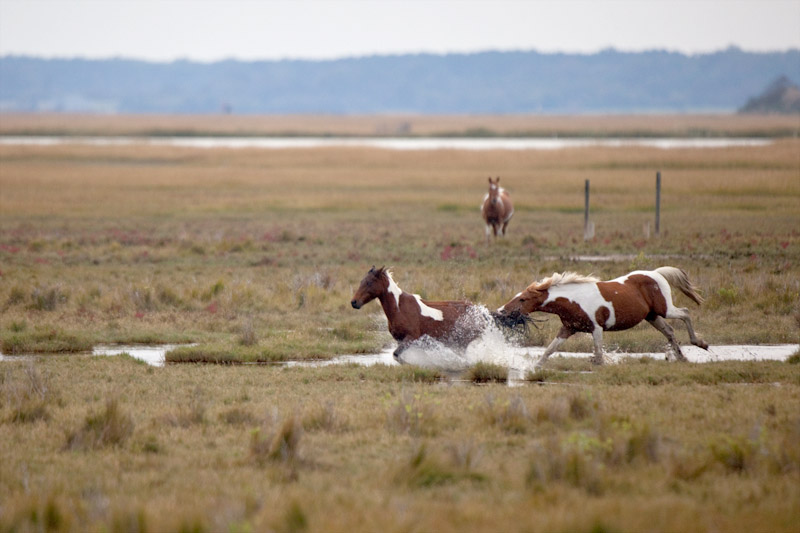
 I heard something and looked up and saw a drama.  At the time I thought perhaps a predator had spooked these two. But when I looked at the pictures later, I realized that it was horse politics.


One pony was chasing the other trying to bite it.


And it was determined to get the other horse, both were racing.


Their hooves were pounding.


The horses closer to me raised their heads in curiousity and I suspect to see if there was reason for them to take flight as well.  However, they only paused a moment before returning to their grazing.


 There are two sets of wild horses here - one on Assateague Island and one on Chincogeague.  Legend says the horses arrived when a Spanish galleon carrying wild mustangs sank nearby.  Perhaps they are descendants of horses turned loose by early settlers.  Through the years, penning became an annual event with historical records dating from 1835. Pony Penning is still an annual tradition with the ponies being herded up to swim the Assatague Channel.  Beginning in 1925, a carnival was held and colts sold to raise funds for the Chincoteague Volunteer Fire Company.  This tradition continues each year in July when over 50,000 people watch the horses swim and colts are still sold to keep the herd at manageable numbers. 

Marguerite Henry wrote three books which made the Pony Penning known throughout the world. I read the first after I got home.  "Misty of Chincoteague"  is a sweet book about two children who do odd jobs to save money to buy the pony of their dreams, Phantom.  There are two others in the series that I'm going to order from Amazon as my local bookstore only had the first.

I would like to have had more time to spend at Chincoteague. There were many trails that beckoned, a lighthouse to explore, a beach to enjoy, but we were beginning to run out of time and I had more places that I wanted to explore this trip.

Friday, October 29, 2010

Bombay Hook National WIldlife Refuge

Our first visit to Bombay Hook National Wildlife Refuge was in April of 2003.  One of the first sightings was a pair of ring neck pheasants.  As I rounded the bend to the first pool, the air seemed filled with flying egrets, herons, etc - giving it a primeval feel.  The ponds had many varieties of ducks and wading birds.  One of my favorite sunset sequences was shot on that visit:


Our first destination after leaving Cape May this fall was to Bombay Hook.  While we weren't there in time for sunrise, we were there early in the morning.


When we were there in April, the snow geese had already left, but for this October visit, the snow geese had arrived!  It is amazing to be there when the snow geese are flying.  The patterns they make in the sky are beautiful, and they are all calling to each other, so it is a beautiful cacophany of sound.  We paused and watched with wonder as they flew directly overhead.  

We drove the Auto Route, but most of the other birds that I was expecting had apparently already flown south for the winter.  Different season, different feel - much quieter, except for that first flight of geese overhead.  

I want to come back to Bombay Hook again in the spring when the other birds have returned, but since I had new places to visit, we regretfully said "good-bye" and headed on down the road. 


Cape May Sunsets


A cape is a pointed piece of land jutting out into a body of water.  Therefore, you have opportunities for both sunrise and sunset on the water.  Sunset Beach is on the western side of the cape and is a wonderful place to enjoy the sunset.  There are some lovely benches set up on the beach as well as the Sunset Beach Gift store and The Grille.

Also at Sunset Beach is an interesting shipwreck.  During World War I, about a dozen ships were constructed out of concrete because steel was scarce. One of these ships, the S.S. Atlantus, was docked at Cape May after the war. A 1926 storm ran her aground at Sunset Beach.  What is left of her hulk rests out in the water. 

As I was waiting for sunset, I chatted with folks sitting on the benches with me.  One of them introduced me to Cape May "diamonds."  She even gathered some for me from the beach while I was photographing the sunset. I realized after the fact that I had captured some of these "diamonds" during my sunrise shoot.  These "diamonds" catch the light of the rising or setting sun and when they are wet, they glow.  The reality is they are water polished quartz about the size of pearls.  You can buy polished ones at the gift store at Sunset Beach, but I treasure my gifts from a generous stranger.


I shot different angles and exposures trying to capture the setting sun and the waves whipped up by the wind that day. I suspect other days have much smaller waves hitting the beach, but I had a beautiful, tranquil sunset to capture with my camera and to enjoy.