Showing posts with label Water. Show all posts

Saturday, November 06, 2010

Water Studies

 I like to sit at streams with my camera finding different compositions with the water.  Fall is such a great time because the leaves land on the rocks, blanket the banks, and flowing down the water.

I've learned to photograph streams when they are shaded. The least bit of sunlight blows out the highlights in the water.  The other nice thing about shade is that it requires longer shutter speeds that give the water a soft, silky, flowing look.

I accidently left one of my lenses at home, so I played with using my 300-800mm lens to try to get "intimate" landscapes of the streams and leaves.


These last two are the same scene, just different compositions. 


Wednesday, June 25, 2008

Water studies

One of the field trips for the NANPA Colorado Regional Event was to the forks at Chicago Creek near the base of Mount Evans. Usually Colorado clouds up in the afternoon, but during the regional event we had good sunny weather the whole time. So I waited for a cloudy day and made my own trip to Chicago Creek.

The creek is surrounded by forest. When I first got there I was afraid it was going to be too dark. Even after the sun peeked out, the valley floor was still pretty dark. But I decided I would see what I could do even with the dark conditions.

I wanted to take several kinds of shots. I wanted the big picture shots, where you could see the creek and its surroundings. You can see what I mean about it being dark - to get the proper exposure, the water is very silky.
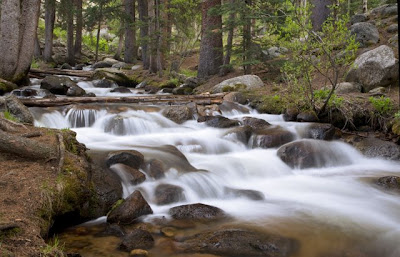


Then I wanted to zoom in and see what I could do with the cascades.
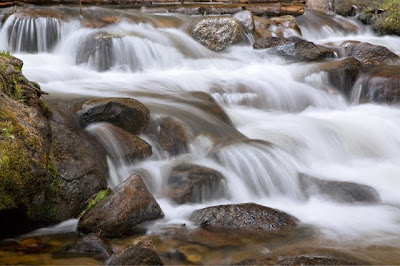


I had only taken my 24-105mm lens and I wondered if that was going to be enough to get the intimate landscapes in the creek that I was hoping for. I begin to zoom in closer more detailed shots of the water and the rocks.
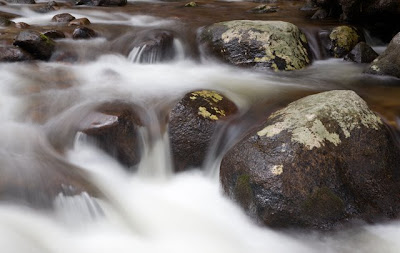


It is amazing how going vertical changes the image.
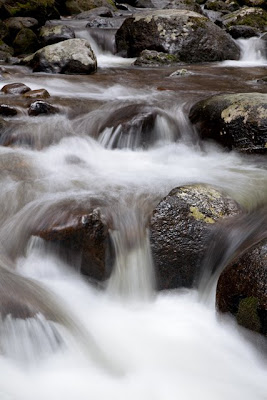


I then zeroed in on a couple of rocks to get an even more intimate landscape. I also played with saturation on this one.
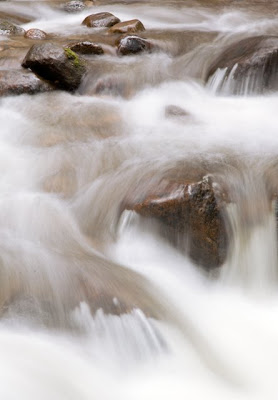


I was fascinated by the natural scallops in the water here.
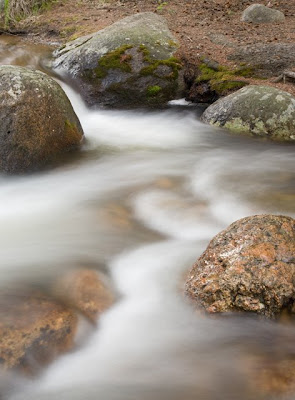


I stayed in one location quite a while, but decided that I need to check out some of the other areas along the creek to see what else I could find. I followed some of the same techniques - shooting both the larger view and trying to get those intimate landscapes.
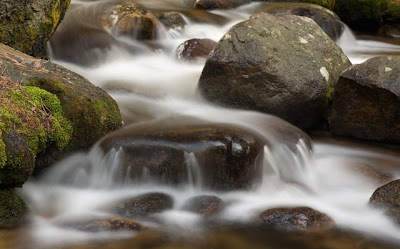


Tips for stream and water photography:

Shade or cloud cover is best to avoid getting blown out whites in the water.

Set your camera for aperture priority for the maximum sharpness of your lens. For me that is F/16. The amount of available light will determine how much water blur you will get. In very bright situations you can use a solid neutral density filter to reduce your shutter speed to make the water silkier. For this day I played with the ISO. Normally for landscapes I set the ISO to 100 which is the lowest possible on my camera to avoid noise. However, because the water was getting so blurred out I tried higher ISO's to see if I could get the look I wanted for the water.

Use a polarizing filter. I forgot on some of my shots, but it takes away some of the shine on the rocks bringing out their true color as well as giving more detail in the water.

Monday, April 14, 2008

Water Issues

When I was a freshman in college up in Canyon, Texas, I took a geology course. One of the topics was the aquifer for the Texas Panhandle, the Ogolala aquifer. I've paid attention to water issues ever since. I currently live in Central Texas where most our water comes from rivers and from the Edwards Aquifer. While the water issues here are different, keeping our aquifer pure and using groundwater resources rather than wells is important.

In the 1990's I served on two committees dealing with financing of the canals for the water which brings water from the Colorado River to the farmers in Arizona. So I learned more about Arizona water issues than I probably wanted to know.

Reader's Digesthas a good article this month about America's current water crisis.

As I browsed my news feed today, I came across yet another issue about water around the world.

My question: Are world leaders paying attention? What can we do to conserve water? As a nation and as a global community, we must find new ways of dealing with our precious resource.

Tuesday, October 02, 2007

Appreciating the little things - water

I have a new appreciation for the meaning of drawing bath water. Linda had warned me to enjoy my bath at Chanter's Guest House, because there were water issues at Namwianga. I am very impressed with the continual upgrading to the systems that is ongoing at Namwianga. They were in the process of trying to get a larger pump to fill the water tanks without depleting the well. But as is often the case, there were obstacles - hidden obstacles that took several days to work out. There was plenty of "lake water" but not plentiful well water.

Henry and I have been campers most of our lives - so we were not too concerned. One morning Linda offered to draw us a bath (which would mean literally carrying water to the tub and heating water on the stove.) I told her that was not needed - spit baths work just fine.

The next morning she had already drawn water in 5 gallon buckets and the water was already hot. You added enough treated lake water to the hot water to get the temperature you desired. A 2 quart pitcher dipped into the warm water and poured over my hair and body felt SO good! It really does not take a lot of water to leave your body feeling refreshed and clean.

And before long, the mystery of the disappearing well water was solved. I could really appreciate the warm water coming from the shower head, but I was still frugal with my water usage knowing we were at the end of the dry season.

As we travelled around the villages - the electric pumps that provide the water at Namwianga are also a luxury. At a fishing village, the "well" was a -8 foot pit with a small amount of water at the bottom. We saw children help pump water at hand pumps near their village (also a blessing - the pumps although human powered were new!). We saw women hauling water on their heads as well as people getting water at the local high school to carry home. One of the more distant villages had to haul water with oxcarts from the river which was quite a distance from their village. I believe they are next in line to get a bore hole. I hope I remember for a long time what a privilege and blessing it is to be able to walk over to a faucet and get clean, pure water.

At the hotel in Cape Town I enjoyed a wonderful, long shower - and appreciated the luxury of a long hot shower. And then again after the long flights home, even the shower in the RV (we spent our first night in the RV - since the air conditioner in the house was out) felt like luxury living.