Monday, June 28, 2010

Today's Adventurous Jeep Road

We're not going to be in Breckenridge long this trip, so I wanted to get out and enjoy the mountains this afternoon. We headed up over Boreas Pass, a nice gravel road that we've travelled many times before. We turned off to look at the Selkirk National Forest Campground near the south fork of the Tarryall River. We retraced our steps and found another road to the Tarryall River and decided to see if it lead over the mountains back to the Breckenridge side. The road started pretty much like most jeep roads, calm at first, then getting rockier where you had to be careful where you put your wheels so you don't bottom out. We were doing good . . . until . . . we came to a place where you went up before you went down and you couldn't see what you were doing. Then we weren't moving . . . stuck!


The front wheel had rolled over a steep hole, the center was bottomed, and the passenger rear tire had no traction and just spun.


Our jeep has a winch, but the Trailblazer doesn't. We were wishing for the winch!

We tried rocking it back and forth and while we got a little movement, the hole in front was too large to roll the tire back up.


Henry jacked the car up and put rocks and fallen wood to improve traction - no go.


We had started such that with no problems we should have gotten back to the main road on the other side before dark, but it was late enough in the afternoon/evening that I was concerned that the other travelers might have already gone home. It was obviously a well travelled road - lots of tire tracks. I knew the worse case scenario was that we would spend the night in the car on the mountain. We had water, sweaters and jackets, and a car for shelter. But I hadn't brought snacks. We would be hungry, but we'd be OK.

We thought about trying to hike back to the campground, but that was quite a ways back.

But I couldn't help hoping and praying that some one would pass by, someone with the right equipment or experience to get us unstuck. I could hear planes overhead. Henry thought he saw mountain goats on the nearby peak. And then I heard it, the sound of engines - not a plane in the air, engines on the ground moving our direction. YES! It was two young men on motorcycles. The working solution - they got on the back bumper and jumped up and down - forcing the back tires into contact with the ground. Sigh . . . we were unstuck, but the very next area had another tricky spot - one very easy to get stuck again. Carefully avoiding the tree on the right and the stump on the left and the bigger hole farther to the left, we made it through the muddy water crossing. The next stretch was a very steep uphill - 4 wheel low in low gear, the Trailblazer had no problems with that part.

Once again we were doing good. But then there was this snow drift. We'd crossed several that had appropriate tracks through them going fairly fast so we wouldn't get stuck. But this snow drift blocked the road with only space for motorcycles to follow the road. There was an alternative route through the trees, but it was narrow - with a big stump in the wrong place. In our first attempt we hit the tree on the right. We backed up and Henry tried to put some wood around the stump so we make it over. No . . . stuck again.

We had cell signal here and I got hold of Debra so that someone would know where we were and if we didn't get back in a reasonable length of time, someone could send the calvary to us.

We knew the motorcyclists were coming down behind us, so the contact with Debra was just for good measure. We waited. More wood around the stump and once again two young men on the back bumper rocking the car. Yes . . . past that part. But we had at least one more obstacle to get through - a bog where we could possibly get stuck once more. Our faithful motorcyclists stayed with us. By this point I would hardly call this path a road - dodging big rocks and deep ruts we bounced along. We sailed right through the blog and the next muddy stretch.

The motorcyclists assured us that we could make the rest. It turns out one of the used to work for River Mountain Lodge and lives next to the Resort Quest manager that used to be in charge at River Mountain. I told them that they were guardian angels for us this evening. They told us that they just couldn't leave until they knew we had gotten past the places where we could get stuck.

When we finally got to the gravel road at the Blue River area, I started texting Debra so she'd know we were back in civilization. As I texted her, she called me . . . the Melton telepathy at work. In short order we were back on a paved road and back at the condo!

Now - I'm unlikely to ever take that particular route unless I have the jeep with better ground clearance and winch, or 4 wheelers that are light enough to push out of trouble, etc. But I am so grateful that God always provides for us when we get ourselves stuck somewhere. We've never yet been stuck out in the middle of nowhere having to spend the night in the car unprepared. But next jeep road trip - I'm packing more water and snacks . . . just in case there is a first time to be stuck overnight.

By the way, while we were eating our dinner back at the condo, the front desk called. Andrew, the Resort Quest director, had called them to make sure we had made it home ok. Even far from home, God places us in good hands with caring people.

Tuesday, June 15, 2010

A Survivor's Tale

I met Julie Zickefoose several years back at the Festival of the Cranes at the Bosque del Apache in New Mexico. She and her husband were tour leaders. She is an expert birder, an incredibly talented artist as well as a talented musician. I've followed her blog ever since.

She has run a series of posts that I want to pass along to my readers. There is a tale here that needs to be read in order to be fully appreciated.

The first post: Meet Debbie Kaspari introduces us to another interesting and talented artist.

Julie had been in Oklahoma as the keynote speaker at the the Lesser Prairie Chicken Festival in Woodward, Oklahoma. While in Oklahoma she visited the Alabaster Caverns, the Wichita Mountains Wildlife Refuge. and her friends, travel writer/photographer, TIm Ryan and artist Debby Kasapari.

Julie's next post, An Oklahoma Eden shows an incredibly beautiful paradise that Debbie and her husband Mike had created. Certainly an inspiration for what beautiful natural spaces we can create in our home environments.

I grew up in the Texas Panhandle. In my household, the spring and early summer thunderstorms meant my grandfather came and picked up my mother and I so that if a tornado came our way, we would have access to the storm cellar in his backyard. I have vivid memories of near black menacing skies and a couple of times when we took shelter in that underground concrete shelter. I remember listening to the radio the night the big tornado hit Lubbock and the stories of the people who died when the tornado hit the lake houses near Clarendon. The sister of a friend of mine lost her leg that night. I'm really not afraid of too many things, but I have to say that the thing here on earth that I'm most afraid of is tornadoes.

Julie's next two posts tell the story of the May 10th tornado and how it impacted the lives of her friends. And I think they are worth sharing:

The May 10 Tornado

Aftermath of a Tornado

There are many worthwhile causes to donate money, but I wanted to add one more to your list. The Kaspari family will be struggling for awhile to get their life put back together. Apparently if you live in town, there are services to help you haul off the broken lumber from a flattened home and dead broken tree trunks. If you live in the country, you are on your own. There has been a fund set up to help this family. You can donate via Paypal or you can send a check:

Deborah Kaspari
Dept. of Zoology
University of Oklahoma
730 Van Vleet Oval
Room 314
Norman, OK 73019

Reading this story makes me ponder anew whether we should eventually add a Safe Room or an underground shelter of some sort. Fortunately, we live in Central Texas where tornadoes are infrequent. Because we do occasionally have tornadoes (Jarrell Texas is not that far from us), the idea does appeal to me to have a "safe" place to hide from these destructive storms. Some day . . .

Friday, June 11, 2010

The Butterfly's Demise

As I sit on my porch this year, we've had more butterflies than I remember from other years. Because we live in the country, we don't do a complete mow until the widlflowers have seeded out. So I've been enjoying watching the butterflies flit from flower to flower. One morning, I saw a butterfly near the horsemint bloom. One minute it was fluttering gracefully along. The next minute the wing beats were struggling and the butterfly was dangling upside down. I knew instantly what had happened, the butterfly had been attacked by a spider. The butterfly hadn't got stuck in a web, rather the spider had somehow bitten the butterfly as it was near the bloom. With my binoculars, I could see the small spider on the butterfly's body. The butterfly went limp and swayed in the breeze held by one strand of the spider's silky web thread. On one level, I should have gone and gotten my camera with a macro lens. It was certainly high drama. I'm pretty sure the butterfly was doomed from the first moment I saw its distress.Once the spider's venom paralyzed it, I'm pretty sure it couldn't have recovered. I don't think I could have changed the outcome even if I had tried to intervene. On one level, I'm ok with the spider getting its needed nourishment. It was amazing how that small spider could conquer the much larger butterfly. The spider was hiding inside the bloom of the horsemint, waiting patiently for its opportunity. How amazing is God's creation.

But another part of me grieved a little, because like most of us, I value butterflies more than I value spiders. I did some web searching and found one article about spiders that said that while spiders are beneficial to humans because they eat insects, that people generally find them unsavory because they tend to lurk in dark places, they often have a grotesque appearance, and their toxicity has been exaggerated. Spiders are also prey for other animals - some wasps paralyze spiders and lay their eggs on the paralyzed body for their young's first nourishment.

I want to value and appreciate all of God's creation. But I have to confess that various critters that invade my indoor space do not always survive to tell about it. When practical, yes, I relocate. But things like mice, wasps on the exterior of the house, little moths invading the interior, scorpions crawling on the floor don't always survive their encounter with me. But it is truly amazing to me the variety of animal species, all with a different purpose and a different diet. Some things I appreciate more in their native environments, but I wonder if there aren't wider applications to this story of the spider and the butterfly even if nothing more than to appreciate something for what it is - even when our first reaction is negative.

One of the things that went through my mind was from the story of Jonah. When Jonah was upset because God was not going to destroy Nineveh because the people had repented. God sent a vine that grew and brought joy to Jonah when he was discouraged. A worm came and chewed the vine and it withered and died. Both the vine and the worm were part of God's creation - fulfilling their intended purpose.

Father, help me to see the world through your eyes. Help me to value all parts of your creation - from the smallest microbes to the largest creatures of the sea - from the beautiful butterflies and birds to the spiders, vultures and hyenas. Help me also to value the people in your world. Some people are like the spider - hard to like or love. Father, help me to look for the good in the people around me and to value them as you do.

Monday, June 07, 2010

A Moment in Time

This is not one of my "usual" posts. But a newspaper article today brought back memories of an event long ago.

Crime and Punishment after 32 Years

Back in 1978, I was working the night shift, the graveyard shift, for the Department of Human Resources in South Austin. There is one night I remember vividly - at my "lunch" break, I needed to go out to my van to get the meal I had forgotten to bring in with me. The night watchman told me that he needed to escort me to my van because there was an active manhunt going on - a police officer had been shot nearby. When I saw the headline in today's Austin Statesman, I had a sinking feeling that it was going to be about Ralph Ablanedo's killer. I didn't have to read the article to remember the name Ablanedo - it is etched in my memory. It was a brutal, senseless murder and the next morning, David Powell was found hiding in a tree on the school grounds too close to where I worked. None of us at work felt very secure that evening, knowing that this extensive manhunt was going on around us.

1978 is truly a long time ago. The wheels of justice seem to have rolled very slowly to come to a conclusion on this case. Turns out Powell is only a year older than I. It is too easy for me to look back and think, "I was working, productive, sober, and responsible 32 years ago." But, today I'm older, slower, wiser - maybe. Am I a better person now than 32 years ago? Hard for me to know or judge. After so many years of incarceration, David Powell is certainly not the same person he was the night of the murder. I find it sad for many reasons that this case has continued on. Delayed closure for the Ablanedo family . . . prolonged uncertainty for David Powell and his family (and yes, I feel more grief for his family's ordeal of uncertainty and grief than his waiting time in prison.)

I remember another Texas death penalty case several years ago - a woman was executed who had turned her life around in prison. But once again, in youthful folly she was involved in a brutal murder. That story was also hard to follow . . . justice vs mercy for a life that had changed.

In some ways, life today still has moments where brutal murders, random, senseless death still occur. Sometimes it seems like there are more brutal crimes committed in these present years. Far too many young people are making poor choices during their teenage years when perhaps they are too young to fully understand all the ramifications of their actions.

The article in the Stateman is long by newspaper standards. Most people won't read all of it. It manages to cover most of the issues about the death penalty - determent, justice, is the person likely to commit another such crime, closure for the victim's family, etc.

I haven't chosen to listen to the video that goes with the article - an interview with David Powell. And I don't profess to have wisdom as to whether life in prison is a better alternative to the death penalty for this case specifically or for all cases. Too many issues . . . too many points of view . . . with reasonable arguments on both sides.

But I was too close to the action the night that Ralph Ablanedo died. I read the newspaper articles then that detailed how he was shot. While all policemen are not perfect, I want to live in a world where policemen are respected. They should not have to wonder each time they go out on patrol whether they will come home to their loved ones - and especially they shouldn't die making a routine traffic stop.

I also believe that there are consequences - both good and bad for what we do in life. We make choices either consciously or unconsciously every day. Sometimes our choices are good - benefiting ourselves and our families. Sometimes they are destructive - hurting ourselves and others. While I hate to see someone who may have turned their life around punished for something they did long in the past, there is a sense of justice needed here - we need to be accountable for what we do and for what we've done - both good and bad. We also need to get the word out to our young people that the choices they make when they are young can resonate through the rest of their lives.

There seems to be at least one more avenue of appeal for David Powell, I find myself not caring what the final outcome is - God is truly the final judge for David Powell. But this story needs an ending. I just hope that the final ending brings peace and closure for the Ablanedo family and that God gives David Powell's family and loved ones healing and acceptance for whatever the final decision brings.

This is such a lose-lose scenario. Sigh . . .

Thursday, May 27, 2010

The Mockingbird vs the Red Tailed Hawk

I like to sit on my front porch when I first get up. I never know what I'll get to see, but often I get to see something interesting in the natural world.

This morning, I noticed a Red Tail Hawk landing on the utility pole at my neighbor's house across the street. As I was watching him through my binoculars, I noticed that a mockingbird was attacking him. At first I thought the mocking bird was just flying near him to harrass him. But, no, this mockingbird was in full attack mode, nosediving him such that I could see the hawk shudder when contact was made. This went on repeatedly, but the hawk just stayed calm, unreacting as the mockingbird continued the attack. The mocking bird tired and landed within a foot or so of the hawk on the wires. It wasn't long before it took up the attack again. Finally, the long suffering hawk flew down to the ground and stayed for awhile, later flying off low to the ground.

The mystery is why was the mockingbird so determined to fight the hawk. Yes, mockingbirds are very territorial, so perhaps it was just a territory squabble. But it is nesting time, perhaps there was a nearby nest that the mockingbird was defending.

I have to give the mockingbird credit, the hawk was much larger, bigger claws and beak. Whether it was courage or stupidity, the mockingbird was certainly attacking a much larger, more powerful creature. I have to give the hawk some credit to, I suspect it could have easily taken out that annoying, pesky mockingbird, but chose not to act.

This sure reminds me of some human behaviors as well. As humans, we have territory issues as well and we can be pretty "courageous or stupid" when we defend those human boundaries. Sometimes we are like the hawk, ignoring those people trying to peck at us - choosing not to retaliate in kind.

Yes, there are many life lessons I learn by watching the wildlife from my front porch!

Thursday, April 22, 2010

James River Road

I love finding new places to explore. I had heard about the James River Road from several sources. I left early church retreat to try to capture some more Texas wildflower images. I headed first to Llano. Lunch was at Coopers Old Time Pit Bar-b-que! You go straight to the pits outside to get your meat and then inside to get the "fixins." The atmosphere inside is very informal with long benches that you share with the other folk around you. I don't remember eating there before, but I'll be back!

Since I hadn't done the James River Road, that was where I headed next using information from San Angelo Standard Times which gave not only great directions to the James River Road but also mentioned some additional wildflower loops around Mason, Texas.

I'm sure that Henry and I have never been here before. You take 87 south out of Mason and make two turns onto Farm to Market Roads before you finally reach this road. I was enchanted from the word go. The first place I got out to photograph flowers was extraordinarily fragrant from the thousands of bluebonnets surrounding me. The gentle breeze was wafting the scent into the air around me and I breathed in all the peace and serenity from such a wonderful fragrance.


The gravel road twists and curves through the hills with quite a few stream crossings as well cliffs and small waterfalls.


This public road crosses private land with the inevitable cattle guards and traffic impediments. I was the first of three cars going through this batch of cows. They stubbornly held their ground. I got within inches of them before they moved. But . . . the cars behind me had a clear path.


When I got to this stream crossing, there was a couple surveying it before crossing. The gentleman was out of the car trying to gauge how deep the water was and where the crossing was safest. I knew that two other cars had gone on ahead and had to have crossed safely. So after looking at it and the fence posts that seemed to be the guideline, I headed across. I knew that I must keep my forward momentum going, so I kept my foot steady on the gas pedal and went right straight through. It reminded me of crossing the river every day in Africa to get to one of the game preserves. Only I was the driver this time. Knowing that I had someone watching me probably made me bolder, but later I crossed it again coming back. I continued on my way, but began to get nervous about not waiting until the other couple made it across. What if they tried and got stuck - way out in the middle of nowhere? As I headed back, I passed them and we chatted. They had made it safely, but they had thought about it longer than I did before trying the crossing.


This next crossing is picturesque, but wasn't difficult to cross at all.


At the end of the afternoon, the sun peaked out giving me a chance to get some sunlight and a patch of blue sky on the scene. A neutral density graduated filter helped me keep the details in the sky and a good exposure on the bluebonnets.


I have more to work from the day, but this gives you a sample of how much fun I had exploring a new place!

Thursday, April 15, 2010

Winecups

We spent last night in Leakey, Texas. We awakened to another cloudy, rainy day. We headed south toward Concan and a patch of wildlfowers on HWY 127 between Concan and Sabinal.

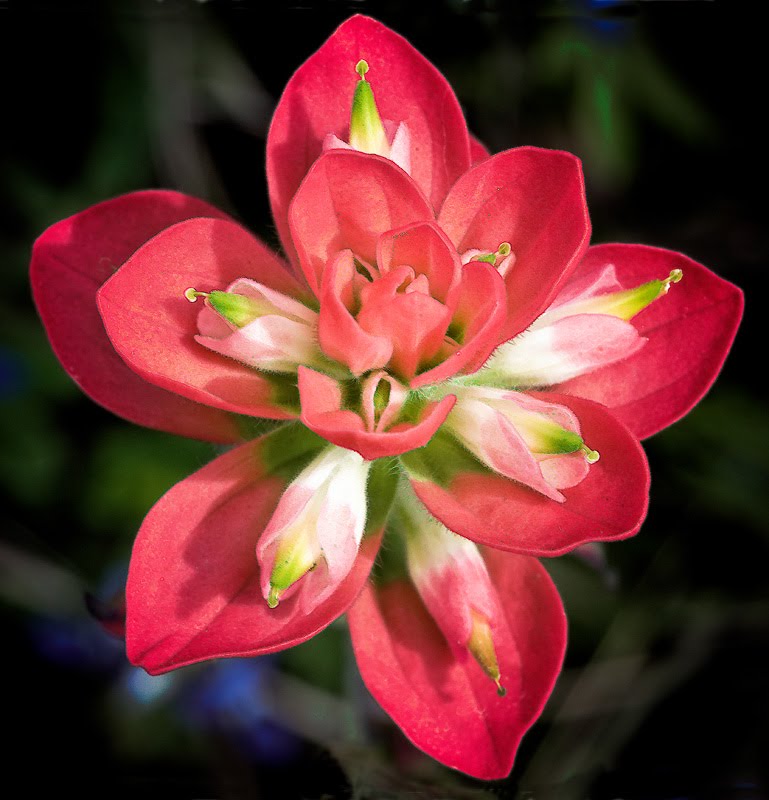
The highlight of the day was a beautiful large patch of wineups. So often I see one winecup mixed in with a bunch of bluebonnets or other wildflowers, but here it was solid and striking. In working the shot this evening, I found that Topaz BuzSim and Topaz sharpen helped me get the look I wanted for this shot.


I've tried many times to capture the details in a single winecup. Their stems are so flexible, the least bit of wind whips them around, so it always feels like you're trying to shoot a moving target. The fresh raindrops were a bonus on this attempt to capture these delicate wildflowers.

Tuesday, April 13, 2010

More Texas Wildflowers

Monday, we headed east and south to the La Bahia road. US 290 always has wonderful wildflowers. These were shot just west of Burton.

I was looking for attractive mixes of wildflowers and found a place where the bluebonnets and the paintbrush were intermingled. I started with the wide shots, getting the full riot of colors.


Then I worked my compositions closer, with more simplicity.


Concluding with a single bloom.


As I worked on these last night, I found myself going the DA route to get what I wanted. A radial gradient filter to darken the edges around the paintbrush and make it stand out from its background. Artistic filters that both simplified and sharpened.

Then I decided I wanted to see how this would look using polar coordinates to create a circle.

Monday, April 12, 2010

Spring in Texas!


Spring is my favorite time of year in Central Texas. This year has been especially delightful, because we've had two years of drought followed by a wet winter. The flowers are outstanding this year.

Today we headed west into the Hill Country near Johnson City and Fredericksburg. The bluebonnets are thick and beautiful!


I love how they form such a beautiful carpet under the trees and yucca.


I'm hoping I get enough chances to get out and see more of this amazing bloom year!

Thursday, April 08, 2010

Red Bay, Labrador


I was totally charmed by the small fishing villages in Labrador. The small historic towns each had their own charm. To photograph this one, I fought mosquitoes and another biting insect as I tried to bracket my shots and get decent photos to use. The lighting was such that my guess was correct that I needed to be shooting for HDR so I could catch the subtlety of the clouds and still get the town sufficiently exposed.

Red Bay was the 16th Century World Whaling capital. The Basques Whalers hunted whales in small boats called shallops to render into the oil that lit the Europe's lamps during the late Middle Ages. They built a whale oil factory on Saddle Island to produce this oil. The Basinview Bed & Breakfast has accomodations in Red Bay. Nearby Battle Harbor has accommodations in restored historic buildings. At Battle Harbor there are opportunities for boat tours to see whales and icebergs as well as seabirds.

Labrador is in the middle of an extraordinary road building project. These small village used to accessible only by boat. This new road goes from the Ferry Terminal at Cartwright and connects with the ferry terminal to New Fewfoundland at Blanc Sablon. We were amazed at the engineering behind this wonderful gravel road. Built high above the perma frost, it has a base of big boulders and towers above the small tiaga trees.


Southern Labrador is an area worth allowing time to explore and savor the beauty of the landscape as well as the ambiance of the historic villages. On a more extended visit to Labrador I would like to explore the northern village that still require the ferry for access.

Saturday, April 03, 2010

L'Anse Amour Historic Site and Point Amour LIghthouse

As we travelled south along the coast of Labrador, we had seen the L'Anse Amour historic site on the map. Since I am really interested in early man sites, this one captured my attention because it dates to 7500 years ago. As with many early man sites, there is not a lot to see - this was a special burial mound of an adolescent boy - special because there seems to have much ceremony related with the burial: The body was buried in a deep and wide pit, fires burned, food was cooked and weapons and tools were placed as offerings in the grave. A large stone was placed on the boy's back and a large mound of rocks were placed over the grave. The archaeologists believe that the elaborate detail of this burial means that this young man either had a special role or association with the tribe or there was something significant about his death. The site has been excavated and the human remains have been removed. Since the grave has been reconstructed, it loses a little of its historical sense for me - I always marvel when I see things still remaining from human activity so long ago.

I also knew I had a light house to enjoy - the Point Amour Lighthouse.

It was an overcast afternoon, and it looked like there was an event going on in one of the buildings. Lighthouses always need electricity so I explored trying to find a camera angle to minimize the distracting wires. As I was photographing I heard a noise coming from the sea, a harumph! I glanced over and a minke whale was feeding just off the shoreline, gracefully surfacing to breath. I was shooting with my landscape lens, so I didn't try to photograph the whale. Instead, I just enjoyed the magic of the moment, the quiet evening, the peaceful sea, and the amazing whale as it moved off into the distance.


I came back the next morning. The clouds were still covering the sky, but the light and clouds were still different than the evening before. While the whale was no longer hanging around, this lighthouse is still a peaceful and beautiful place to sit and enjoy the beauty around you.

Wednesday, March 17, 2010

Joyous Spring!


This year my pear tree was laden with blooms - almost more than I remember from other years. After a longer and colder winter, the signs of spring are especiailly welcome.

Thursday, March 04, 2010

Wrens

Last weekend I went on a field trip to Chalk Ridge Falls Nature Area below the dam at Stillhouse Hollow Lake. Right near the parking area we saw two wrens - a canyon wren and a rock wren. I wanted to go back with my big Sigma lens and see if I could get photos.

We went this morning. At first I was disappointed - no wrens in sight. But I meandered the path below the dam, rewarded by a sighting of a kestrel and a phoebe as well as watching the vultures (both turkey and black) begin their morning soaring, riding the thermals around the dam. As I was heading back to the car, I saw movement at the top of the boulders along the dam slope. Yes, it was the rock wren. But so much farther away than on Saturday. I dutifully took my photos, knowing quite well that I would have a little wren in a big picture. It would still be a good memory, even if not publishable quality.

I came on back to the car, and stopped to study the area where the water was spilling out. It was on these rocks that we had seen the canyon wren the day before. I was about to give up, when I saw movement again. Yes . . . it was the canyon wren, but really far away - a very small bird in a big frame. And there was a swallow as well, a rough winged swallow, I think.

I came home and took a look to see if I had anything and began to play with two of the images. Now one of the phrases of common wisdom in photography: "garbage in-garbage out" which means it is really difficult if not impossble to create a high quality image in photoshop when the original is not good. And, I agree with that statement which is one of the reasons I work really hard when I am working with the camera to capture the best image possible. But sometimes, that is not always possible. These two little birds were a long way away and not willing today to come down and play with me. I'm hoping to go back more than once with the big lens and hope that I get lucky enough that I have the chance to capture them up close and personal with publishable images. But I wanted to have images to share with the group that went birding last week.

I started with the rock wren. I picked the frame that looked the best and did the standard conversion from RAW. Then I used Genuine Fractals to enlarge the image, knowing I was going to be cropping a lot and would need all the details I could keep. Then I chose my crop, knowing that even with the crop, I would not be able to fill the frame and have a decent image. Then I went to Topaz Sharpen which can do a really nice job in bringing out details that are trying to hide in the pixels. I had to use enough Topaz that this really becomes "digital art" rather than straight photography.


I went in with the canyon wren and did things a little differently. I upsized in Camera Raw. I left him smaller in the final crop because there just wasn't enough detail to make him look good larger. Once again some creative work in photoshop left me a a image that if nothing else will be a great memory shot for me of one of the few canyon wrens I've ever seen.

Wednesday, March 03, 2010

Crab Pots

One of the main industries and certainly the oldest industry in Labrador is fishing.

I wanted to see what I could do artistically with these crab pots that we were seeing so frequently.


I was hoping to capture both texture and abstract ideas.


The colors are subtle, including the rusty frame.


And I was also trying to find views that would work as marine still lifes.


For many reasons, the fishermen in Labrador and Newfoundland face difficult challenges - declining catches, over fishing, fishing from foreign nations, and recession caused slower demand. I suspect that being a fisherman has always been a physically demanding profession, but for many reasons, I hope that the small fishermen in this area can find a way to continue this traditional way of life.

Tuesday, March 02, 2010

Bakeapples!


We had noticed a number of cars parked along the road in what seemed like the middle of nowhere. There were usually no people in sight. We wondered about it, but couldn't think of a good explanation. As we were enjoying our picnic lunch, we saw a lady coming back to her car carrying a plastic container and wearing high topped water proof boots. It was bakeapple season! And she was gracious enough even in a year that was not a good crop of bakeapples to give us a sample. She warned us that they were better with sugar. As we travelled through Labrador and Newfoundland, I took every opportunity to try bakeapples - bakeapple sunday, bakeapple cobbler, and bakeapple jam.

Bakeapples are orange berries in the bramble family (raspberries, blackberries) that grow in bogs, coastal marshes, and moors in far northern climates. In Scandinavia they are known as cloudberries. They grow in the Nordic countries, a few places in the moors of Britain and Ireland, Canada, Alaska, northern Minnesota, New Hampshire, Main and even a few on Long Island, New York. They don't propagate well, so if you don't live near an area where they grow wild, you are not likely to run across them. They require both male and female plants to create the berries from the blooms.

One source said they only produce one berry per plant which would certainly make them harder to get outside their growing areas.

We found them to be mild in flavor, slightly tart. We enjoyed them wild and fresh, but we also enjoyed the ice cream sauces, the jellies, and the baked products.

The Dark Tickle Company carries bakeapple jam that can be ordered and shipped. $15.00 is the minimum shipping charge for up to $25.00 worth of jam.

I brought home some small jars of jelly and jam for some of my friends, but I put them in a "safe" place. I can hardly wait till they come out of hiding so I can pass them around.

Monday, March 01, 2010

South from Cartwright

While there was a long string of cars leaving the ferry at the beginning of the road south from Cartwright, everyone travelled at their own rate. We were not in a big hurry, so before long we had the road to ourselves. I loved the local greeting!


This fish trap reminded me of one's we had seen on our Alaska trip.


This stretch of road is dotted with small fishing villages to visit. I was amazed at the ingenuity and use of local materials. Note the wooden platform boat ramp. We did not see much concrete up here.


I was fascinate by the nets hanging out to dry.


We were on the Islands and Coves loop. We saw these wooden sleds everywhere. So much of the land is "crown" land. People are allowed to cut wood on crown land and they leave the piles of wood, properly labeled, near where it is cut. Then in the winter, they make runs with these sleds to bring wood back home.


The small fishing villages are just so photogenic! I love the beautiful white frame houses and the small communities.


This is Fox Harbor Labrador.


We were thrilled to see an iceberg in the bay.

Sunday, February 28, 2010

Ferry - Happy Valley/Goose Bay to Cartwright

I love ferries! We've ridden short ones and long ones. I love being outside on the open water seeing what there is to see!

The weather was nice and mild as we left the harbor, so except for dinner time, I spent the rest of the daylight hours on the deck enjoying the clouds, the rainbow, and the sunset.

As we left the doc, the sun was peaking out behind some clouds above the horizon.


The clouds in front of the boat were also beautiful. I was taking photos in almost every direction.


When this rainbow first began to form it was very faint and very small. Henry and I were even debating whether it was really a rainbo


While it stayed small for awhile, it began to grow until it became this beautiful wide arc!


I love the tranquility of being aboard a ship at sunset. No chores are staring you in the face demanding attention. You are free to enjoy the salt air, the beautiful clouds, the vibrant colors as the sun sinks below the horizon - an ever changing scene. My camera stayed glued to my eye as a I tried to capture the beauty I was seeing.


Even after the sun had left the sky, the clouds were still mesmerizing. Henry pointed out this "angel."


As a Texas gal, I was glad to see the road runner in the sky!


We were pleasantly surprised to find that the ferry had wireless internet. I had started playing Farmville on this trip, and it was nice to be able to havest my "crops" before they withered.

We had checked on the possibilities for accommodations. There were 2 and 4 people cabins. While there was a four person one available where we would have both had a lower bunk, I thought it was too expensive. So we chose the dormitory style bunks. Each of these "dormitory rooms" slept 16 people in plywood bunks with mattresses and curtains. There was even a light above your bunk for reading. While some people might find the small cozy bunks claustrophobic, I only spent time there sleeping, so it was fine for me. Henry stayed up much later enjoying being out on the deck looking at the stars. He visited with one gentleman who was taking the ferry to see his village one last time before the ferry service ends. When Henry got back to the dorm room, the lights were out, and he chose not to climb up into a bunk in the dark - sleeping instead on one of the sleeping chairs in one of the lounges surrounded by other passengers who had chosen to sleep there.

It was a calm passage and morning came quickly.

Saturday, February 27, 2010

Happy Valley - Goose Bay - Cartwright

Coming down into the valley from Churchill Falls brought an abrupt change from short taiga, tundra trees to much taller trees lining the valley walls. We entered the city of Happy Valley around lunch time and enjoyed a meal at the local Burger King. I entered the grocery store to pick up some snacks and marveled that there were fresh strawberries from California here. Expensive! Happy Valley-Goose Bay is the largest population center with over 7,000 residents. Arriving at mid-day is not conducive to wonderful photographs, but we were scheduled to catch the ferry that afternoon, so I wanted memory shots.

This broad tidal plain, the mouth of the Churchill River was beautiful even under the noonday sun.


The town began in 1941 during the building of the Goose Bay Air Force Base, the largest military air base in northeastern North America. Interestingly enough, Goose Bay Airport is on the official NASA list of alternate Space Shuttle landing sites.

The Trans Labrador Highwy and the ferry system as well as the airport connect this community to the rest of the world. A new highway is under construction and due to be completed perhaps by the end of last year will replace the need for the Happy Valley/Goose Bay to Cartwright ferry. I'm glad we were visiting while the ferry was still running. There are some other fishing villages north of Happy Valley and Goose Bay that I suspect will still have a smaller ferry in operation. I would love to come back and visit those small villages as well as the Torngat Mountains National Park at the northern tip of Labrador.

Thursday, February 25, 2010

My Winter Backyard Birds

Because the weather was so cold and snowy the birds were flocking to my bird feeder. After driving around to get the scenic photos, I decided to sit on the porch (with the propane heater running) to see if I could get some snowy day bird photos. We were expecting two more bands of snow, so i was hoping maybe I would be lucky and get some snowy branches or birds with snow flakes on them. While we did more snow, it didn't accumulate, but I enjoyed my time on the porch. And I was pleased with the bird photos I got.

We get tons of white crowned sparrows in the winter. The adults are easy to identify with those solid white markings.


The juveniles lack those prominent white head markings and for years I've had trouble distinguishing them from chipping sparrows. I've been sure the ones near my house have all been juvenile white crowns because they are always hanging around the mature ones. Experienced birders always scoffed because chipping sparrows are a lot smaller than white crowns. On this snowy day, I had a lot of different juveniles whose markings differed from one another just slightly. After photographing them, I pulled out both my Sibleys Guide to Birds and my Sparrows of the United States and Canada. After careful comparisons between the juvenile white crowns and chipping sparrows, I'm very confident that the ones I saw were all juvenile white crowns. I noted that chipping sparrows have a darker beak, only one white wing bar, and darker legs. My birds had yellow orange legs, two distinctive white wing bars, and yellow orange beaks in addition to being similar in size to the adults.


I don't know how many juveniles I had, but as I'm going through the images, I have many more juvenile images than adults.


I was especially happy that this Lincoln sparrow visited while i was out with the camera. I'd seen him in the yard and was pretty certain that I had the correct ID, but a picture confirms the identification so much better because you have time to study the markings in detail with a bird that is not hopping around and flying off.


He came back several times giving me several opportunities to get a good shot of him.


One of my favorite winter yard birds is the Harris Sparrow. He's one of the larger sparrows, but I love how the bright browns and blacks contrast against that very white breast. He has such distinctive markings that I find him easy to identify. With the males and females looking alike, it keeps the identification simple.


When I first starting watching the orange crowned warblers in my yard, they were sneaky. They would come in quickly to eat and fly quickly away so fast you couldn't get the details in the field marks. Today, they were hungry and stayed around long enough for me to get some good photos.


The day wouldn't be complete without the cardinals.


Also seen coming to the feeder, red winged blackbird females, northern mockingbird, brown headed cowbirds, and Carolina chickadees.