Henry and I have our own system of exploring the refuge. We've been around the loops many times on the trips we've made. But I wanted to see the refuge with someone else's eyes. And I was hoping to get to parts of the refuge that were not open to the public. Plus a tour guide tells you background things you may not learn elsewhere. So, I signed up for two refuge tours.
My first one started at 2:00 in the afternoon. We loaded on to a big white school bus and headed off. At first the information was stuff I already knew. And it was not nearly as focused on identifying the little birds we drove by. But bit by bit, I warmed to the tour leader. In the big ponds the snags (the dead tree skeletons) had been planted dead as perches and roosts for the raptors, particularly the eagles. The open spaces in the dense coyote willow is chopped each year to allow the refuge visitors a better view into the ponds and fields where the cranes and the geese feed. I learned that the geese need at least three days to regain the weight they've lost during their migration. FIve or more days if they are too disturbed.
And yes, we did go back into areas of the refuge that you can't get to otherwise. While it was the same loop as we travelled with the Black Belt Birding, it was a different time of day and we saw more raptors. But still no turkeys!
For several reasons, I opted not to do the second tour. But it was nice to see the refuge through a volunteer's eyes. There are a number of retired people who spend the winter as volunteers at the refuge. If it is like Santa Ann NWR, you do 24 hours a week of volunteer work and get to park your RV at the refuge. The minimum stay during the winter at the Bosque is 4 months. Hum . . . . I could see doing that one winter!


Showing posts with label Bosque del Apache. Show all posts
Showing posts with label Bosque del Apache. Show all posts
Saturday, November 18, 2006


Birding by Ear
One of the things that has impressed me both at the Rio Grande Valley Birding Festival and here at the Bosque is people's ability to recognize the bird songs and calls. So I was eager to attend this workshop. The presenter did a great job teaching us what to listen for to learn the calls. It is like learning a language with a new set of vowels, consonants, musical sequences, low notes, high notes, buzzy notes, clear notes, fast rhythms, and slow rhythms. The time passed quickly as we listened to his selection of bird calls to help us learn what to listen for. I liked his teaching style because he helped each of us listen with our own unique style. Many times the guide books give human words to the bird sounds (such as chicka dee dee dee), but each of us hears and interprets things uniquely. His activities with us helped us start making those links in our own brain's vocabulary. He also stressed the need to be patient with ourselves, this skill takes time and much practice. He's been at it over 20 years.
Some of his recommendations for learning tools were things I had bought at the RGV Birding Festival - the Peterson Field Guide CD's and the Stokes CD's. I've got them loaded on my computer and will soon have them on my IPOD. One more set of things to listen to as we drive down the road!
These were listed as good references. The Stokes guide is very good about saying which bird you are going to hear and then giving the bird call which makes for easy study on your IPOD.
Peterson Field Guides - Western Birding by Ear
Peterson Field Guides - Birding by Ear East/Central
Stokes Field Guide to Bird Songs - Eastern Region
Stokes Field Guide to Bird Songs - Western Region
Some of his recommendations for learning tools were things I had bought at the RGV Birding Festival - the Peterson Field Guide CD's and the Stokes CD's. I've got them loaded on my computer and will soon have them on my IPOD. One more set of things to listen to as we drive down the road!
These were listed as good references. The Stokes guide is very good about saying which bird you are going to hear and then giving the bird call which makes for easy study on your IPOD.
Peterson Field Guides - Western Birding by Ear
Peterson Field Guides - Birding by Ear East/Central
Stokes Field Guide to Bird Songs - Eastern Region
Stokes Field Guide to Bird Songs - Western Region
Thursday, November 16, 2006
Keynote Speaker - Julie Zickefoose
I had met Julie briefly at the Black Belt Birding Event. Her husband, Bill Thompson, rode in my van. They began the evening with Bill playing his guitar to accompany Julie's song with a lovely set of photos on the screen.. Her speech was a delight. She told of three sets of animal rescues that she and her family had done over the last few years. I was charmed by the story that is also available on NPR, "My Hummingbird Summer" . They ended up with four baby humingbirds that required feeding every 20 minutes. The story of the bonding, the personalities of the hummers, and the continued relationship even after release is heartwarming and well worth the time to hear her tell the stories.
"When Hummingbirds Come Home" tells the story of the following summer when at least one of the hummers returned.
Another year, they had baby chimney swifts, another remarkable tale.
July is an artist, a writer, and a wonderful story teller. She has a new book that also looks to be worth reading,
Letters from Eden: A Year at Home, In the Woods.
When checking out the rest of her books at Amazon, I found many interesting titles.
I was glad I got to hear her stories first hand. She combines her love of nature, her art, and her role of mother of two children and shares her fascinating world with us.
"When Hummingbirds Come Home" tells the story of the following summer when at least one of the hummers returned.
Another year, they had baby chimney swifts, another remarkable tale.
July is an artist, a writer, and a wonderful story teller. She has a new book that also looks to be worth reading,
Letters from Eden: A Year at Home, In the Woods.
When checking out the rest of her books at Amazon, I found many interesting titles.
I was glad I got to hear her stories first hand. She combines her love of nature, her art, and her role of mother of two children and shares her fascinating world with us.
The Photo Contest
I've had the opportunity to photograph at the Bosque two different years now. While there are many opportunities for crane and snow goose shots, there are many other raptors, ducks songbirds on the refuge. The backdrop is the ponds, the beautiful New Mexico scenery and the crimson sunsets. I've been trying to get my work out in more places, so I submitted 9 photos.
During the Annual Friends Dinner, they announced the winners of the contest. I was overjoyed to have picked up a 2nd place and a 3rd place. I was also very well pleased with my prizes - a plamp and a Canon compact flash card holder (6 slots). When we actually went in to the display, I found that I had an honorable mention as well and that all of my photos had made the exhibit.
It is fun to watch people study your work. Some turned the photos over to see who the photographer was. There were some beautiful photos to enjoy. I was proud to be part of such a great display.
During the Annual Friends Dinner, they announced the winners of the contest. I was overjoyed to have picked up a 2nd place and a 3rd place. I was also very well pleased with my prizes - a plamp and a Canon compact flash card holder (6 slots). When we actually went in to the display, I found that I had an honorable mention as well and that all of my photos had made the exhibit.
It is fun to watch people study your work. Some turned the photos over to see who the photographer was. There were some beautiful photos to enjoy. I was proud to be part of such a great display.
Black Belt Birding
I confess I felt a little intimidated by the name, especially after my time in the Valley where I'd been around so many birders who seemed to know every bird right off the top of their head. But my guide for the day, Emerson Learn greeted us enthusiastically. We started the day at the refuge headquarters at 5:30. The Black Belt Birding group broke up into two groups and loaded up into vans.
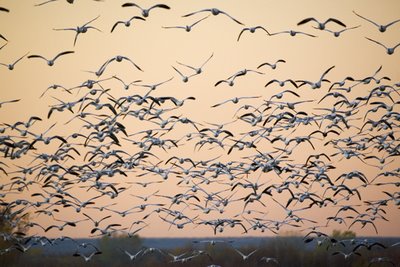
First stop, the Flight Deck, where we watched the snow geese take off. Bill Thompson was our other leader. He is editor for Bird Watcher's Digest. He pulled out his scope and we got a good look at the difference between a Ross's goose and a snow goose.
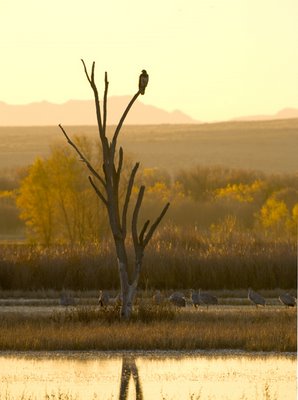
We also checked the snags for raptors.
We loaded up and drove over to one of the other decks and were treated to a gopher working on his hole Next stop was to see where the belted kingfisher usually hangs out. He was a no show. We also went over to see if we could see the dipper, but likewise he was a no show. But we saw ruby crowned kinglets in the trees. One of our group was hoping to see a sora - one of the rails that lives at the refuge. Bill Thompson had a birding IPOD, and they heard the sora answer the call. The batteries gave out and the sora declined to make an appearance. But now I know one place to look for a sora as I make my loops around the refuge. We paused at one of the places where eagles hang out and found a dark morph red tailed hawk. I was amazed that one of our group spotted it. It was the color of the dead branch and blended right in. We got a good look at it through one of the scopes.
Then we headed to a part of the refuge that is closed to the public. When the geese first come in, they need 3-5 days to recover from their long flight. This area gives them a place away from people to regain some of their weight. Wild turkeys live back here, but they were also hiding well in the underbrush. Close to the Bill Norton Blind we saw a tree full of lesser goldfinches - what a delight.
I don't want to forget one of the other treats on this outing. They had prepared bags for each of us. Not any garden variety paper bag, no siree. We got beautiful cloth bags with this year's design labeled black belt birding. Inside was a beautiful mug, jalepeno cheese bagels, an apple, a banana, a bottled water, and two different slices of fruit bread. We munched on these goodies all morning. What a great souvenir for a wonderful morning.
This is one event I would gladly do again next year. In fact, I'll probably sign up for it more than once. Emerson Learn is one of the past presidents of the Friends of the Bosque and an avid birder. Going birding with him is truly a fun education.
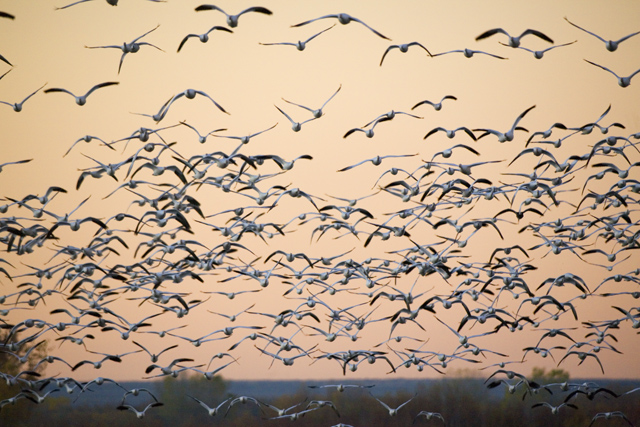
First stop, the Flight Deck, where we watched the snow geese take off. Bill Thompson was our other leader. He is editor for Bird Watcher's Digest. He pulled out his scope and we got a good look at the difference between a Ross's goose and a snow goose.

We also checked the snags for raptors.
We loaded up and drove over to one of the other decks and were treated to a gopher working on his hole Next stop was to see where the belted kingfisher usually hangs out. He was a no show. We also went over to see if we could see the dipper, but likewise he was a no show. But we saw ruby crowned kinglets in the trees. One of our group was hoping to see a sora - one of the rails that lives at the refuge. Bill Thompson had a birding IPOD, and they heard the sora answer the call. The batteries gave out and the sora declined to make an appearance. But now I know one place to look for a sora as I make my loops around the refuge. We paused at one of the places where eagles hang out and found a dark morph red tailed hawk. I was amazed that one of our group spotted it. It was the color of the dead branch and blended right in. We got a good look at it through one of the scopes.
Then we headed to a part of the refuge that is closed to the public. When the geese first come in, they need 3-5 days to recover from their long flight. This area gives them a place away from people to regain some of their weight. Wild turkeys live back here, but they were also hiding well in the underbrush. Close to the Bill Norton Blind we saw a tree full of lesser goldfinches - what a delight.
I don't want to forget one of the other treats on this outing. They had prepared bags for each of us. Not any garden variety paper bag, no siree. We got beautiful cloth bags with this year's design labeled black belt birding. Inside was a beautiful mug, jalepeno cheese bagels, an apple, a banana, a bottled water, and two different slices of fruit bread. We munched on these goodies all morning. What a great souvenir for a wonderful morning.
This is one event I would gladly do again next year. In fact, I'll probably sign up for it more than once. Emerson Learn is one of the past presidents of the Friends of the Bosque and an avid birder. Going birding with him is truly a fun education.
Wednesday, November 15, 2006
Duck Butts
The wildlife manager at the Bosque presented a wonderful program about the water birds that frequent this area. There are "wet butts" and "dry butts" - check out how the tails ride in the water when the birds are swimming. The other amazing thing - the duck-like birds can all feed cooperatively together peacefully, because they are all eating something different. Some eat the clams at the bottom of the marshes. Some eat fish, others eat the tubers of the water plants.
After the program I went out to the refuge. I think it will get easier to identify these birds. There will also be field trips related to this seminar. Unfortunately, they are all full for this year.
Tomorrow morning is an early morning - I'll need to be at the Bosque at 5:30 for Black-belt Birding.
After the program I went out to the refuge. I think it will get easier to identify these birds. There will also be field trips related to this seminar. Unfortunately, they are all full for this year.
Tomorrow morning is an early morning - I'll need to be at the Bosque at 5:30 for Black-belt Birding.
Burrowing Owls
My first activity on Wednesday was a presentation on burrowing owls put on by two ladies that are involved in research projects here in New Mexico. I knew that the populations of burrowing owls was declining - due to loss of habitat and the reduced number of prairie dogs. What I did not know was how little is known about certain aspects of burrowing owls' lives. I thought that burrowing owls were permanent residents in the Texas panhandle. Now I'm not so sure. It seems that they do migrate, but no one knows exactly where they go. They are doing research in New Mexico. They put radio collars on 26 burrowing owls and were hoping to locate them in Mexico. The last two years they have done some extensive studies of burrowing owls in Mexico. They were hoping to use the radio signals to locate the wintering owls. Unfortunately, no radio owls or banded owls have been found in Mexico.
They brought both a burrowing owl and a barn owl, both rehab animals used for education purposes.
I'm hoping I get to hear more about what they learn about burrowing owls over the next few years.
They brought both a burrowing owl and a barn owl, both rehab animals used for education purposes.
I'm hoping I get to hear more about what they learn about burrowing owls over the next few years.
Deadly Beauty Behavior
I got to the "Owl Bar" early. We joined our falconer and drove about 15 miles east of San Antonio, New Mexico. He had with him a peregrin falcon and a Harris hawk. The plan was to watch the peregrin hunt and then watch the Harris hawk. We had a moment of watching the peregrin chasw one of the homing pigeons. However, this morning the peregrin decided that the wide open sky beckoned him. Fortunately the falconer was able to relocate the peregrin after about an hour. We did get acquainted with the Harris hawk as well. Harris hawks are very gregarious animals. They live and hunt in family units. This hawk explored the top of many our vehicles. He enjoyed riding on the shoulder of several of the participants. He wears bells on his legs so that his handler will always know when he takes off.
I also learned some interesting things about hawk behavior. One of them, I think it is the peregrin imprints on its original nesting area. They learned this because when they were reintroducing them (after the DDT had been removed and the birds were recovering), they put food on platforms for the newly relocated birds. The birds began nesting on these platforms, and then increased to nestin on other flat objects such as porches. Another bird was raised in a play pen. When it was time to breed it, they set up a nice flat gravel area. It ignored it. Then one day the bed was unmade and the bird began mating behaviors. It had found its "nest".
I had a chance to talk to some local people about the rare aplomado falcon. Henry and I remember seeing this bird in southern New Mexico 15-20 years ago. Apparently the birds are no longer nesting where we saw them. I saw some empty nests on my way to Ruiodoso. I would love to get back to the area in the summer to see which birds are using those nests.
On the way back to the "Owl Bar," we stopped and got a great look at a prairie falcon that was perched on one of the power line platforms. As it flew off, we got a good look at the markings under the wings.
Even though the event did not go as planned, it was still worthwhile and fun.
I also learned some interesting things about hawk behavior. One of them, I think it is the peregrin imprints on its original nesting area. They learned this because when they were reintroducing them (after the DDT had been removed and the birds were recovering), they put food on platforms for the newly relocated birds. The birds began nesting on these platforms, and then increased to nestin on other flat objects such as porches. Another bird was raised in a play pen. When it was time to breed it, they set up a nice flat gravel area. It ignored it. Then one day the bed was unmade and the bird began mating behaviors. It had found its "nest".
I had a chance to talk to some local people about the rare aplomado falcon. Henry and I remember seeing this bird in southern New Mexico 15-20 years ago. Apparently the birds are no longer nesting where we saw them. I saw some empty nests on my way to Ruiodoso. I would love to get back to the area in the summer to see which birds are using those nests.
On the way back to the "Owl Bar," we stopped and got a great look at a prairie falcon that was perched on one of the power line platforms. As it flew off, we got a good look at the markings under the wings.
Even though the event did not go as planned, it was still worthwhile and fun.
Monday, November 13, 2006
Festival of the Cranes
Well, we made the 950+ miles and are now in Socorro, New Mexico. While I have been to the Bosque del Apache before, I've never been to the Festival of the Cranes. I have chosen a lighter schedule, but I'll still be going out at either sunrise or sunset to watch the cranes and geese. And, of course, I'll be blogging.
My first event . . . . "Deadly Beauty Behavior," a raptor demonstration.
My first event . . . . "Deadly Beauty Behavior," a raptor demonstration.
Tuesday, December 20, 2005
A Photographer's Winter Morning

Early morning is a special time. Symbolically it is the start of a new day. While I am not a "morning" person, sunrises are worth getting up for. As a photographer, getting to your photographic spot well before dawn is important. Part of the experience is seeing the world turn from a dark, black and white place in a crescendo of brilliant colors. That first hint of glow in the east is a promise of a new beginning. And the sky joyfully gets brighter and brighter until the glory of the sun finally breaks the horizon in a golden burst.
The early morning is also a good time to view animals. We had a chance to go back to Bosque del Apache in New Mexico. In the winter months thousands of snow geese, sandhill cranes, and other water fowl migrate here to spend the winter. Arriving at the refuge before dawn allows one to experience these beautiful creatures' morning rituals.
The snow geese stay together in flocks of several thousand. They come and go in a noisy group of powerful, beating wings and loud, honking calls. This year they seemed to make one initial move before dawn filling the sky in the distance with beautiful white graceful V-shaped lines. So our first task each morning was to discover which pond they had chosen. Our first morning was the coldest, the ponds had a layer of ice. We found many of the snow geese asleep on top of the ice. The beautiful golden rays of the rising sun gave them almost a heavenly lighting. It was fun to watch them wake up, go through their morning grooming rituals, and then doze off again, floating in the water with their heads tucked under their wing.

As a photographer, I wanted to capture their incredible take off. I discovered that you do have a few moments warning. Something will startle them, they all begin honking. Sometimes it is a false alarm and they settle back in to splashing and grooming. But other times, that caucophony of sound is the signal, and they all leave the pond at once.
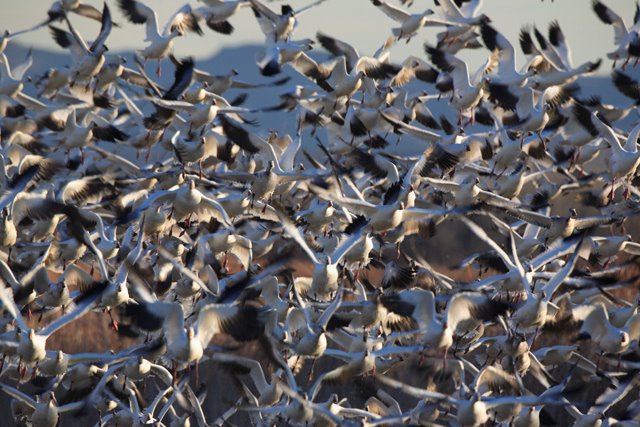
Each day I positioned myself in a different place to try to capture the magic of thousands of birds in close proximity taking to the air at once. I tried slow shutter speeds to catch an artistic blur and I tried faster shutter speeds to get sharp details on each bird.

The sandhill cranes have a total different morning regimen. The frantic flight of the geese leaves them undisturbed. The cranes leave for the feeding grounds in family groups of two to five. They run across the ice or water in order to gain enough momentum for flight.

There are also signs to watch for to be prepared to capture their take off. You will see a group begin to stretch their necks out together in one direction. It is almost as though they have to psyche themselves up. If you are patient and quick with your shutter finger, you can catch them in the act of running and slipping clumsily on the ice before they are finally airborne in an incredible graceful flight. Because so many congregate on the ponds, you have plenty of opportunities to practice your panning and your eye-hand coordination to capture their beauty and grace.
Subscribe to:
Posts (Atom)