Thursday, April 15, 2010

Winecups

We spent last night in Leakey, Texas. We awakened to another cloudy, rainy day. We headed south toward Concan and a patch of wildlfowers on HWY 127 between Concan and Sabinal.

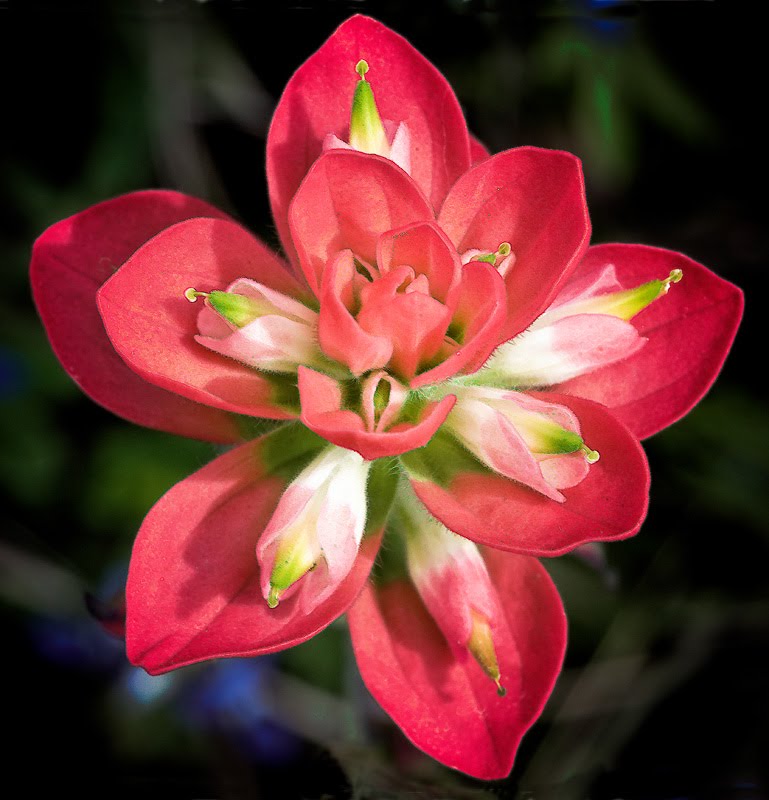
The highlight of the day was a beautiful large patch of wineups. So often I see one winecup mixed in with a bunch of bluebonnets or other wildflowers, but here it was solid and striking. In working the shot this evening, I found that Topaz BuzSim and Topaz sharpen helped me get the look I wanted for this shot.


I've tried many times to capture the details in a single winecup. Their stems are so flexible, the least bit of wind whips them around, so it always feels like you're trying to shoot a moving target. The fresh raindrops were a bonus on this attempt to capture these delicate wildflowers.

Tuesday, April 13, 2010

More Texas Wildflowers

Monday, we headed east and south to the La Bahia road. US 290 always has wonderful wildflowers. These were shot just west of Burton.

I was looking for attractive mixes of wildflowers and found a place where the bluebonnets and the paintbrush were intermingled. I started with the wide shots, getting the full riot of colors.


Then I worked my compositions closer, with more simplicity.


Concluding with a single bloom.


As I worked on these last night, I found myself going the DA route to get what I wanted. A radial gradient filter to darken the edges around the paintbrush and make it stand out from its background. Artistic filters that both simplified and sharpened.

Then I decided I wanted to see how this would look using polar coordinates to create a circle.

Monday, April 12, 2010

Spring in Texas!


Spring is my favorite time of year in Central Texas. This year has been especially delightful, because we've had two years of drought followed by a wet winter. The flowers are outstanding this year.

Today we headed west into the Hill Country near Johnson City and Fredericksburg. The bluebonnets are thick and beautiful!


I love how they form such a beautiful carpet under the trees and yucca.


I'm hoping I get enough chances to get out and see more of this amazing bloom year!

Thursday, April 08, 2010

Red Bay, Labrador


I was totally charmed by the small fishing villages in Labrador. The small historic towns each had their own charm. To photograph this one, I fought mosquitoes and another biting insect as I tried to bracket my shots and get decent photos to use. The lighting was such that my guess was correct that I needed to be shooting for HDR so I could catch the subtlety of the clouds and still get the town sufficiently exposed.

Red Bay was the 16th Century World Whaling capital. The Basques Whalers hunted whales in small boats called shallops to render into the oil that lit the Europe's lamps during the late Middle Ages. They built a whale oil factory on Saddle Island to produce this oil. The Basinview Bed & Breakfast has accomodations in Red Bay. Nearby Battle Harbor has accommodations in restored historic buildings. At Battle Harbor there are opportunities for boat tours to see whales and icebergs as well as seabirds.

Labrador is in the middle of an extraordinary road building project. These small village used to accessible only by boat. This new road goes from the Ferry Terminal at Cartwright and connects with the ferry terminal to New Fewfoundland at Blanc Sablon. We were amazed at the engineering behind this wonderful gravel road. Built high above the perma frost, it has a base of big boulders and towers above the small tiaga trees.


Southern Labrador is an area worth allowing time to explore and savor the beauty of the landscape as well as the ambiance of the historic villages. On a more extended visit to Labrador I would like to explore the northern village that still require the ferry for access.

Saturday, April 03, 2010

L'Anse Amour Historic Site and Point Amour LIghthouse

As we travelled south along the coast of Labrador, we had seen the L'Anse Amour historic site on the map. Since I am really interested in early man sites, this one captured my attention because it dates to 7500 years ago. As with many early man sites, there is not a lot to see - this was a special burial mound of an adolescent boy - special because there seems to have much ceremony related with the burial: The body was buried in a deep and wide pit, fires burned, food was cooked and weapons and tools were placed as offerings in the grave. A large stone was placed on the boy's back and a large mound of rocks were placed over the grave. The archaeologists believe that the elaborate detail of this burial means that this young man either had a special role or association with the tribe or there was something significant about his death. The site has been excavated and the human remains have been removed. Since the grave has been reconstructed, it loses a little of its historical sense for me - I always marvel when I see things still remaining from human activity so long ago.

I also knew I had a light house to enjoy - the Point Amour Lighthouse.

It was an overcast afternoon, and it looked like there was an event going on in one of the buildings. Lighthouses always need electricity so I explored trying to find a camera angle to minimize the distracting wires. As I was photographing I heard a noise coming from the sea, a harumph! I glanced over and a minke whale was feeding just off the shoreline, gracefully surfacing to breath. I was shooting with my landscape lens, so I didn't try to photograph the whale. Instead, I just enjoyed the magic of the moment, the quiet evening, the peaceful sea, and the amazing whale as it moved off into the distance.


I came back the next morning. The clouds were still covering the sky, but the light and clouds were still different than the evening before. While the whale was no longer hanging around, this lighthouse is still a peaceful and beautiful place to sit and enjoy the beauty around you.

Wednesday, March 17, 2010

Joyous Spring!


This year my pear tree was laden with blooms - almost more than I remember from other years. After a longer and colder winter, the signs of spring are especiailly welcome.

Thursday, March 04, 2010

Wrens

Last weekend I went on a field trip to Chalk Ridge Falls Nature Area below the dam at Stillhouse Hollow Lake. Right near the parking area we saw two wrens - a canyon wren and a rock wren. I wanted to go back with my big Sigma lens and see if I could get photos.

We went this morning. At first I was disappointed - no wrens in sight. But I meandered the path below the dam, rewarded by a sighting of a kestrel and a phoebe as well as watching the vultures (both turkey and black) begin their morning soaring, riding the thermals around the dam. As I was heading back to the car, I saw movement at the top of the boulders along the dam slope. Yes, it was the rock wren. But so much farther away than on Saturday. I dutifully took my photos, knowing quite well that I would have a little wren in a big picture. It would still be a good memory, even if not publishable quality.

I came on back to the car, and stopped to study the area where the water was spilling out. It was on these rocks that we had seen the canyon wren the day before. I was about to give up, when I saw movement again. Yes . . . it was the canyon wren, but really far away - a very small bird in a big frame. And there was a swallow as well, a rough winged swallow, I think.

I came home and took a look to see if I had anything and began to play with two of the images. Now one of the phrases of common wisdom in photography: "garbage in-garbage out" which means it is really difficult if not impossble to create a high quality image in photoshop when the original is not good. And, I agree with that statement which is one of the reasons I work really hard when I am working with the camera to capture the best image possible. But sometimes, that is not always possible. These two little birds were a long way away and not willing today to come down and play with me. I'm hoping to go back more than once with the big lens and hope that I get lucky enough that I have the chance to capture them up close and personal with publishable images. But I wanted to have images to share with the group that went birding last week.

I started with the rock wren. I picked the frame that looked the best and did the standard conversion from RAW. Then I used Genuine Fractals to enlarge the image, knowing I was going to be cropping a lot and would need all the details I could keep. Then I chose my crop, knowing that even with the crop, I would not be able to fill the frame and have a decent image. Then I went to Topaz Sharpen which can do a really nice job in bringing out details that are trying to hide in the pixels. I had to use enough Topaz that this really becomes "digital art" rather than straight photography.


I went in with the canyon wren and did things a little differently. I upsized in Camera Raw. I left him smaller in the final crop because there just wasn't enough detail to make him look good larger. Once again some creative work in photoshop left me a a image that if nothing else will be a great memory shot for me of one of the few canyon wrens I've ever seen.

Wednesday, March 03, 2010

Crab Pots

One of the main industries and certainly the oldest industry in Labrador is fishing.

I wanted to see what I could do artistically with these crab pots that we were seeing so frequently.


I was hoping to capture both texture and abstract ideas.


The colors are subtle, including the rusty frame.


And I was also trying to find views that would work as marine still lifes.


For many reasons, the fishermen in Labrador and Newfoundland face difficult challenges - declining catches, over fishing, fishing from foreign nations, and recession caused slower demand. I suspect that being a fisherman has always been a physically demanding profession, but for many reasons, I hope that the small fishermen in this area can find a way to continue this traditional way of life.

Tuesday, March 02, 2010

Bakeapples!


We had noticed a number of cars parked along the road in what seemed like the middle of nowhere. There were usually no people in sight. We wondered about it, but couldn't think of a good explanation. As we were enjoying our picnic lunch, we saw a lady coming back to her car carrying a plastic container and wearing high topped water proof boots. It was bakeapple season! And she was gracious enough even in a year that was not a good crop of bakeapples to give us a sample. She warned us that they were better with sugar. As we travelled through Labrador and Newfoundland, I took every opportunity to try bakeapples - bakeapple sunday, bakeapple cobbler, and bakeapple jam.

Bakeapples are orange berries in the bramble family (raspberries, blackberries) that grow in bogs, coastal marshes, and moors in far northern climates. In Scandinavia they are known as cloudberries. They grow in the Nordic countries, a few places in the moors of Britain and Ireland, Canada, Alaska, northern Minnesota, New Hampshire, Main and even a few on Long Island, New York. They don't propagate well, so if you don't live near an area where they grow wild, you are not likely to run across them. They require both male and female plants to create the berries from the blooms.

One source said they only produce one berry per plant which would certainly make them harder to get outside their growing areas.

We found them to be mild in flavor, slightly tart. We enjoyed them wild and fresh, but we also enjoyed the ice cream sauces, the jellies, and the baked products.

The Dark Tickle Company carries bakeapple jam that can be ordered and shipped. $15.00 is the minimum shipping charge for up to $25.00 worth of jam.

I brought home some small jars of jelly and jam for some of my friends, but I put them in a "safe" place. I can hardly wait till they come out of hiding so I can pass them around.

Monday, March 01, 2010

South from Cartwright

While there was a long string of cars leaving the ferry at the beginning of the road south from Cartwright, everyone travelled at their own rate. We were not in a big hurry, so before long we had the road to ourselves. I loved the local greeting!


This fish trap reminded me of one's we had seen on our Alaska trip.


This stretch of road is dotted with small fishing villages to visit. I was amazed at the ingenuity and use of local materials. Note the wooden platform boat ramp. We did not see much concrete up here.


I was fascinate by the nets hanging out to dry.


We were on the Islands and Coves loop. We saw these wooden sleds everywhere. So much of the land is "crown" land. People are allowed to cut wood on crown land and they leave the piles of wood, properly labeled, near where it is cut. Then in the winter, they make runs with these sleds to bring wood back home.


The small fishing villages are just so photogenic! I love the beautiful white frame houses and the small communities.


This is Fox Harbor Labrador.


We were thrilled to see an iceberg in the bay.

Sunday, February 28, 2010

Ferry - Happy Valley/Goose Bay to Cartwright

I love ferries! We've ridden short ones and long ones. I love being outside on the open water seeing what there is to see!

The weather was nice and mild as we left the harbor, so except for dinner time, I spent the rest of the daylight hours on the deck enjoying the clouds, the rainbow, and the sunset.

As we left the doc, the sun was peaking out behind some clouds above the horizon.


The clouds in front of the boat were also beautiful. I was taking photos in almost every direction.


When this rainbow first began to form it was very faint and very small. Henry and I were even debating whether it was really a rainbo


While it stayed small for awhile, it began to grow until it became this beautiful wide arc!


I love the tranquility of being aboard a ship at sunset. No chores are staring you in the face demanding attention. You are free to enjoy the salt air, the beautiful clouds, the vibrant colors as the sun sinks below the horizon - an ever changing scene. My camera stayed glued to my eye as a I tried to capture the beauty I was seeing.


Even after the sun had left the sky, the clouds were still mesmerizing. Henry pointed out this "angel."


As a Texas gal, I was glad to see the road runner in the sky!


We were pleasantly surprised to find that the ferry had wireless internet. I had started playing Farmville on this trip, and it was nice to be able to havest my "crops" before they withered.

We had checked on the possibilities for accommodations. There were 2 and 4 people cabins. While there was a four person one available where we would have both had a lower bunk, I thought it was too expensive. So we chose the dormitory style bunks. Each of these "dormitory rooms" slept 16 people in plywood bunks with mattresses and curtains. There was even a light above your bunk for reading. While some people might find the small cozy bunks claustrophobic, I only spent time there sleeping, so it was fine for me. Henry stayed up much later enjoying being out on the deck looking at the stars. He visited with one gentleman who was taking the ferry to see his village one last time before the ferry service ends. When Henry got back to the dorm room, the lights were out, and he chose not to climb up into a bunk in the dark - sleeping instead on one of the sleeping chairs in one of the lounges surrounded by other passengers who had chosen to sleep there.

It was a calm passage and morning came quickly.

Saturday, February 27, 2010

Happy Valley - Goose Bay - Cartwright

Coming down into the valley from Churchill Falls brought an abrupt change from short taiga, tundra trees to much taller trees lining the valley walls. We entered the city of Happy Valley around lunch time and enjoyed a meal at the local Burger King. I entered the grocery store to pick up some snacks and marveled that there were fresh strawberries from California here. Expensive! Happy Valley-Goose Bay is the largest population center with over 7,000 residents. Arriving at mid-day is not conducive to wonderful photographs, but we were scheduled to catch the ferry that afternoon, so I wanted memory shots.

This broad tidal plain, the mouth of the Churchill River was beautiful even under the noonday sun.


The town began in 1941 during the building of the Goose Bay Air Force Base, the largest military air base in northeastern North America. Interestingly enough, Goose Bay Airport is on the official NASA list of alternate Space Shuttle landing sites.

The Trans Labrador Highwy and the ferry system as well as the airport connect this community to the rest of the world. A new highway is under construction and due to be completed perhaps by the end of last year will replace the need for the Happy Valley/Goose Bay to Cartwright ferry. I'm glad we were visiting while the ferry was still running. There are some other fishing villages north of Happy Valley and Goose Bay that I suspect will still have a smaller ferry in operation. I would love to come back and visit those small villages as well as the Torngat Mountains National Park at the northern tip of Labrador.

Thursday, February 25, 2010

My Winter Backyard Birds

Because the weather was so cold and snowy the birds were flocking to my bird feeder. After driving around to get the scenic photos, I decided to sit on the porch (with the propane heater running) to see if I could get some snowy day bird photos. We were expecting two more bands of snow, so i was hoping maybe I would be lucky and get some snowy branches or birds with snow flakes on them. While we did more snow, it didn't accumulate, but I enjoyed my time on the porch. And I was pleased with the bird photos I got.

We get tons of white crowned sparrows in the winter. The adults are easy to identify with those solid white markings.


The juveniles lack those prominent white head markings and for years I've had trouble distinguishing them from chipping sparrows. I've been sure the ones near my house have all been juvenile white crowns because they are always hanging around the mature ones. Experienced birders always scoffed because chipping sparrows are a lot smaller than white crowns. On this snowy day, I had a lot of different juveniles whose markings differed from one another just slightly. After photographing them, I pulled out both my Sibleys Guide to Birds and my Sparrows of the United States and Canada. After careful comparisons between the juvenile white crowns and chipping sparrows, I'm very confident that the ones I saw were all juvenile white crowns. I noted that chipping sparrows have a darker beak, only one white wing bar, and darker legs. My birds had yellow orange legs, two distinctive white wing bars, and yellow orange beaks in addition to being similar in size to the adults.


I don't know how many juveniles I had, but as I'm going through the images, I have many more juvenile images than adults.


I was especially happy that this Lincoln sparrow visited while i was out with the camera. I'd seen him in the yard and was pretty certain that I had the correct ID, but a picture confirms the identification so much better because you have time to study the markings in detail with a bird that is not hopping around and flying off.


He came back several times giving me several opportunities to get a good shot of him.


One of my favorite winter yard birds is the Harris Sparrow. He's one of the larger sparrows, but I love how the bright browns and blacks contrast against that very white breast. He has such distinctive markings that I find him easy to identify. With the males and females looking alike, it keeps the identification simple.


When I first starting watching the orange crowned warblers in my yard, they were sneaky. They would come in quickly to eat and fly quickly away so fast you couldn't get the details in the field marks. Today, they were hungry and stayed around long enough for me to get some good photos.


The day wouldn't be complete without the cardinals.


Also seen coming to the feeder, red winged blackbird females, northern mockingbird, brown headed cowbirds, and Carolina chickadees.

Tuesday, February 23, 2010

Winter in Central Texas - A Rare Snow!

We've lived in Central Texas since 1971. Snow is rare. We can go for years without seeing it even fall from the sky. If we are going to have snow it usually falls in January. By February, there are hints of spring - daffodils beginning to bloom, trees beginning to bud, and even sometimes a few bluebonnets. However, this year, it has been colder and wetter than normal. I do have a plum tree that is trying to bloom. We've had a few days with sleet and a few falling flakes. But today, we had real snow. Big flakes, sticking to the ground, accumulation! WHEEE!

I had other things on my need to do list, but snow is so rare here, that I decided that I had better take the time to go and see what images I could find representing winter in Central Texas.

I headed first to the pond just south of Brushy Creek near HWY 685. This tree with its coating of snow on the north side grabbed my attention.


The ground around Brushy Creek was protected by the tree branches and did not have a lot of snow, so I headed north of Hutto to a couple of places that I thought might have some good photographic opportunities.

I wasn't expecting this one, but I loved the way this little creek meandered through the trees. As I worked this image, it needed a little extra something, so I used my Topaz filters to make the image flow more smoothly and hopefully bringing out the natural beauty.


I was glad I took more than one angle, because the first composition had some out of focus limbs that were annoying and caused me to use a panoramic crop. This angle was much cleaner with only a little cleanup needed as well as the Topaz filters.


I stopped on a one lane bridge for these next two shots. Another photographer passed by, knowing like I did that this would be a good spot for a snowy Central Texas landscape.


I like to shoot a scene many ways and from different angles. I also like to zoom in for a more intimate look, especially when streams and moving water offer such inviting vistas.


I'll try to get these up in larger versions at my SmugMug Gallery tomorrow. I've already got some snapshots of the snow around our yard at my website.