This morning started off with what we called a raggedy beginning in Girl Scouts. From my photos, I knew I needed to clean the sensor in my camera. So I got up when I was "fresh" and did a quick clean. Started grabbing the stuff I needed for the day. And then . . . . . I could not find the car keys. After checking the most logical places, I knew I needed to get Henry's keys and scoot. When I got to the municipal auditorium, I grabbed my camera bag and my tripod. I put my water, Dr. Pepper and granola bars in a bag. I tied the jacket around my waste and started walking over to the buses. Something nagged me . . . I felt like I was missing something. But I shrugged it off to the fact I had put the water bottles in a bag so I was not juggling several bottles and the other stuff like I did the day before. About 10 minutes into the bus ride I realized that I had indeed left something behind . . . . my binoculars. Sigh . . . . Determined not to let that ruin my morning, I told myself that I did have my big lens. When we got to the first location near the Convention Center on South Padre, most of the bird watching was done with the scopes. Since everyone shared their scopes with those that did not have them, I was able to get some good looks at the shorebirds and water birds. When I went out on the board walks, most of the birds were visible, pretty up close and personal. I got to see moor hens, a tri-colored heron up close, a marsh wren, and a common yellow throat. Because I ended up on the board walks before many of the others I had a chance to observe some very interesting little fish. These fish were about three to four inches long. They spent most of their time feeding on the surface. Sometimes you would see their silvery bodies as they would flop out of the water. The fun part came when something startled the whole school and they all surfaced at once. I waited patiently with my camera ready and actually got some shots of this. None of the guides and none of the people on the tour seemed to know what species of fish. Mullet comes to mind, but in my experience, mullet behave differently. Mullet are larger and tend to jump higher out of the water. A single mullet will make three or four giant leaps before vanishing again under water.
Closer to the convention center, was an area with trees. We saw pewees, golden crowned kinglets, ruby crowned kinglets, yellow rumped warblers. We made another stop several blocks south of the convention center at an area that has been preserved for wildlife. It is a small area, but we actually saw quite a few birds here. Cedar wax wings, pine warbler, yellow rumped warblers, and golden crowned kinglets. The warblers acted very tired from their recent migration.
Then we piled on the same boat from the Arroyo trip to cruise Laguna Madre. One of our first bird sightings was a peregrin falcon near the bridge. We stopped traffic as we went through a swing bridge. I always enjoy going through a port area watching the big fishing boats. We came on a sandy area where there were quite a few osprey just perched on the sand. At least two of them had a fish that they were eating for breakfast. And both of those had a seagull sitting about three feet away hoping to steal the fish away from the osprey. There was another sandy area that had maybe two dozen blue herons standing on the sand. We saw several different turns, black skimmers, some white ibis, roseate spoonbill, sanderlings, marbled godwits, willets, a northern harrier.
Heading toward the passageway to the gulf we passed a gulf oil rig being towed by several tugboats. Quite a sight. As we got to the south end of Padre Island we began to see bottle nosed dolphins in the water. The rocky jetties had a fair number of fishermen, but I only remember seeing a ruddy turnstone trying to find food in the rocks. As we actually entered the gulf, it got pretty choppy. I'm so glad I don't have problems with sea sickness. I just held on and was glad I had secured my camera bag and tripod. On our way bag we encountered a pod of dolphins with at least one baby.
While I did not get as good a look at some of the birds, if I had to forget my binoculars one day, this was a good day for it. The first part had scopes, and the latter parts had birds that were pretty much out in the open even if they were far away. Plus, after 5 days of birding, my get up and go had left. I found myself checking out all the birds that were being pointed out, but I made less effort to id the shorebirds For one thing, I am familiar with some of them. For another, I bought the book that goes through the shorebirds and helps you identify them in ways besides their plumage (which changes each season of the year anyway.) . I found myself enjoying a bird sighting and then going to the back and sitting down until the next new bird came along. Normally I'm at the front of the boat, taking it all in. But today, I was tired.
We got back to the Municipal Auditiorium. I made one last purchase at the Birder's Bazaar (an ocelot T-shirt to commemorate seeing the ocelot.) Henry was there, jeep attached to the RV, ready for the sprint to New Mexico. After lunch, I crashed into a deep slumber as Henry made the miles.


Showing posts with label Rio Grande Valley Birding Festival. Show all posts
Showing posts with label Rio Grande Valley Birding Festival. Show all posts
Monday, November 13, 2006


Sunday, November 12, 2006
Cruising the Arroyo
A cold front came through over night and the weather went from sunny to overcast. I took a light jacket in case it rained some more on the boat. I was beginning to recognize faces from the previous field trips. It is always nice to make new friends along the way.
Each trip seems to have had a predominant bird. And for the Arroyo Colorado, it has to be the Night Crowned Heron. I've never seen so many in one are before. It was not uncommon to pass a tree with 3 or 4 in the tree. And there were the juveniles.
The first part of the trip was upstream. Numerous blue herons, snowy egrets, great egrets, ringed kingfishers, belted kingfishers, green kingfishers, a kiskadee, a northern harrier, numerous osprey were among the birds we saw. The upper part of the arroyo is lined with short cliffs with various trees growing both along the cliff and on the top of the bank. When we turned and began heading toward the bay, the vegetation changed dramatically. The soil got much sandier, and the plants much shorter with more native palms and yuccas. We could see the mouth where the river empties into the bay. There was a salt marsh where we saw northern shovelers, and other duck like birds.
The highlight of the day was near where the arroyo empties into the bay. One of our eagle eyed guides spotted a peregrin falcon. I think it was in flight when he first spotted it. Then it landed on the sand. I kept trying to get a lead on where it was, because I had never seen one in the wild. Finally I located it in the sand. I followed it as it took to the air. There was another dark bird and they were on a collision course. Because I've seen a lot of crows trying to attack eagles, my first thought was "bird fight." But what was actually unfolding in front of my eyes was amazing to watch. The peregrin falcon was attacking a coot in flight. The falcon caught him with those powerful talons and quickly brought him down to the sand for his meal. Everyone on the boat witnessed this incredible drama.
Our guides on this trip were especially good at spotting the birds and making sure that everyone was able to find them in their binoculars. What really amazes me is how these expert birders can see a bird that is far in the distance - sometimes in the air, sometimes on the ground - and make an accurate identification. That initial peregrin sighting is a case in point. Our guide picked out that peregrin from quite a distance. It took him a moment or two to relocate him and finalize the id.
I'm a long way from being able to identify birds that quickly. I'm learning that some of this instant recognition has to do with relative size, some of it with the way the bird flaps its wings, some in the silhouette, and some of it is behavioral, and some of it is based upon where the bird is. Trying to figure out in my mind how some of these birders have acquired this amazing ability, I realized that some of it is a memory process, some of it involves a lot of time in the field actually watching the birds (spending time with people who know their birds speeds this process up), and some of it is spending a lot of time in the field guides studying the information about the various birds.
Each trip seems to have had a predominant bird. And for the Arroyo Colorado, it has to be the Night Crowned Heron. I've never seen so many in one are before. It was not uncommon to pass a tree with 3 or 4 in the tree. And there were the juveniles.
The first part of the trip was upstream. Numerous blue herons, snowy egrets, great egrets, ringed kingfishers, belted kingfishers, green kingfishers, a kiskadee, a northern harrier, numerous osprey were among the birds we saw. The upper part of the arroyo is lined with short cliffs with various trees growing both along the cliff and on the top of the bank. When we turned and began heading toward the bay, the vegetation changed dramatically. The soil got much sandier, and the plants much shorter with more native palms and yuccas. We could see the mouth where the river empties into the bay. There was a salt marsh where we saw northern shovelers, and other duck like birds.
The highlight of the day was near where the arroyo empties into the bay. One of our eagle eyed guides spotted a peregrin falcon. I think it was in flight when he first spotted it. Then it landed on the sand. I kept trying to get a lead on where it was, because I had never seen one in the wild. Finally I located it in the sand. I followed it as it took to the air. There was another dark bird and they were on a collision course. Because I've seen a lot of crows trying to attack eagles, my first thought was "bird fight." But what was actually unfolding in front of my eyes was amazing to watch. The peregrin falcon was attacking a coot in flight. The falcon caught him with those powerful talons and quickly brought him down to the sand for his meal. Everyone on the boat witnessed this incredible drama.
Our guides on this trip were especially good at spotting the birds and making sure that everyone was able to find them in their binoculars. What really amazes me is how these expert birders can see a bird that is far in the distance - sometimes in the air, sometimes on the ground - and make an accurate identification. That initial peregrin sighting is a case in point. Our guide picked out that peregrin from quite a distance. It took him a moment or two to relocate him and finalize the id.
I'm a long way from being able to identify birds that quickly. I'm learning that some of this instant recognition has to do with relative size, some of it with the way the bird flaps its wings, some in the silhouette, and some of it is behavioral, and some of it is based upon where the bird is. Trying to figure out in my mind how some of these birders have acquired this amazing ability, I realized that some of it is a memory process, some of it involves a lot of time in the field actually watching the birds (spending time with people who know their birds speeds this process up), and some of it is spending a lot of time in the field guides studying the information about the various birds.
Friday, November 10, 2006
Laguna Atascosa NWR
After the seminar I decided to head over to Laguna Atascosa. I had seen a sign for it off the loop around Harlingen. I'm trying to experience as many of the birding places as I can while I'm down here. As usual, it was a pretty good drive, it took about 45 minutes from the RV park to get there. But it was well worth the drive. I took the bay shore drive just around sunset. The water was beautiful. I saw a large number of herons and egrets fishing near the shore. On the way in I got a good sighting of an osprey. And the view of the water was lovely and peaceful.
But the highlight of the trip was when I spotted an ocelot near the road. When I first saw it, I thought it was a coyote. But then I realized that the body shape was wrong, the coloring was wrong, and the tail was certainly wrong. The animal I saw had a cat like tail and certainly the right blotchy coloring for an ocelot. The head was more catlike than coyote like although I thought it looked a little boxy. But this is one of the safe havens for ocelots - so I'm pretty sure of my id. I'm pretty sure I had not seen one of these in the wild before!
It was another one of those times where putting yourself out in the wild gives you opportunities to see things. The more you go out and explore, the more surprises you get like this one.
But the highlight of the trip was when I spotted an ocelot near the road. When I first saw it, I thought it was a coyote. But then I realized that the body shape was wrong, the coloring was wrong, and the tail was certainly wrong. The animal I saw had a cat like tail and certainly the right blotchy coloring for an ocelot. The head was more catlike than coyote like although I thought it looked a little boxy. But this is one of the safe havens for ocelots - so I'm pretty sure of my id. I'm pretty sure I had not seen one of these in the wild before!
It was another one of those times where putting yourself out in the wild gives you opportunities to see things. The more you go out and explore, the more surprises you get like this one.
The Shorebird Guide
The seminar I went to this afternoon was done by one of the authors of a new guide to shorebird identification,
The Shorebird Guide. I liked both the concept and the photos that he showed from the book. The premise is to learn not the identifying feathers and markings, but rather the overall shapes and relative sizes.
Because I'm really trying to get my bird identification where I can do it more reliably, I went ahead and bought this book. I'll post more when I have a chance to study it.
The Shorebird Guide. I liked both the concept and the photos that he showed from the book. The premise is to learn not the identifying feathers and markings, but rather the overall shapes and relative sizes.
Because I'm really trying to get my bird identification where I can do it more reliably, I went ahead and bought this book. I'll post more when I have a chance to study it.
Canoeing the Rio Grande
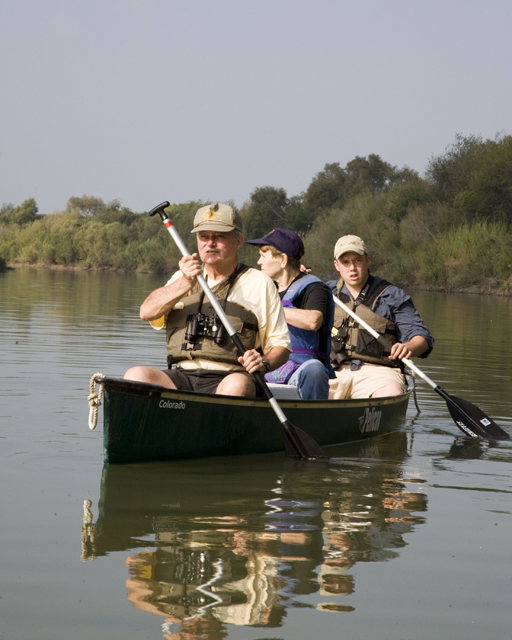
Henry joined me today on a canoe trip down the Rio Grande. We started about 2 miles north of the main headquarters of the Santa Anna National Wildlife Refuge. We had about 14 people and 6 canoes. While some canoes had three, Henry and I got to have our own. We had a reporter and camera man on our trip. Our guides were two young men, one a graduate student from Chicago, the other a Nikon representative. The refuge also sent a guide with us.
It seemed to me that the birding in some ways was a little thin. We could hear a lot of birds in the trees around the river, but we did not see many of the smaller birds. The most common bird was the spotted sandpiper. We had good looks at many of the heron family - a family of white crowned night herons, several blue herons, snowy egret, great egret, cattle egret, and green heron. We saw all three kingfishers . . . . A really good sighting of the green kingfisher. Several raptors. One of the guides heard and saw the grooved bill Ani. That's on my list of birds I had not seen. Unfortunately, he ducked right back into the brush, so I'm still waiting to see him.
I'm learning to accept that on any given birding trip, no one will see all the birds. Sometimes you're not in the right place and the bird moves quickly away. Sometimes, even with directions, it is hard to spot a little bird in a big tree or brushy thicket. But the nice thing about going with experienced birders, they not only see the birds, but they recognize many of the songs.
The disadvantage of the canoe trip was that we tended to stay scattered along the river making it hard to hear what someone else was saying when they were first sighting birds.
But I don't get to take many canoe trips. There is something very peaceful and satisfying about going along at slow speed along the river. I hope to take this canoe trip again.
P.S. I took a lot of pictures of the people on this trip. In the next couple of weeks I'll try to get them posted on my website.
King Ranch
Growing up in Texas, the King Ranch was one of the legends of Texas. Probably the largest ranch in the world, it is still a working ranch today and still owned by the original family. I had heard about the great birding on the ranch, but I was not sure how one got access. When I saw the King Ranch as one of the field trips, I knew that one had to be on my list.
Arriving at the bus, it was obviously a popular trip, the bus was full. We headed out during the predawn. Turns out our field trip leaders were either former or current employees of the King Ranch as wildlife managers. We were given some of the history of this extraordinary place as we travelled from Harlingen to the Norias Unit.
I learned new uses for duct tape! They brought several colors (presumably so we could color coordinate with our clothes). You can wrap duct tape around the bottom of your trouser legs to keep chiggers and ticks from getting on your legs. You can cover your shoe laces with duct tape to keep stickers from collecting on them. There were lots of stickers! But I did not get too many on me, but a few did make it all the way back to the RV at the end of the day.
 After we were all duct taped and sprayed with insect repellant, we trekked off into the woodlands in search of the pygmy owl. The King Ranch has probably the largest population of pygmy owls anywhere. Our guides had recorded calls to make contact with one of them. We finally heard the answering call in a wooded thicket.
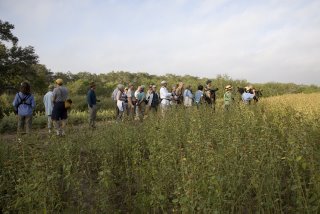
The owl was well hidden behind twigs and branches, but we all (45 of us) got a chance to see him through several scopes that gaves us a pretty good view. The scope I chose gave me a good view of his eye and the back of his head.
The photo I'm posting here is of a pygmy owl sighting I made at Bentsen Rio Grande State park a couple of years ago. Even though it is not a great photo, I'm proud of it, because I found this owl all by myself!

The guides were patient while everyone had their chance to see the pygmy. At the end they even thanked us for our patience in waiting for everyone to get to view this special owl.
After we had all seen the pygmy owl. We headed deeper into the ranch and the search began for the Sprague's Pipit. The guides gave us all the information to identify which bird would be the pipit. Then one group went to the slight rise and began to walk through the tall grass. And they were successful in flushing not only a pipit, but a savannah sparrow as well. The pipit was cute with its stairstep assent and its flight pattern of beating its wings rapidly and then pulling them in tight to his body to glide for a second or so then beat beat beat . . . . We also went over to a marsh area and added the sedge wren. They were hoping for LeConte's sparrow but that one alluded us.
Our last stop was a wooded area. I was pleased to get a good view of a ruby crowned kinglet. But the real find at this site was Northern Beardless-Tyrannulet.
As a group we saw or heard 57 species. For me the highlights were the pygmy owl, the sprague pipit, the ruby crested kingbird, the white tailed hawk, the Wilson's snipe, and the green jay.
Arriving at the bus, it was obviously a popular trip, the bus was full. We headed out during the predawn. Turns out our field trip leaders were either former or current employees of the King Ranch as wildlife managers. We were given some of the history of this extraordinary place as we travelled from Harlingen to the Norias Unit.
I learned new uses for duct tape! They brought several colors (presumably so we could color coordinate with our clothes). You can wrap duct tape around the bottom of your trouser legs to keep chiggers and ticks from getting on your legs. You can cover your shoe laces with duct tape to keep stickers from collecting on them. There were lots of stickers! But I did not get too many on me, but a few did make it all the way back to the RV at the end of the day.
 After we were all duct taped and sprayed with insect repellant, we trekked off into the woodlands in search of the pygmy owl. The King Ranch has probably the largest population of pygmy owls anywhere. Our guides had recorded calls to make contact with one of them. We finally heard the answering call in a wooded thicket.
The owl was well hidden behind twigs and branches, but we all (45 of us) got a chance to see him through several scopes that gaves us a pretty good view. The scope I chose gave me a good view of his eye and the back of his head.
The photo I'm posting here is of a pygmy owl sighting I made at Bentsen Rio Grande State park a couple of years ago. Even though it is not a great photo, I'm proud of it, because I found this owl all by myself!

The guides were patient while everyone had their chance to see the pygmy. At the end they even thanked us for our patience in waiting for everyone to get to view this special owl.
After we had all seen the pygmy owl. We headed deeper into the ranch and the search began for the Sprague's Pipit. The guides gave us all the information to identify which bird would be the pipit. Then one group went to the slight rise and began to walk through the tall grass. And they were successful in flushing not only a pipit, but a savannah sparrow as well. The pipit was cute with its stairstep assent and its flight pattern of beating its wings rapidly and then pulling them in tight to his body to glide for a second or so then beat beat beat . . . . We also went over to a marsh area and added the sedge wren. They were hoping for LeConte's sparrow but that one alluded us.
Our last stop was a wooded area. I was pleased to get a good view of a ruby crowned kinglet. But the real find at this site was Northern Beardless-Tyrannulet.
As a group we saw or heard 57 species. For me the highlights were the pygmy owl, the sprague pipit, the ruby crested kingbird, the white tailed hawk, the Wilson's snipe, and the green jay.
Thursday, November 09, 2006
Quinta Mazatlan
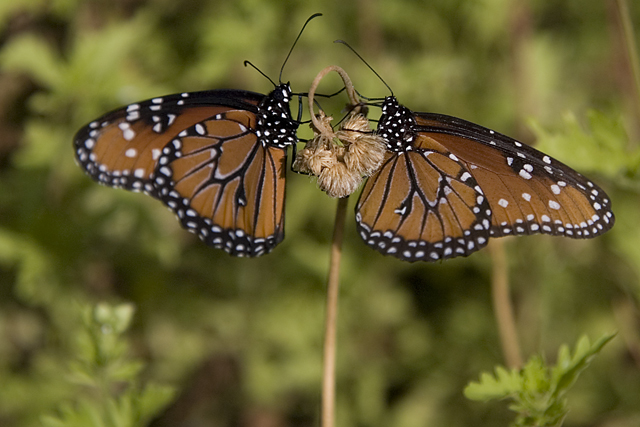
Quinta Mazatlan was a wonderful place to visit. We spent about an hour there. I could easily go back and spend a day.
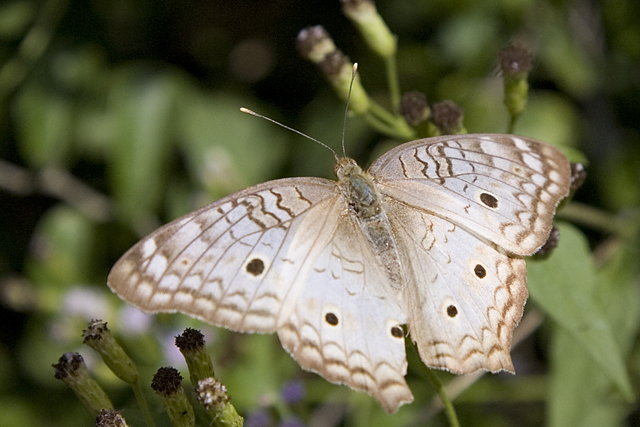
From the butterflies to the wonderful feeding stations to the beautiful buildings, there is much to see, explore, and photograph. I would love to go back with my big lens and sit for a while at each feeding station.
Common black hawk or Zone tail . . . zone tail
While I can identify many birds on site, I am not as well versed in distingushing between hawks (I'm working on this . . . ). After a lot of debate which was most instructional for me, the best information points to the hawk being a Zone tailed hawk.

Perched above the river

In flight

Perched above the river

In flight
Wednesday, November 08, 2006
Riverside Dreamer Pontoon Boat on the Rio Grande
Morning came very early today. I got up at 5 to get to the bus for my first excursion. And even so, I was the last one on the bus. I'll do better tomorrow.
 We rode on the bus about 45 minutes to an hour to get to Mission where we boarded the Riverside Dreamer. A beautiful boat, just three weeks old was a wonderful setting for our excursion this morning.
A loud kiskadee greeted us from the lamppost as one of our first birds of the day. A black phoebe farther away and a Lincoln sparrow got us off to a good start. The fog was thick as we went upstream by the Chimney campground where my friends and I had camped on my first visit to the Valley.
 We had attentive and knowledgeable guides who made every effort to find the birds and help us find them also.
It is so much fun to go birding with experienced birders. They know the birds not only by sight, but they can distinguish the differences between the bird calls. There were several birds that we could hear, but that never came into view. And with so many watching eyes, I doubt that we missed many birds this morning.
From the boat ride, the list of birds I saw:
Lesser scaup
Pied-billed grebe
neotropic cormorant
double crested cormorant
anhinga
great blue heron
snowy egret
tricolored heron
cattle egret
turkey vulture
osprey
sharp shinned hawk
Common black hawk
American kestral
Sora
Common moorhen
American Coot
spotted sandpiper
rock pigeon
White-winged dove
Inca Dove
Mourning dove
Belted kingfisher
Green kingfisher
Golden fronted Woodpecker
Black phoebe
Eastern Phoebe
Vermillion flycatcher
Great kiskadee
Couch's kingbird
meadowlark
barn swallow
common yellowthroat
boat tailed grackle
oriole (I don't remember which one - Audubon's I think)
Other people saw:
blue winged teal
caspian tern
Cooper's hawk
Red shoulder hawk
ladderback woodpecker
white-eyed vireo (heard)
green jay
orange crowned warbler
Quinta Mazatland I saw
gray hawk
black catbird
long billed thrasher
buff bellied hummingbird
house sparrow
chachalaca
Other people saw:
cactus wren
house wren
blackcrested titmouse
ruby crowned kinglet
olive sparrow
indigo bunting
redwing blackbird
While riding the bus we saw:
white pelican
burrowing owl
I don't think I've gotten all 70 species on this list. But for me there were several species I had not seen before:
the sora, the vermillion flycatcher, buff breasted hummingbird, long billed thrasher, the gray hawk.
The most exciting bird was the common black hawk which is usually found much farther south. Our leaders were very excited to see this one. I posted more photos of the black hawk on my website, Mary Ann's View.
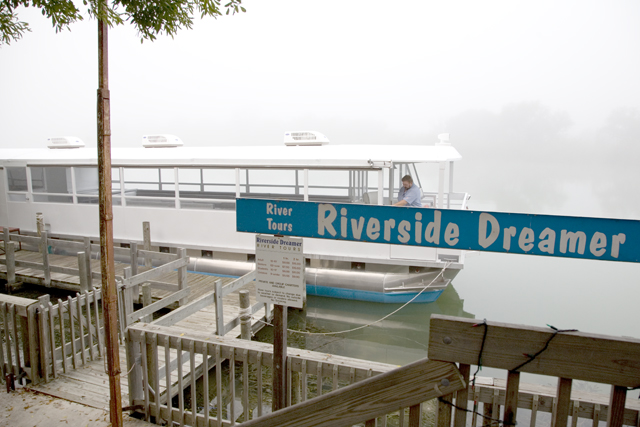 We rode on the bus about 45 minutes to an hour to get to Mission where we boarded the Riverside Dreamer. A beautiful boat, just three weeks old was a wonderful setting for our excursion this morning.
 A loud kiskadee greeted us from the lamppost as one of our first birds of the day. A black phoebe farther away and a Lincoln sparrow got us off to a good start. The fog was thick as we went upstream by the Chimney campground where my friends and I had camped on my first visit to the Valley.
 We had attentive and knowledgeable guides who made every effort to find the birds and help us find them also.
It is so much fun to go birding with experienced birders. They know the birds not only by sight, but they can distinguish the differences between the bird calls. There were several birds that we could hear, but that never came into view. And with so many watching eyes, I doubt that we missed many birds this morning.
From the boat ride, the list of birds I saw:
Lesser scaup
Pied-billed grebe
neotropic cormorant
double crested cormorant
anhinga
great blue heron
snowy egret
tricolored heron
cattle egret
turkey vulture
osprey
sharp shinned hawk
Common black hawk
American kestral
Sora
Common moorhen
American Coot
spotted sandpiper
rock pigeon
White-winged dove
Inca Dove
Mourning dove
Belted kingfisher
Green kingfisher
Golden fronted Woodpecker
Black phoebe
Eastern Phoebe
Vermillion flycatcher
Great kiskadee
Couch's kingbird
meadowlark
barn swallow
common yellowthroat
boat tailed grackle
oriole (I don't remember which one - Audubon's I think)
Other people saw:
blue winged teal
caspian tern
Cooper's hawk
Red shoulder hawk
ladderback woodpecker
white-eyed vireo (heard)
green jay
orange crowned warbler
Quinta Mazatland I saw
gray hawk
black catbird
long billed thrasher
buff bellied hummingbird
house sparrow
chachalaca
Other people saw:
cactus wren
house wren
blackcrested titmouse
ruby crowned kinglet
olive sparrow
indigo bunting
redwing blackbird
While riding the bus we saw:
white pelican
burrowing owl
I don't think I've gotten all 70 species on this list. But for me there were several species I had not seen before:
the sora, the vermillion flycatcher, buff breasted hummingbird, long billed thrasher, the gray hawk.
The most exciting bird was the common black hawk which is usually found much farther south. Our leaders were very excited to see this one. I posted more photos of the black hawk on my website, Mary Ann's View.
Subscribe to:
Posts (Atom)